After testing the Bodyguard 2.0 earlier this year, I became an immediate fan of the extremely compact .380 ACP. I consider it among the best pocket pistols in this caliber ever made. I was perfectly satisfied with it, but Smith & Wesson wasn’t. This brings us to the new S&W Bodyguard 2.0 Carry Comp.
The S&W Bodyguard 2.0 Carry Comp
Retailing at around $400, the Bodyguard 2.0 is small, thin, and light for easy carry. However, it doesn’t sacrifice the accuracy and shootability that many little guns do. Likewise, it has more firepower than the usual micro .380 with its standard 10-round, flush-fit, and 12-round extended (slightly) magazines.
It’s sized right for medium and small hands. The 10-round magazine and the 12-round extended magazine add an extra 0.44 inches of grip. Those with large hands will appreciate this.
Advertisement — Continue Reading Below
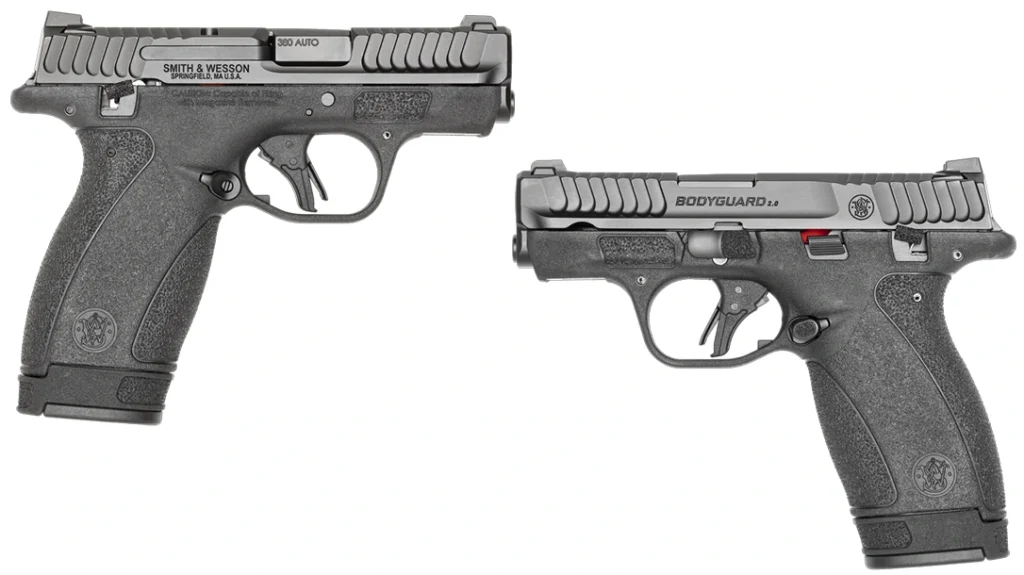
The entire polymer frame is lightly textured with patches of aggressive stippling on the front and backstraps and pads above the trigger guard. A deep undercut at the back of the trigger guard, combined with a high and deep beavertail at the back of the frame, gets the shooting hand up close to the bore axis for improved control.
In fact, looking at the pistol, one gets the impression that it’s all grip. All that grip makes this small gun easy to hang onto, aim effectively, and control recoil for quick, accurate shooting.
Advertisement — Continue Reading Below
The new Carry Comp pistol is $50 more than the original and has all its essential characteristics plus a few enhancements.
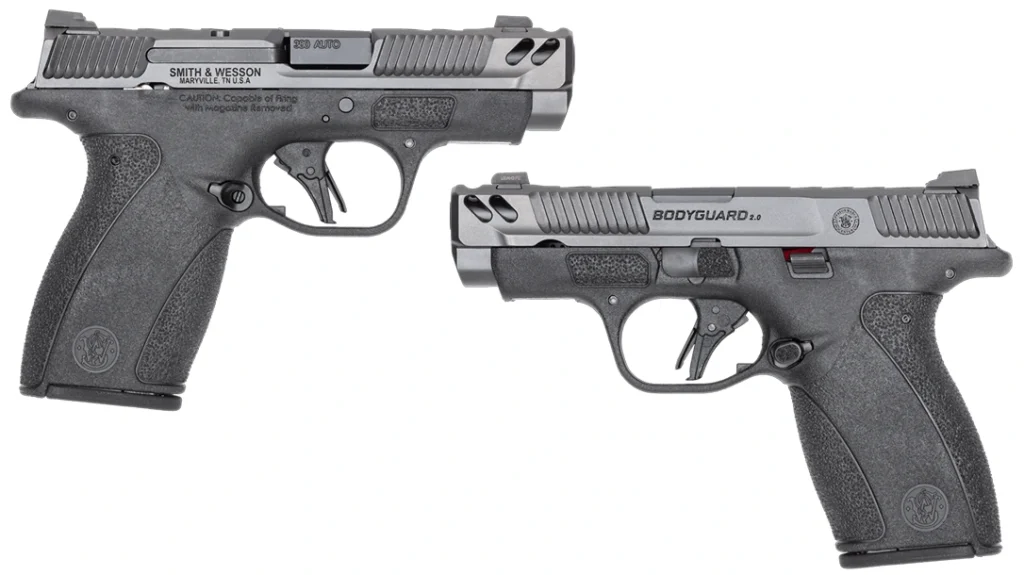
Among the old features as yet unmentioned are:
Advertisement — Continue Reading Below
- Two steel-bodied magazines (10 and 12 round capacity with ammunition witness holes) that drop freely from the grip when released
- Aggressively stippled, reversible, magazine release button
- Short, crisp, two-stage trigger pull
- Grooved slide lock release lever
- Captive dual-spring guide rod assembly for mitigating recoil impulse
- Rugged steel windage-adjustable front and rear sights
- Easy field stripped for cleaning.
Carry Comp Updates
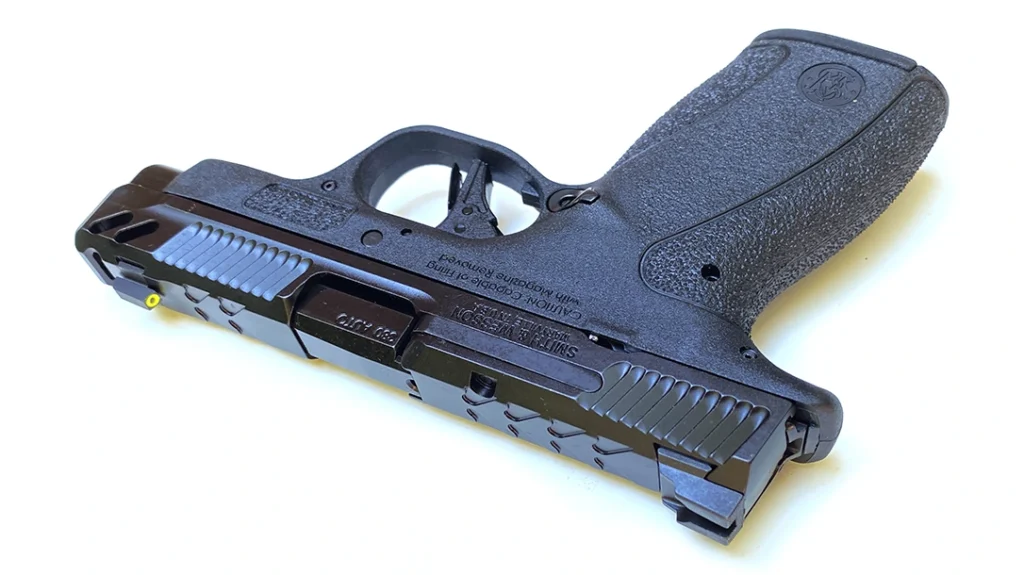
New to the Carry Comp model are grasping serrations on the front and rear of the slide. They are smaller, sharper, and more numerous than the original, offering more bite on the skin.
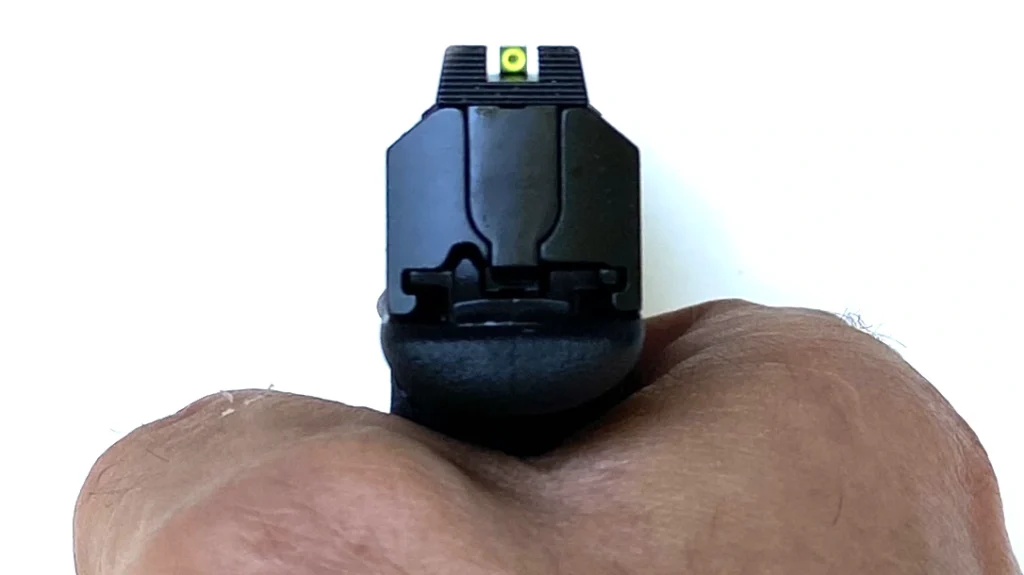
The sight radius is increased by 0.40 inches. The color of the ring around the tritium-illuminated big dot-style front night sight now features a slightly larger fluorescent green ring instead of the original orange one.
Advertisement — Continue Reading Below
Precise aiming is easier now with a new, narrower, rectangular rear sight notch. The new rear sight notch is 0.150 inch wide, replacing the 0.190 inch wide “U” notch. In fairness, the original wide rear sight notch was better for faster target acquisition and arguably better for combat shooting.
The top of the Carry Comp slide also has shallow lightening cuts that resemble pine trees. This partially compensates for the added weight of its longer length. Remember that if you have occasion to do some pistol whipping in the Christmas season
Advertisement — Continue Reading Below
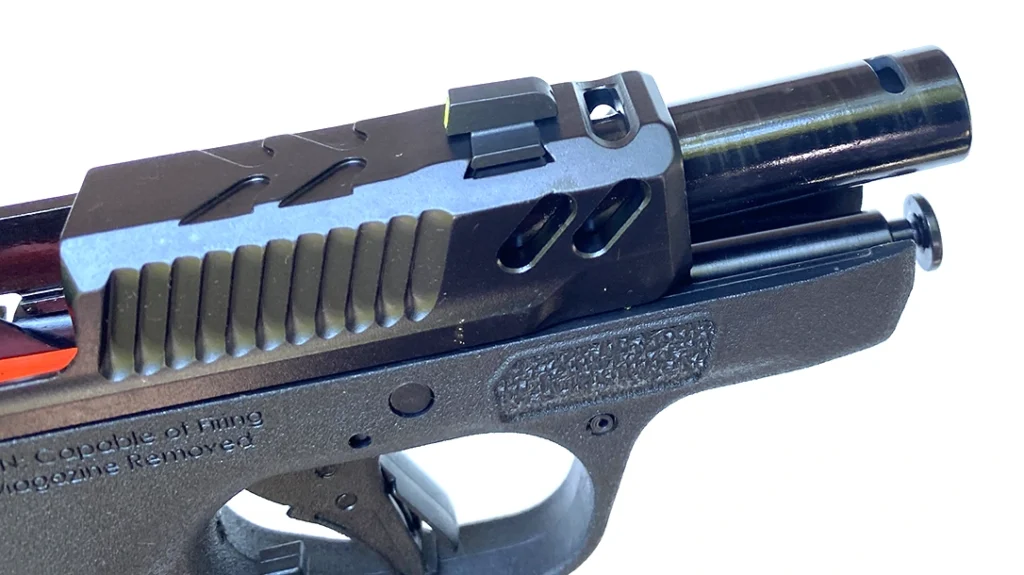
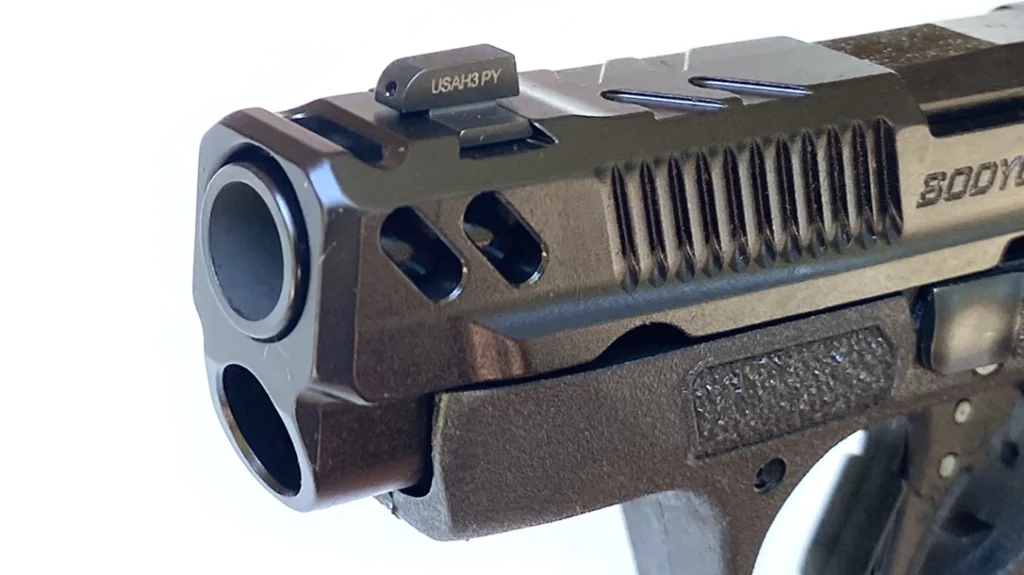
The Carry Comp barrel is 3.1 inches long (compared to 2.75 inches on the original). Correspondingly, it has a single gas port cut along the top just behind the muzzle that matches up with a similar oblong hole cut through the top of the proportionally lengthened slide. That’s the S&W “Power Port” compensator.
Additional dual diagonal cuts on the sides of the slide’s nose seem more about lightening the slide than venting gas. In principle, a compensator of this type taps off some of the burning propellant gases just before the bullet leaves the barrel and directs them upward like a little jet exhaust to counteract the normal muzzle rise in recoil.
The Compensator Difference
I’ve shot ported-barreled .357 Magnum snubnose revolvers with magnum loads. The upward venting gas is really helpful in reducing muzzle rise and recoil for faster follow-up shots. The effect of the porting on the .380 ACP Bodyguard 2.0 Carry Comp is far more subtle. I suspect it will be most significant and noticeable to people with little shooting experience, high recoil sensitivity, or low arm and hand strength.
Advertisement — Continue Reading Below
I have decades of shooting, hammer swinging, spinach eating, and other Popeye the Sailor Man-type toxically masculine activities. So, I couldn’t detect a difference in recoil or muzzle flip between the original Bodyguard 2.0 and the new Carry Comp. I shot them side-by-side, and to me they were identical.
I asked my wife, who never shoots recreationally, weighs 80 pounds less than I, and doesn’t have my vise-like grip, to try both guns. She immediately noticed the Carry Comp had less recoil. Take that for what it’s worth.
We made a video of the muzzle blast from each gun in total darkness. To my surprise, the blast from the Carry Comp was only a little larger than the uncompensated pistol. Likewise, the flash didn’t seriously obstruct my vision as I feared the upward venting gas might.
I fired both pistols with the muzzle six inches below my forearm as if I were shooting while holding off an attacker. My arm was unaffected by the muzzle blast from the original 2.0. With the Carry Comp, I could feel the jet of gas on my shirt sleeve, but it didn’t hurt. I didn’t dare try it closer than that.
Shooting the Bodyguard 2.0 Carry Comp
The original Bodyguard 2.0 shot much tighter groups than I ever anticipated. So, I decided to do my testing on the Carry Comp with targets at 25 yards instead of the seven-yard range normally used to evaluate short-barreled pistols.
Shooting from the bench with a simple Caldwell Shooting Sports Pistolero rest, I fired five-shot strings using the same quality self-defense loads I tested with the original 2.0. The trigger pull on the Carry Comp was slightly lighter at 4.5 pounds. Accuracy was impressive.
Remington Ultimate Defense 102-grain coiled brass and bonded JHP averaged 3.17-inch groups. Winchester Train & Defend “D” 95-grain JHP averaged 4.29-inch groups. Hornady Critical Defense 90-grain FTX JHP averaged 5.95-inch groups. Velocity loss from the compensator port was surprisingly low, ranging from less than one percent to 2.1 percent.
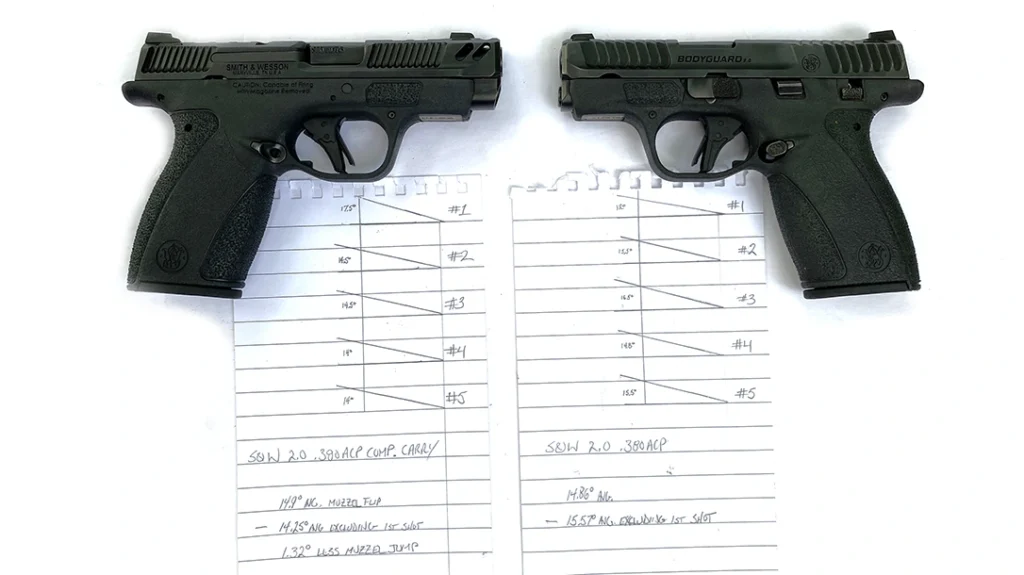
My final test involved shooting the original Bodyguard 2.0 and the new Carry Comp with a standard 95-grain FMJ load. I filmed them in slow motion to record and measure the maximum muzzle jump during recoil with a protractor.
In my solid grip—excluding the first shot of each string—the Carry Comp muzzle rose 14.25 degrees on average. This is compared to 15.57 degrees on average for the original, uncompensated pistol. That difference (in my case, only 1.32 degrees) wasn’t perceptible to me, but my wife felt it right away.
Keep that in mind when deciding which one to buy.
S&W Bodyguard 2.0 Carry Comp Specs
| Caliber | .380ACP |
| Operation | semi-auto, locked breech blowback, striker-fired |
| Capacity | includes two magazines, 10-round flush fit and 12-round w/extended floorplate |
| Barrel | 3.1 inch, stainless steel, 1:10 twist |
| Slide | stainless steel, black Armornite finish |
| Frame | polymer |
| Safety | trigger blade safety and optional ambidextrous manual thumb safety |
| Overall Height | 4.00 inches with 10-round magazine, 4.47 inches with 12-round magazine |
| Overall Length | 5.84 inches |
| Width | 0.75 inch across the slide, 0.88 inch across the grip. |
| Weight | 11.8 ounces empty with 10-round magazine |
| Trigger | two-stage, flat-faced, average 4.5-pound pull weight |
| Sights | steel, Ameriglo® Protector LumiGreenbig dot front night sight and square notch rear with grooved rear sight face to minimize glare, dovetailed on the slide, adjustable for windage. |
| MSRP | $549 |
Performance
| Hornady Critical Defense | |
| Bullet Weight & Type | 90 FTX JHP |
| Velocity | 912 |
| Best | 5.81 |
| Remington Ultimate Defense | |
| Bullet Weight & Type | 102 BJHP |
| Velocity | 833 |
| Best | 2.45 |
| Winchester Train & Defend D | |
| Bullet Weight & Type | 95 JHP |
| Velocity | 804 |
| Best | 3.39 |
Performance was tested with a series of five-shot groups fired at 25 yards from a bench rest with a Competition Electronics Pro-Chrono Digital Chronograph set 15 feet from the muzzle. Bullet weight is in grains, velocity in feet per second, and the group size in inches.
WHY OUR ARTICLES/REVIEWS DO NOT HAVE AFFILIATE LINKS
Affiliate links create a financial incentive for writers to promote certain products, which can lead to biased recommendations. This blurs the line between genuine advice and marketing, reducing trust in the content.