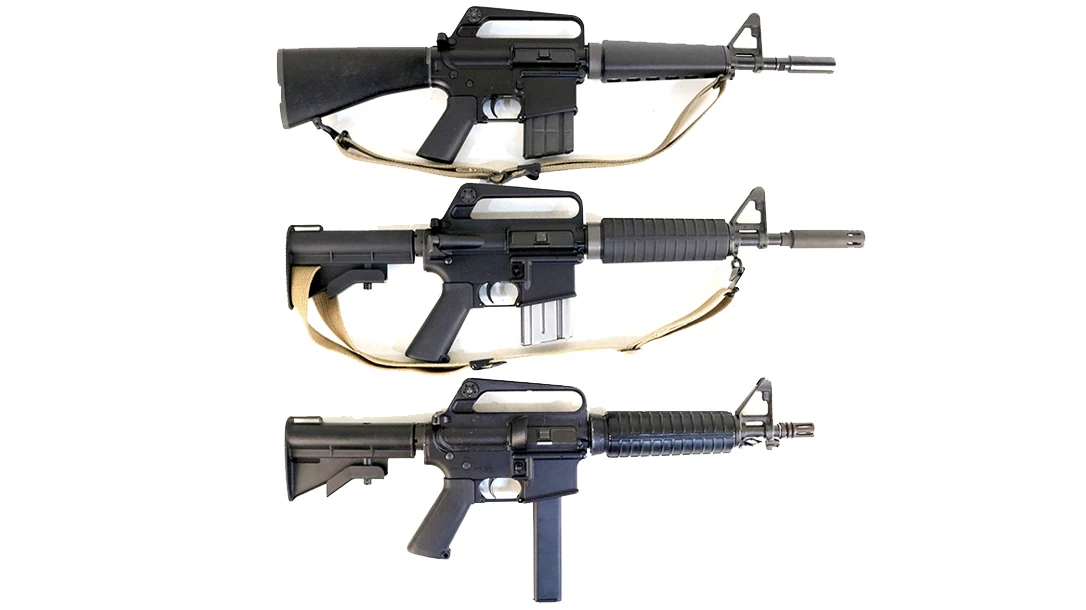
The origin story is foundational dogma to most gun nerds. Gene Stoner served as an ordnance specialist during World War 2 and came home from the Pacific with the dream of applying modern aviation engineering and materials science to the world of small arms. Despite not being school-trained as an engineer, Stoner was clearly blessed with an engineer’s mind. He and a few others eventually staffed a tiny little subsidiary of Fairchild Engine and Aircraft Corporation called ArmaLite. Stoner was ArmaLite’s ninth employee.
ArmaLite was not equipped to build guns. They were a think tank of sorts. Once they had contrived the 7.62x51mm AR10 and the subsequent smaller 5.56x45mm version, the AR15, they farmed actual production out to other folks. Colt’s Manufacturing ended up with the contract to produce the militarized M16.
Big Army adopted the M16 in 1964. It seemed the perfect weapon with which to prosecute the rapidly-expanding war in Vietnam. However, after a few well-publicized failures, the future of Stoner’s zippy little Space Age rifle seemed to be in doubt.
Advertisement — Continue Reading Below
Colt emergently chromed the bores and barrels, and Uncle Sam began teaching his troops proper gun maintenance. By the end of our involvement in the war, the M16A1 was a mature and effective weapon system. However, it wasn’t the perfect gun for all users.
It soon became obvious that there existed a need for a smaller, handier version of the already small and handy M16 rifle. In the past, this role would have been filled by M1 carbines or M3 Grease Guns. The intent was to contrive something lighter and more compact with which to equip aviators, dog handlers, Special Forces soldiers, and the like. The first proper Colt SMG prototype was the 607.
The Real & First Colt SMG
Introduced in 1965, the Colt 607 looks like you took a full-sized M16 and squished it fore and aft in a vise. There were only between 50 and 400 copies ever produced, dependent upon what you read. The tiny details varied a good bit throughout the abbreviated production run.
Advertisement — Continue Reading Below

These guns were essentially hand made. Early versions came equipped with a three-prong open-tipped flash suppressor on the end of a chopped 10-inch barrel. This tube was exactly half the length of the standard M16 barrel at the time. Later versions incorporated a stubby tubular flash suppressor that did a slightly better job of mitigating the chaos.
The triangular handguards were actually crafted from full-sized M16 furniture sawn down short. The gun fed from standard 20-round aluminum box magazines. The most exotic piece of the overall whole was the collapsible solid buttstock.
Advertisement — Continue Reading Below
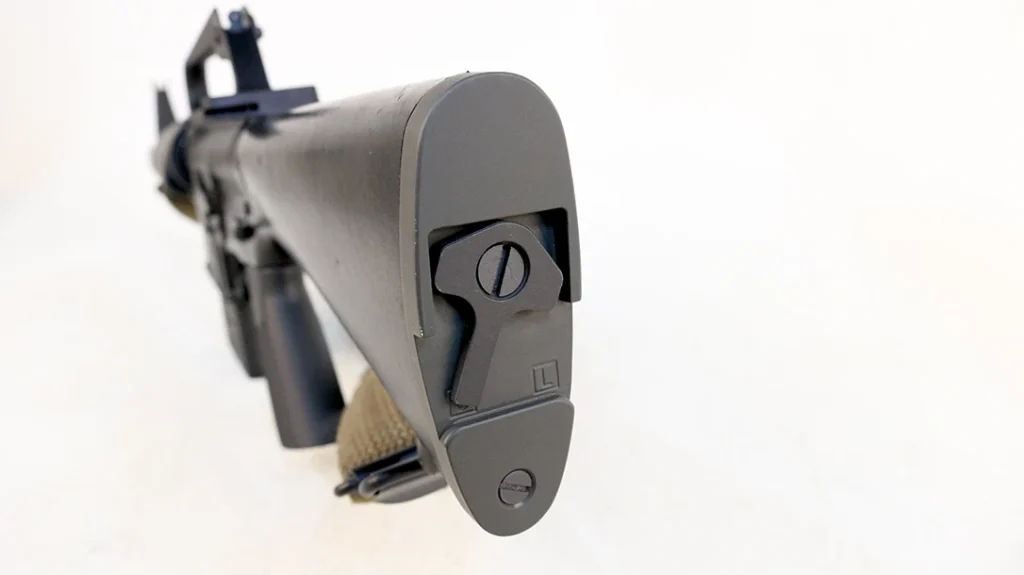
The 607 buttstock was made from a cut-down M16 stock fitted with an innovative sliding mechanism. There is a clutch that allows the stock to be secured in most any position via a pivoting lever nestled within the buttplate. The end result was indeed compact and maneuverable, though the bulk of the buttstock did tend to throw the balance a bit far rearward.
The problem with all of these stubby rifle-caliber M16 variants was that the 55-grain M193 5.56mm round depended upon velocity for downrange effectiveness. Cutting back the barrels slowed the little .22-caliber bullets while increasing flash and noise astronomically. However, these guns looked cool, so there were never enough available to go around.
Advertisement — Continue Reading Below
Enter The XM177
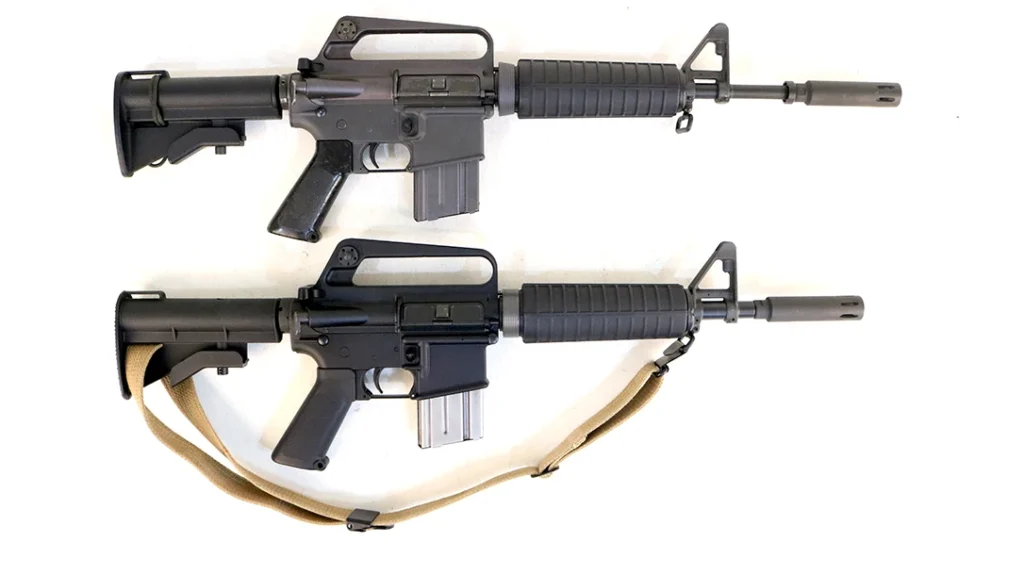
The XM177 came in two variations. It was uniformly referred to as the CAR15 in theater. Like the 607, the XM177 utilized a standard M16 receiver set as its chassis. A Colt engineer named Rob Roy crafted a sliding aluminum two-position buttstock that rode around the gun’s buffer tube. This same design upgraded with polymer furniture and six adjustment positions equips Uncle Sam’s M4’s even today.
The XM177 utilized an improved two-piece round forward handguard. The triangular handguards of the M16 were relatively fragile and had to be stocked in both left and right-hand versions. By contrast, the round XM177 sort were identical, interchangeable, and mounted top and bottom.
Advertisement — Continue Reading Below
The XM177E1 utilized a 10-inch barrel, while the XM177E2 sported an 11.5-inch tube. The longer barrel was more reliable, particularly when firing tracers. Both versions utilized a short sound moderator in an attempt at diminishing the noise and flash. While not a sound suppressor in any traditional sense, the BATF does view these things as NFA items requiring registration today.
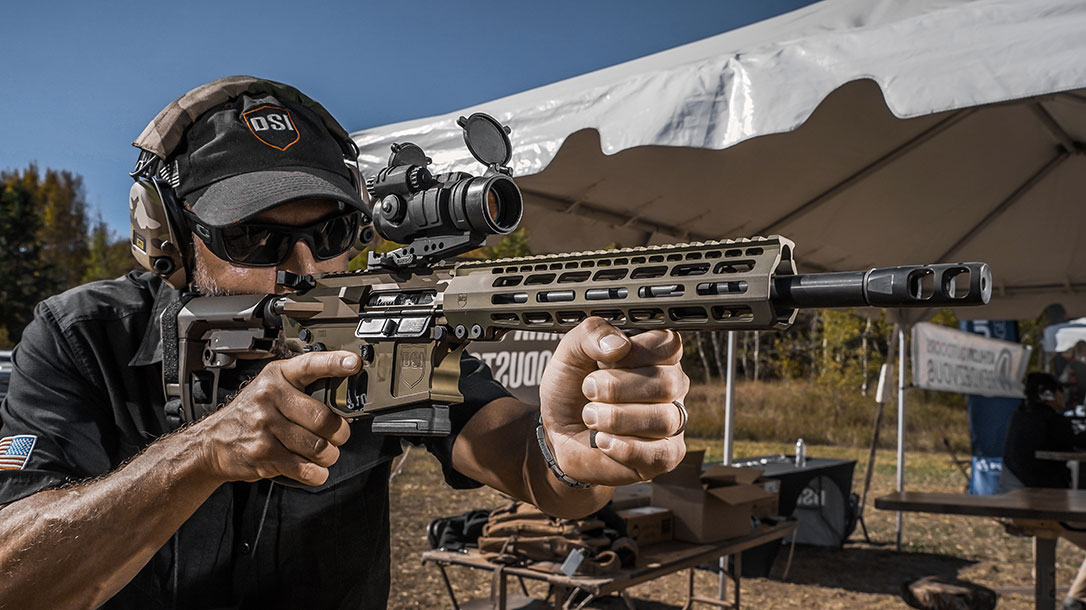
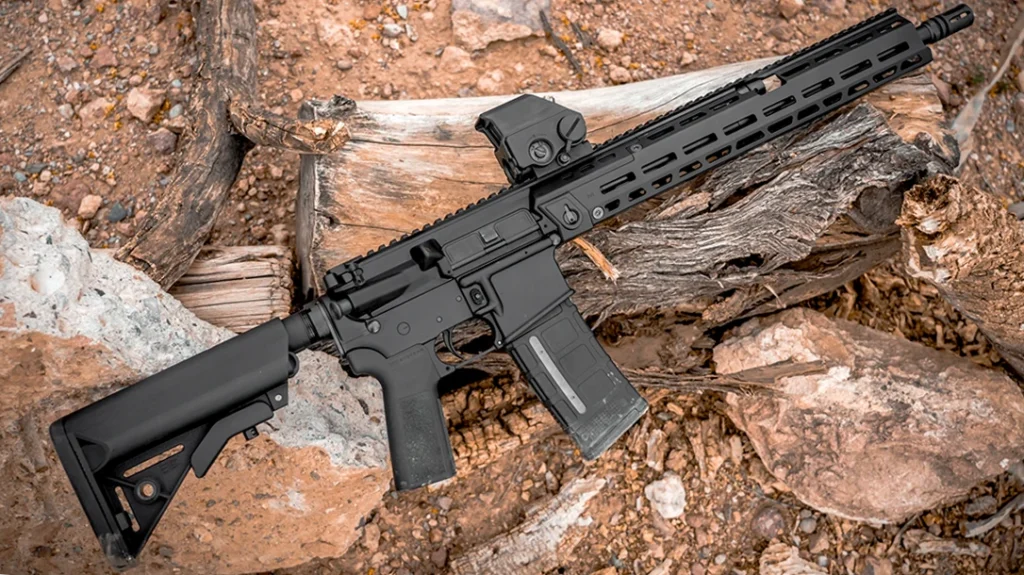
The XM177 is a lovely close quarters tool. Hefting a copy will remind you just how lithe and minimalist these little guns were in the days before we started hanging so much crap onto them. The XM177E2 eventually evolved into the ubiquitous M4 that is absolutely everywhere today.All these rifle-caliber stubby M16 variants used the same direct gas impingement operating system of the parent weapon.
Colt 635
The Colt 635 represented a significant departure from the traditional rifle-caliber M16 carbines. Chambered for 9mm Para, the Colt 635 used a modified upper receiver with an abbreviated ejection port and a standard M16 lower receiver fitted with a permanent magwell insert to accommodate a double-column, double-feed 32-round box magazine. This feed device wasbased loosely upon that of the Israeli Uzi.
Advertisement — Continue Reading Below
The Colt 635 was developed to compete directly with the HK MP5 and the Uzi. The gun operated via direct unlocked blowback and cycled at between 700 and 1,000 rpm based upon the ammo used. It was a reliable and effective pistol-caliber SMG that had the added benefit of sharing a common manual of arms with its parent M16 rifle.
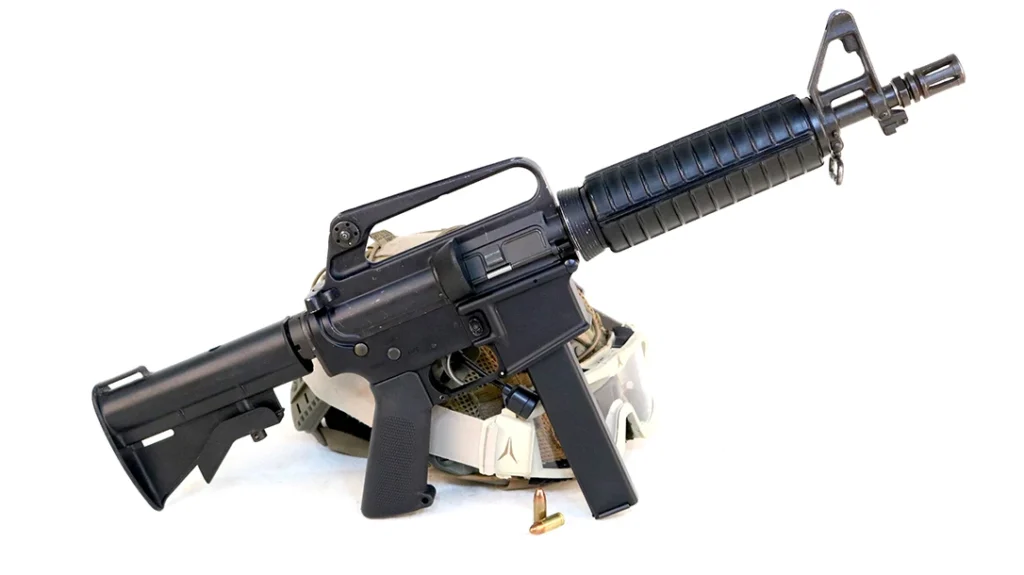
The 635 sold tepidly around the world. The most well-known user was the American Drug Enforcement Agency. The DEA issued these little guns widely back in the 1980’s during the well-publicized drug wars of that era.
The 635 had a prominent gas/brass deflector just behind the ejection port and a 10.5-inch barrel. The gun was available in either full auto or 3-round burst and weighed 5.75 pounds empty. The gun incorporated a hydraulic buffer to help manage the snappy recoil impulse that resulted from a direct blowback 9mm action.
The 9mm DOE SMG
Colt engineers called the Model RO633 the “Briefcase Gun.” This tiny little micro version of the standard 633 was designed to compete with the HK MP5K as a deep cover defensive weapon for operators tasked with securing America’s nuclear stockpile. After a competitive shoot off, the Colt gun won the day.
The RO633 used the same upper and lower receivers as the standard 633 as well as the identical collapsible stock. However, the barrel was shortened to 7 inches, and the gun was fitted with a black polymer forearm unique to the design. The front sight was changed to a pivoting appendage that could be folded down when the gun was stowed.
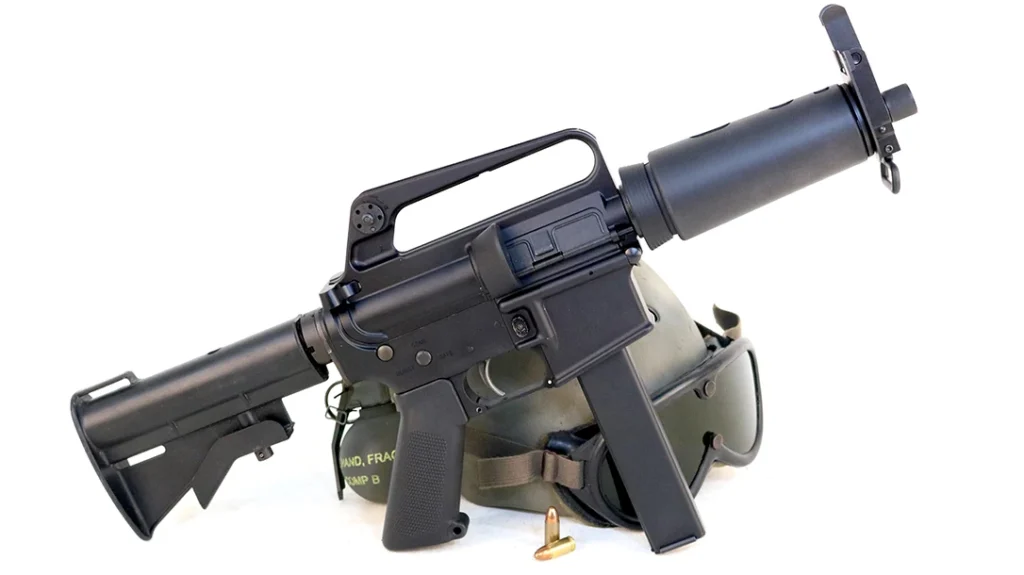
The RO633 was available with the same heavy hydraulic buffer to keep the rate of fire sane. The gun was intended to fill the role of the traditional handgun in scenarios that required a bit more horsepower. Actual production figures were never released for these weapons, though a handful of demilled kits did eventually make their way onto the surplus market. These parts were astronomically expensive. Nowadays, Palmetto State Armory makes a spot-on replica that is available at a reasonable price.
Colt SMG Ruminations
All of these guns are too short to qualify as legal rifles with the original buttstocks installed. They can be purchased otherwise uncontrolled so long as they are rocking a pistol stabilizing brace rather than a buttstock. Mounting the stock demands a BATF Form 1 to register the weapon as a short-barreled rifle. However, after 1 January 2026, the associated $200 transfer tax goes away, which is pretty awesome.
Most of the parts for my 607 came from Luth-AR. Randy Luth’s merry mob of maniacs produce some of the finest, most innovative black rifle parts in the industry. The weird sliding buttstock was a one-off I sourced via GunBroker. That thing cost a holy fortune.
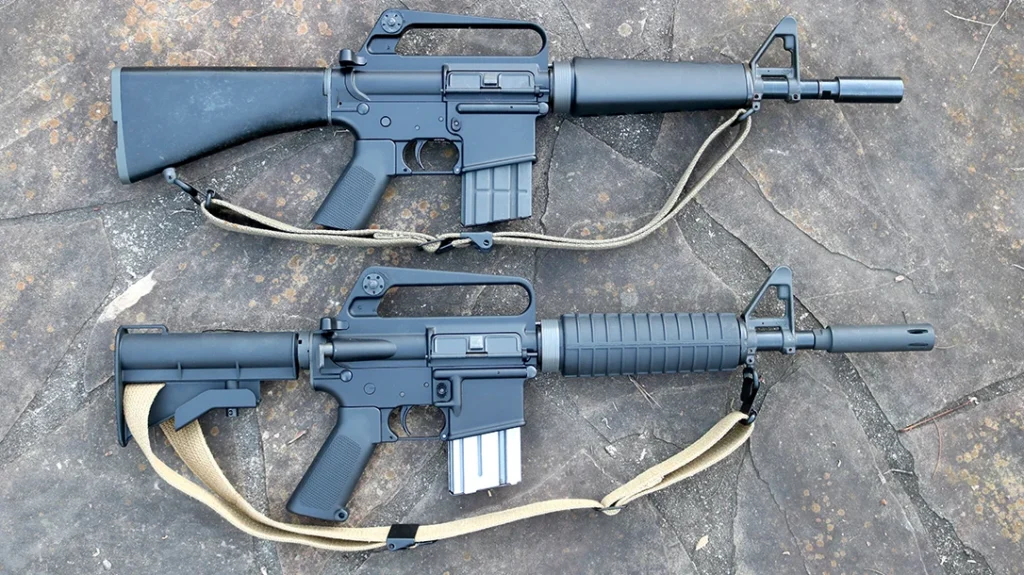
Luth-Ar got me the bits for the XM177 as well. I built my 633 from a demilled high-mileage GI parts kit. The DOE upper came from Palmetto State Armory (PSA). PSA offers semiauto lowers with vintage correct markings as well. Anybody of reasonable intellect can build these guns up from parts at home. Just make sure you have the registration bit squared away before you put a receiver and a short-barreled parts kit in the same place.
These stubby little M16 carbines are less powerful and less effective than the full-sized rifles. However, they look cool and they move well in confined spaces. Thanks to Luth-AR and PSA, nowadays we serious gun nerds can bodge up decent facsimiles of these famous guns at home.
WHY OUR ARTICLES/REVIEWS DO NOT HAVE AFFILIATE LINKS
Affiliate links create a financial incentive for writers to promote certain products, which can lead to biased recommendations. This blurs the line between genuine advice and marketing, reducing trust in the content.