The “improving” of the direct impingement (DI) AR platform via piston-driven alternative is not a recent phenomenon. Even Stoner himself dabbled with piston-driven variants before leaving Armalite. After spawning the AR-15 and selling the rights to Colt, Armalite almost immediately turned to improving the AR-15 design, all the while being careful not to violate any conveyed patent rights. Arthur Miller, George Sullivan, and Charles Dorchester were tasked to create an alternative to the AR-15 that evolved into the AR-18. This was accomplished by turning to a piston-operating rod action, combined with the use of sheet stampings in the manufacture of the lower and upper receivers.
AR18 – Bringing Back the Magic
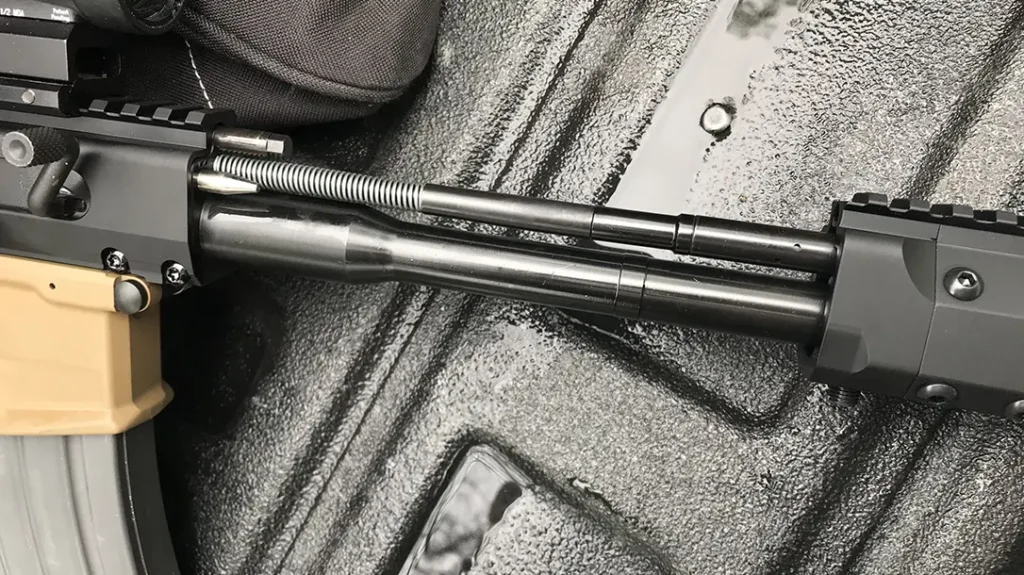
The AR-18 was equipped with a now all too familiar short-stroke gas piston located above the barrel. The AR-18’s bolt carrier rides two metal guide rods that double as return springs. This is different than the AR-15 design, which has the bolt carrier in contact with receiver rails and buffer/return spring located in the buffer tube found inside the buttstock.
Advertisement — Continue Reading Below
This not only allows for the AR-18/180S’s stock to fold or be eliminated for a more compact form (more on this later) but also creates greater clearance and tolerance to foreign materials in the action. Other differences between the AR-18 and AR-15 are evident in the charging handle on the AR-18 being connected directly to the bolt and reciprocating with the action, versus the AR-15 charging handle design. The AR-18 bolt handle allows a user more purchase when operating the weapon during loading, malfunction clearance, etc.
The Rest is History
The U.S. military did purchase a handful of AR-18s in 1964 for evaluation. Instinctually, gas-piston operation appeals to many by the very fact that hot gases and powder residue are not dumped into the action a la the original DI design. Current proponents of piston-driven ARs point to greater reliability in adverse conditions and less reliance on routine maintenance compared to the direct impingement operating method. These same arguments were put forth in the 1960s as well, though to no avail, as the direct impingement AR-15/M16 quickly became entrenched in the military supply chain and commercial market.
Armalite responded to the lack of military sales for the AR-18 by introducing a semi-auto only variant of the AR-18—the AR-180S in 1969. Looking back and analyzing the facts at hand, this seemed a sound idea with great potential due to little competition on the civilian market for “black rifles,” especially one priced as competitively as the AR-180S.
Advertisement — Continue Reading Below
Colt M16’s
Furthermore, Colt had its hands full with producing M16s with little time to consider introducing the AR to the civilian market. What Armalite was trying to do with the AR-180S was to offer a reasonably priced military-style, semi-automatic rifle variant—indeed, they were ahead of their time in the 1970s. We take such models for granted today, with the number of ARs/AKs/G3s/FN-FALs we have on the market.
Ultimately, despite the AR-18’s positive features, the design was not widely adopted or popular with the public. Many contend that the AR-18/180S was a superior design compared to the AR-15. Agree with this or not. Armalite designers were onto something, considering the evolution back to piston-driven AR-15 systems witnessed today. The AR-18/180S’s rocky production road at a variety of locales further hindered civilian sales.
Advertisement — Continue Reading Below
Blast From the Past
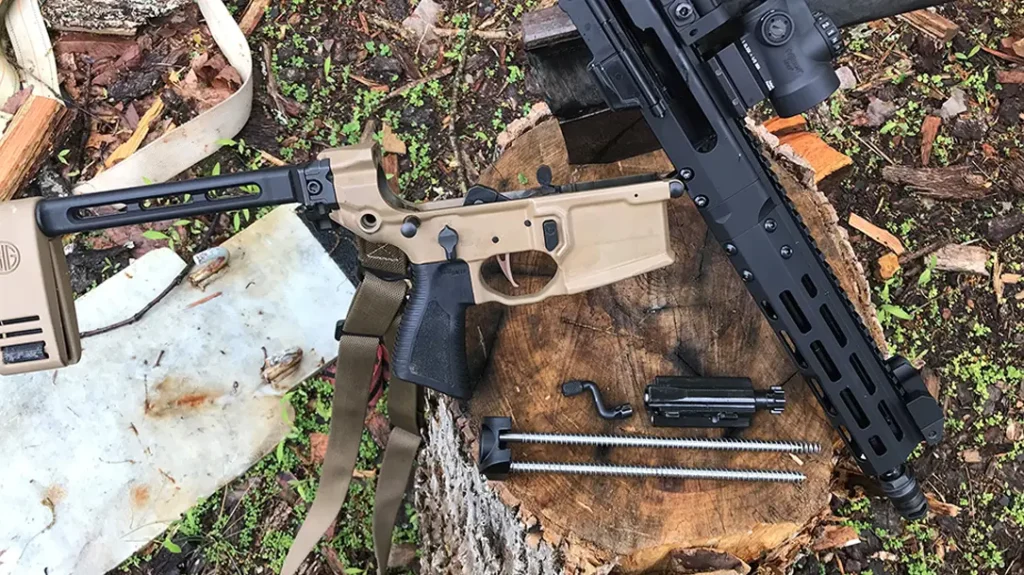
Brownells decided to rejuvenate the AR-18 idea with assistance from design partners PWS and FM Products in the form of the BRN-180S. Wisely, their quest was not centered on producing a pure historic recreation. Instead, Brownells focused on offering the benefits of the AR-18 short-stroke piston operating system in an optics-ready modern form, i.e., full-length upper Picatinny rail and M-Lok compatible forend. This is how we arrive at the Brownells BRN-180S upper.
Further along these lines, the BRN-180S is designed to fit onto a standard AR-15 lower receiver. Smart business move considering it is an “AR world, we just live in it.” Lastly, AR-15 mags are compatible without alteration required, as was the case with original AR-18 magazines. The BRN-180S does away with the AR-18 spot-welded stamped sheet metal construction, going with a machined 7075 T6 aluminum receiver typical of current AR construction.
Advertisement — Continue Reading Below
BRN-180S Gen2
Brownells is offering multiple barrel lengths of 10 inches up to 18.5 inches in .300 BLK and .223Wylde with the BRN-180S. The customer response to the BRN-180S was so positive that Brownells has already made improvements with the BRN-180S in the form of the BRN-180S Gen2 featured in this article. Gen2 models have an adjustable gas block for suppressed or unsuppressed shooting, doing away with the more complicated time-consuming switching out gas cup method from the Gen1. Another major Gen2 tweak involves the handguard attachment method.
The Gen2 handguard is retained by a single, large setscrew. Remove it with a hex wrench, and the whole handguard comes off. Once the guard is removed, you have access to the gas system without removing any internal components. The Gen2 handguard deals with heat generated by firing better as well.
Advertisement — Continue Reading Below
Bringing It All Together
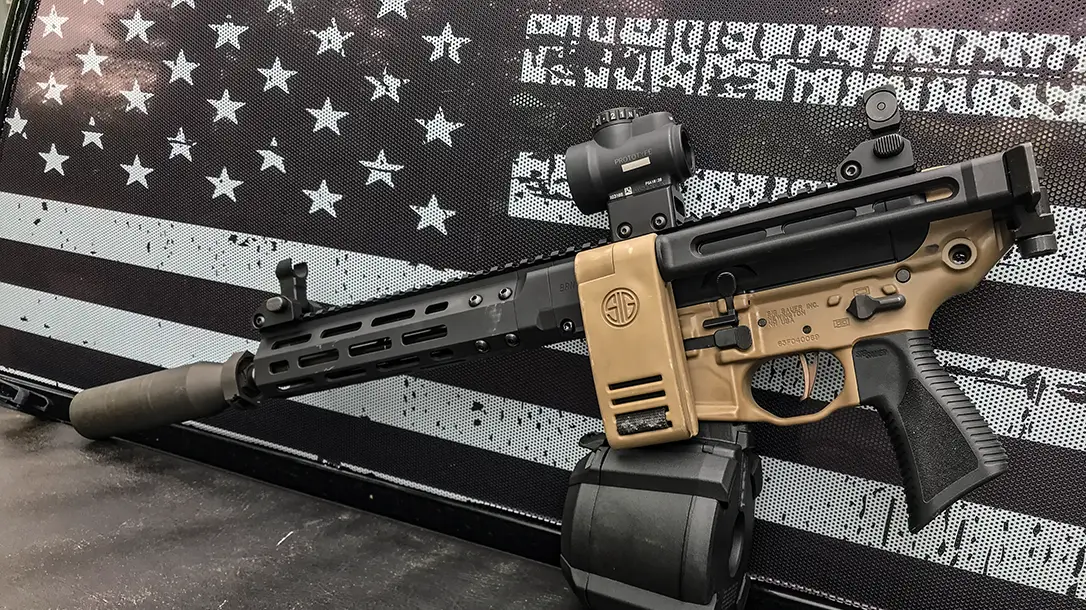
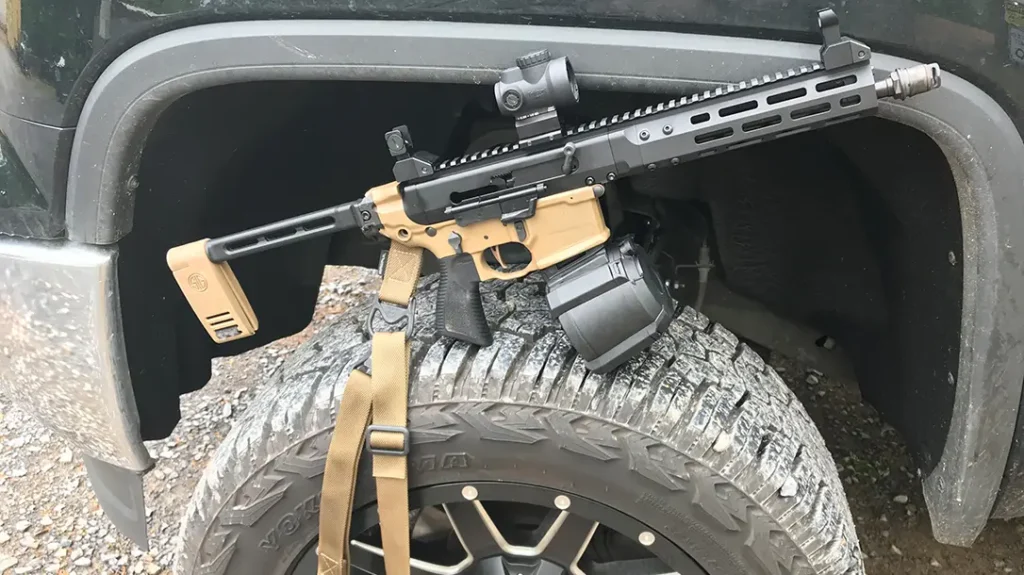
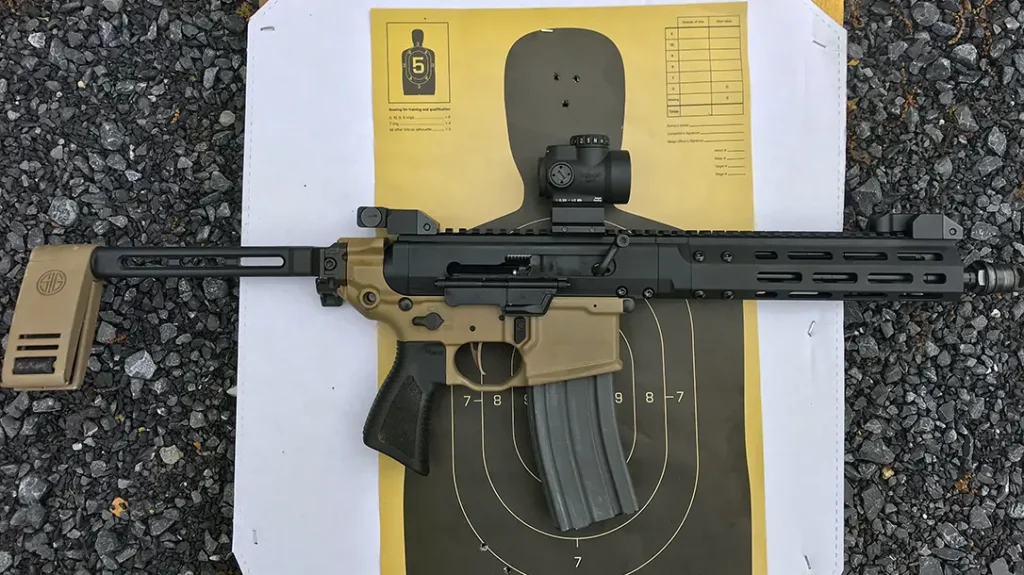
A BRN-180S Gen2 upper chambered in .223 Wylde with a 10.5-inch barrel was chosen as our vehicle for exploring the Brownells concept. Seemed only natural to take full advantage of the compact BRN-180S upper by combining it with an AR-pattern lower that did not feature a buffer tube protruding. A Sig Sauer MCX Rattler pistol lower from an MCX Rattler Canebrake-braced pistol I had in the safe was an easy decision for use.
The SIG lower combined with the BRN-180S turned out to be an ideal mating. Similar to the BRN-180S, the MCX’s bolt carrier group is different than an AR’s. This stemmed from the initial user’s request to use a folding stock in lieu of a typical AR buffer tube setup. Sig created the MCX Canebrake as the ideal choice for operators needing maximum firepower in a compact package. A Sigside-folding Pivoting Contour Brace supports this when combined with the Brownells BRN-180S upper.
Sig Sauer
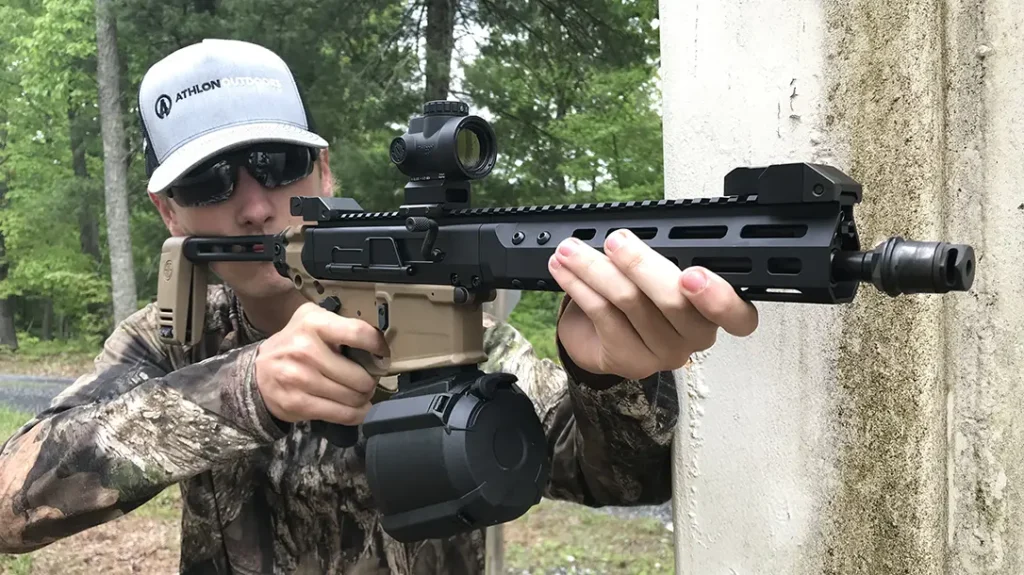
Direct impingement AR-style weapons featuring barrels under 14 inches can be finicky. Plus, do not forget the AR buffer tube limits just how small ARs can be realistically shrunk to. This is not an issue with the piston-driven Brownells BRN-180S/Sig MCX combo. The ability to fold the brace shrinks the BRN-180S/MCX combo to dimensions unattainable for a typical AR. This is no gimmick but a real advantage in having rifle firepower in a package smaller than most SMGs.
Advertisement — Continue Reading Below
The original Armalite-18/180S was ahead of its time with the inclusion of a scope mounting base on the rifle’s receiver, allowing for the quick mounting/dismounting of optics with a proprietary Armalite scope base. It took many years into the AR-15’s development for “flattop” receivers conducive to mounting optics to become the norm. The BRN-180S can accommodate red-dot or magnified optics. A Trijicon MRO was mounted to the BRN-180S upper. The standard three-prong flash hider was changed out for a Sig Taper-Lok Fast-Attach muzzle device. As with the folding brace pistol lower, the thought was to take advantage of the Brownells adjustable short-stroke gas system by mounting a Sig SRD556-QD suppressor during range evaluations.
Time To Canebrake
Ammunition tested with the BRN-180S was a combination of multiple 5.56mm/.223 Rem. loads from Black Hills Ammunition, Hornady, and Federal. A quick word about the BRN-180S’s .223 Wylde chambering is in order. The .223 Wylde was designed as a hybrid chambering for semi-automatic rifles. It will accommodate both .223 Rem. and 5.56mm ammo. It is relieved in the case body to aid in extraction and features a shorter throat for improved accuracy. In effect, the .223 Wylde splits the difference between the 5.56mm and .223 Rem., offering benefits in terms of accuracy and reliability.
No load tested produced greater than 1.5-inch groups at 50 yards with the Trijicon MRO. Several magazines’ worth of ammunition was spent engaging plate racks and man-sized steel targets. Drills quickly moved past stand-and-deliver drills to more dynamic drills involving movement, magazine reloads, and firing from behind cover.
Lightweight
The BRN-180S lived up to the task of being a lightweight, fast-handling weapon. Drills moving around barricades and training evolutions involving firing and evacuating from vehicles clearly bore this out. The light and handy BRN-180S is what individuals will choose to work with in such environments.
More than 500 rounds were fired for this T&E. This was not the goal, considering ammunition issues. However, the BRN-180S proved too enticing to put down. Just seemed there was one more drill needing to be done. The piston-driven BRN-180S proved utterly reliable with only minimal effort given to wiping down the bolt carrier group and lubricating sporadically.
PMAG D-60
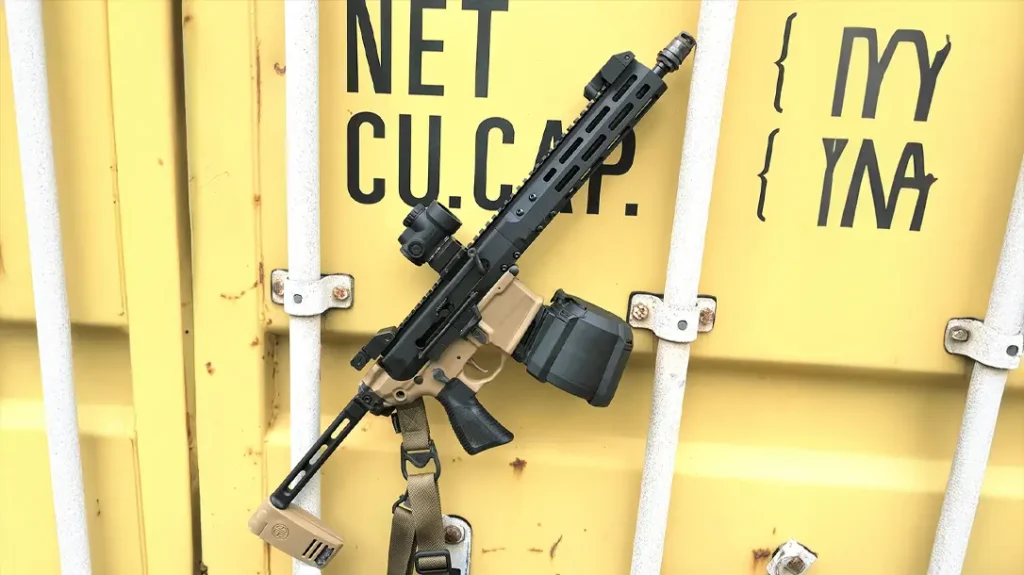
A Magpul PMAG D-60 drum magazine was utilized during T&E. The thought being the best reload is no reload. The BRN-180S/MCX combo was nestled inside an Eberlestock Big Trick pack with a Sig suppressor and a Magpul drum, ready to go. Talk about an effective response to any threat. Might be outnumbered, but won’t be outgunned. One nuance noticed during BRN-180S manipulation during magazine changes was the lack of a typical AR charging handle. The reciprocating dogleg charging handle is on the right side of the receiver. Grip it and rip it.
AR18 Last Blasts
The BRN-180S/Sig MCX combo is an excellent example of what to look for in terms of an effective weapon. What I mean by this is a return to basics, such as lightweight and great handling with potent firepower. This especially applies to civilians and even most law enforcement personnel outside of specialized tactical teams, who do not require the plethora of accessories. KISS (Keep it simple, stupid) methodology can pay dividends in terms of budget and allowing for concentration on other priorities, such as training, for example.
For more information, visit Brownells & Sig
SPECIFICATIONS: Brownells BRN-180S Gen 2 Upper
| CALIBER: | .223 Wylde |
| BARREL: | 10.5 inches |
| OA LENGTH: | 18.7 inches |
| WEIGHT: | 4 pounds |
| SIGHTS: | None |
| ACTION: | Gas piston, semi-automatic |
| FINISH: | Hardcoat anodized |
| CAPACITY: | 30+1 |
| MSRP: | $879 |
PERFORMANCE: BRN-180S Gen 2
| Load | Velocity | Accuracy |
| Hornady TAP 55 | 2,528 | 1.33 |
| Sig Sauer OTM 77 | 2,413 | 0.90 |
| Black Hills Match 69 | 2,369 | 1.25 |
| Federal M855 FMJ 62 | 2,511 | 1.50 |
Bullet weight measured in grains, velocity in feet per second (fps) by chronograph, and accuracy in inches for best five-shot groups at 50 yards.
WHY OUR ARTICLES/REVIEWS DO NOT HAVE AFFILIATE LINKS
Affiliate links create a financial incentive for writers to promote certain products, which can lead to biased recommendations. This blurs the line between genuine advice and marketing, reducing trust in the content.