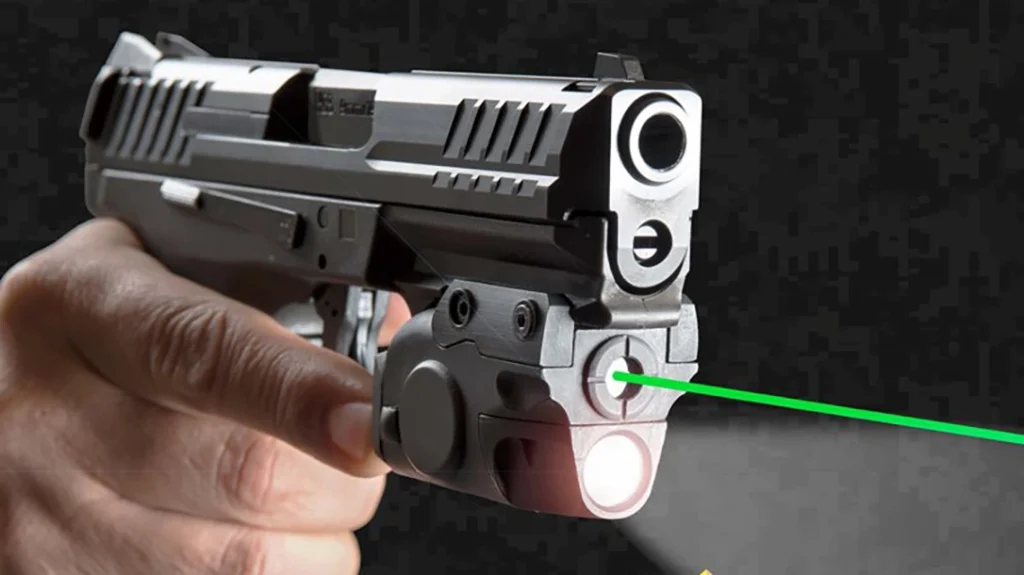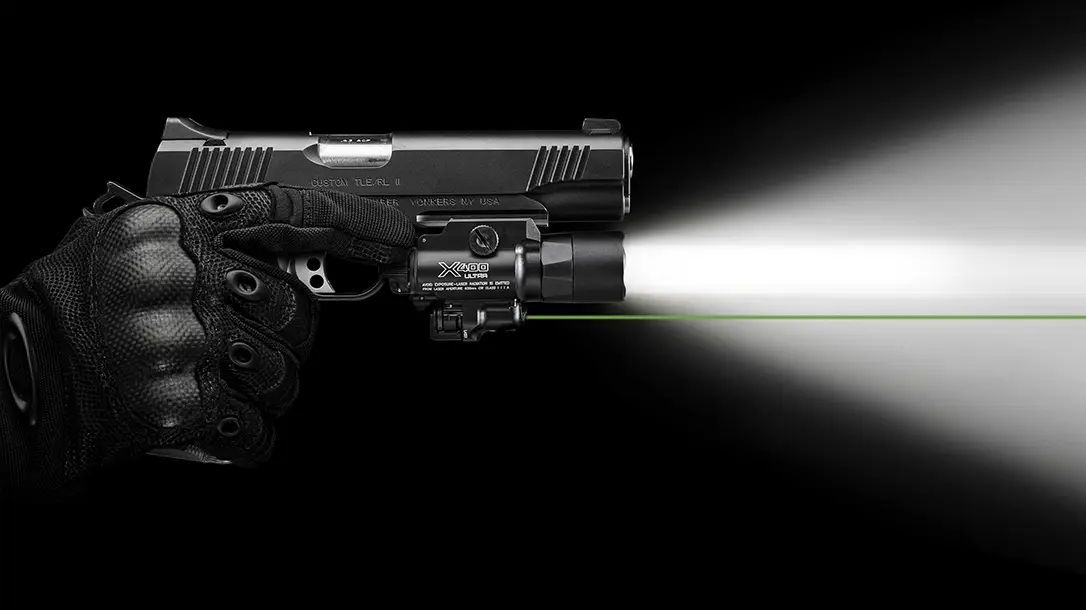
Since the dawn of humanity, we have personalized our weapons. A lot of that was done simply to make yours distinct from someone else’s. But there is also a perceived need to customize your weapon to make it better fit your needs. With a Concealed Carry Weapon (CCW), one popular attachment is the Weapon-Mounted Light (WML). Is it the right thing for you? To make that assessment, the first thing we need to do is analyze the pros and cons of this accessory.
Advantages of Weapon-Mounted Lights for Concealed Carry
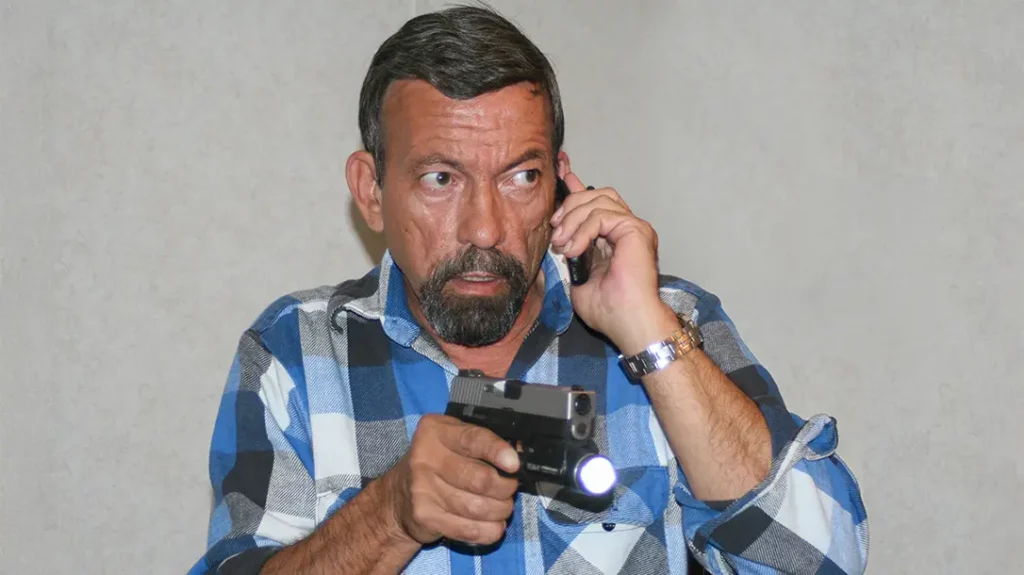
From the tactical side, the single biggest advantage of the weapon-mounted light, in my opinion, is that it allows you to identify the threat—the person and his or her weapon(s)—in suboptimal light. In poor visibility conditions, the naked eye may not be able to tell whether the stranger is holding/retrieving a wallet, cell phone, or gun. The WML provides a last chance to identify the benign from the malign, and avoid a tragic mistaken identity.
In a situation that necessitates gunfire, the weapon-mounted light allows both hands to be fully applied to the pistol. This greatly improves hit potential over firing one-handed only, for the vast majority of defensive handgun users.
Advertisement — Continue Reading Below
Some combinations of “gun in one hand, flashlight in the other” come down essentially to only one hand doing the shooting: the FBI method, for example, and the popular Harries technique. There are techniques in which the flashlight hand provides some support to the firing hand. However, all do so less effectively than a proper two-handed firing grasp. These techniques include the Chapman method, the Rogers method, and my own.
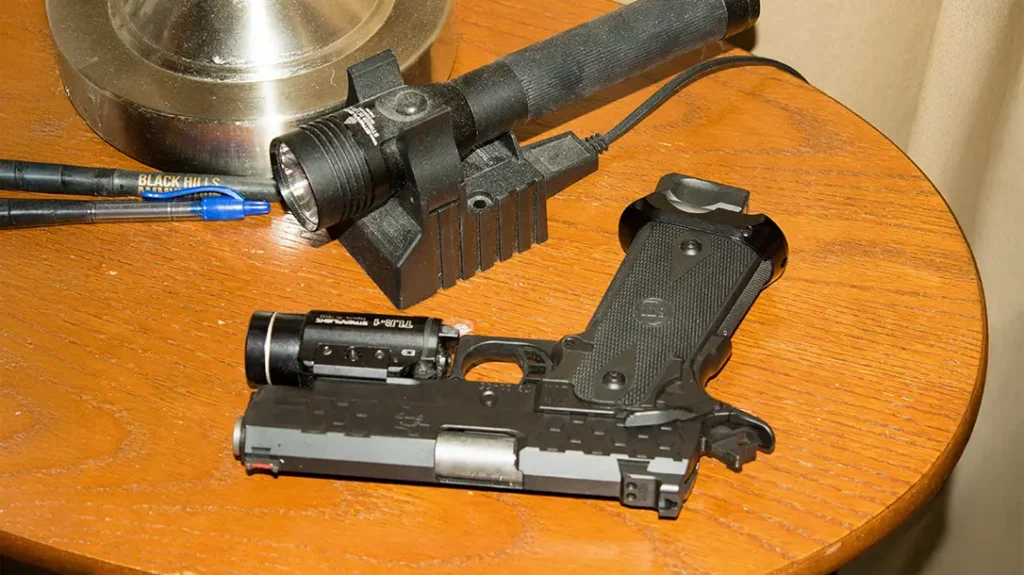
The WML is superior to combined pistol-and-flashlight methods for accuracy and speed for another reason: the beam of the flashlight remains in constant alignment with the firearm’s barrel and sights. Methods that combine a conventional flashlight with a gun allow the hands to separate slightly or the light to move away from its initial alignment during recoil. This is not true of the WML, with which the light source is literally locked to the weapon.
Advertisement — Continue Reading Below
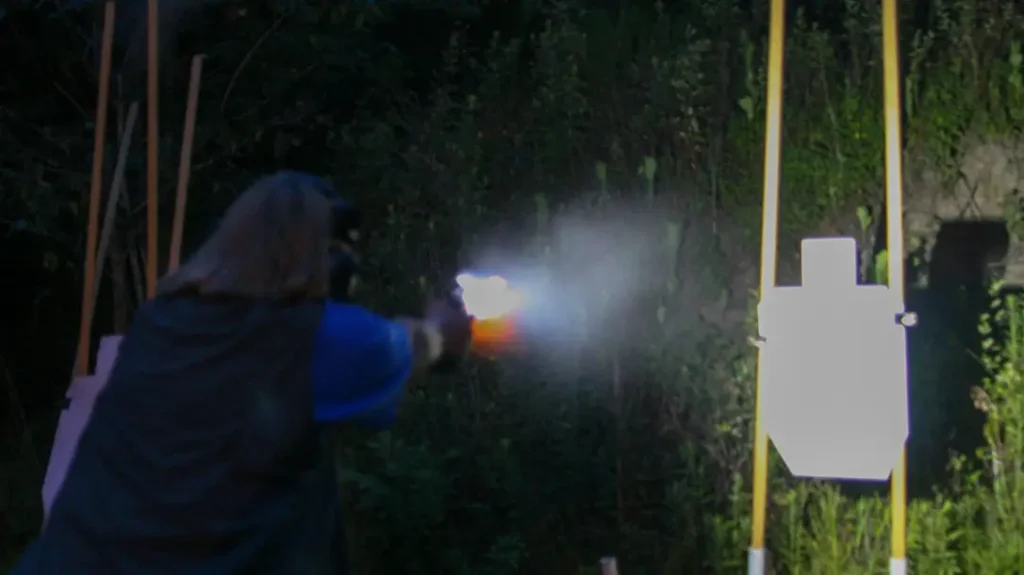
In night shooting, the WML has virtually indisputable advantages. First, you can see your target better. Second, you also see a silhouetted sight picture as clearly and distinctly as an image out of a marksmanship manual.
Stand-Off Capability
A too-seldom recognized advantage of the WML is stand-off capability. In a close-contact, entangled fight that devolves into a need for deadly force, a press-contact shot may be the lawful defender’s only option.
Most semi-automatic pistols will come out of battery when pushed against a resisting surface, such as a human body. That is, the barrel slide assembly is pushed rearward toward the shooter. So the parts are no longer aligned for firing, and the gun won’t fire when the trigger is pulled.
Advertisement — Continue Reading Below
To achieve stand-off, the globe of the WML needs to extend forward of the muzzle. In one famous gunfight, then-street cop and now instructor Jared Reston and his assailant each shot one another seven times. Reston had put four .40 S&W rounds into his ambusher, who then fell atop the wounded officer with a still-loaded Glock .45 in his hand.
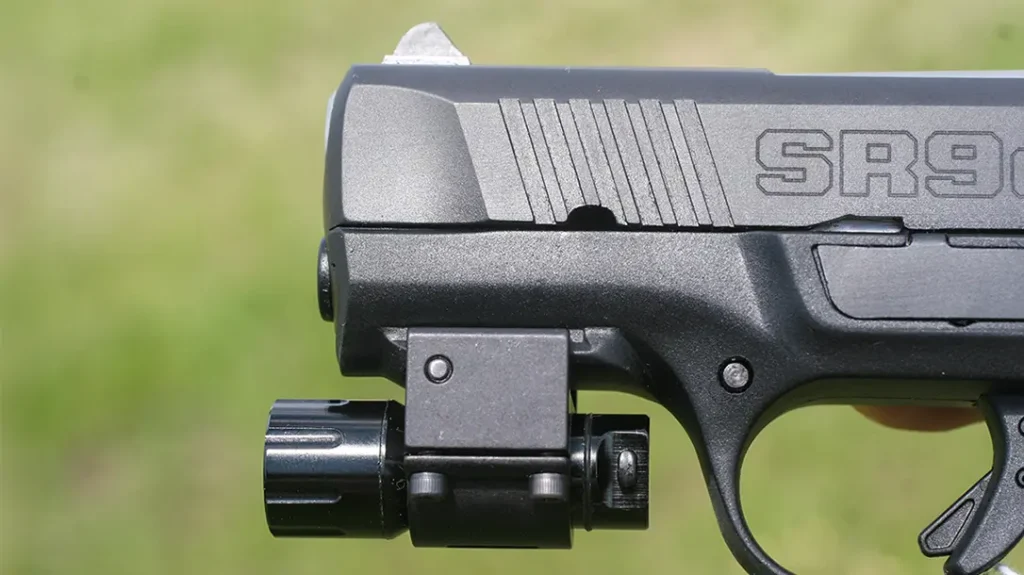
Reston jammed his department-issue Glock 22 against the would-be cop killer’s head and fired three times, at last killing him. The TLR-1 light mounted on his G22 had kept the gun from going out of battery, saving the life of Reston, who went on to win more gunfights as his career progressed.
Advertisement — Continue Reading Below
Disadvantages of WMLs
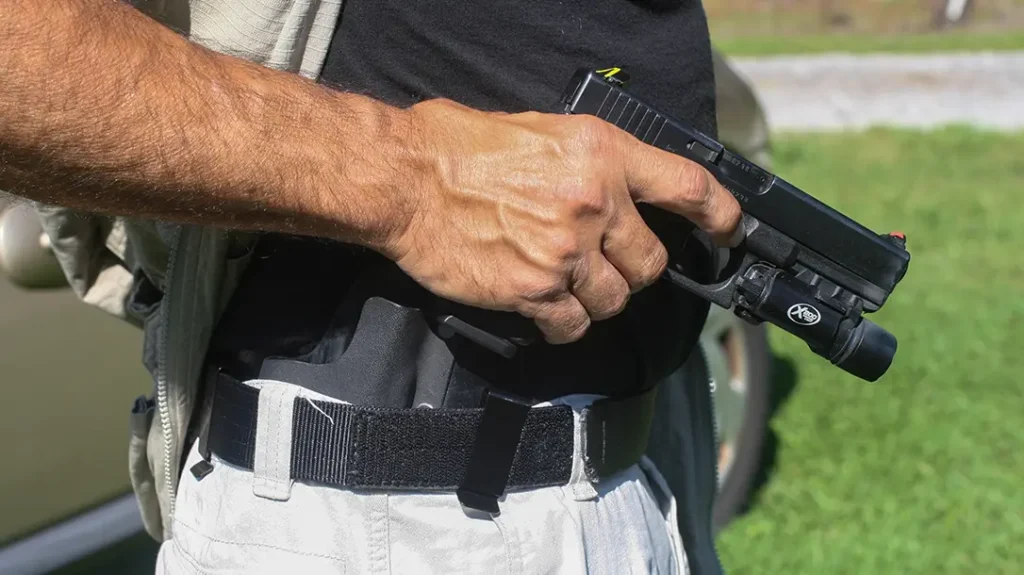
Even small WMLs add bulk to the handgun. This impacts both comfort and discreet concealment. Depending on the size of your pistol and light, expect a protrusion at the lower rear edge of the holster that might become a bulge point.
The gun will, of course, become more muzzle-heavy. Whether or not this impairs shooting ability is highly subjective and dependent on the size of the light and the pistol, and the shooter’s hand strength.
Advertisement — Continue Reading Below
WML users have to choose between a thumb- or fingertip-activated light switch and a pressure-activated one. A pressure-activated switch will normally have the pressure pad attached to the grips. This means that whenever the shooter takes a firm firing grasp, the light goes on—whether or not it’s tactically sound at that moment to give away your position with a flash of light.
More common is the thumb/fingertip activation, which ideally will be an ambidextrous switch. It is generally operated by the support-hand thumb in a two-hand hold, or the trigger finger in a one-handed grasp.
You want to practice live fire with the light attached. This means powder staining and debris will get on the WML’s body and, more particularly, the lens. Make sure you keep it clean. Live-fire practice is essential because, among other more obvious reasons, some polymer-framed pistols have been known to malfunction due to lateral pressure from the light attachment on the frame’s dust cover.
Advertisement — Continue Reading Below
Some authorities have expressed concern that turning the switch on and off can lead to a finger inadvertently activating the trigger, causing an unintentional discharge. While I haven’t seen a documented, confirmed case of this, the allegation has been made in the past.
Important Concern
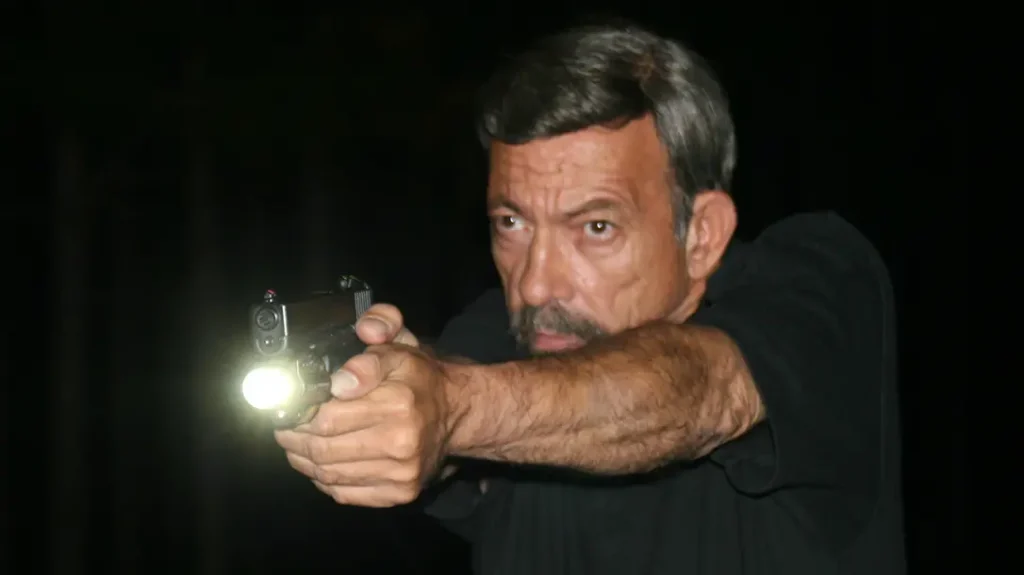
A problem we’ve seen continually in the field is using the WML as an ordinary flashlight while it is still attached to the weapon. This is a misuse of the device! It causes you to point a loaded gun at everything—and everyone—you look at.
In one case, a friendship ended on a night when “A” met “B” and invited B to see his new dog, which was in a cage in the bed of A’s pickup truck. To see better in the dark, B unthinkingly illuminated the dog with the only light he had on his person—the one on his pistol. Last I heard, A was still not speaking to B because B pointed a loaded gun at his dog.
That’s a relatively minor case of what can go wrong. Anyone who has hunted for a long time has run across the “slob hunter” who is too cheap or lazy to use binoculars. So, he scans for game through the telescopic sight of his hunting rifle. He thus points a loaded gun at everything that comes to his eye, including hikers and other hunters.
None of us would consider this responsible. In fact, pointing a loaded gun at a human being without just cause constitutes the serious felony of aggravated assault. It is worth several years in prison in every jurisdiction I know of. Not to mention loss of gun ownership rights.
We must realize that we are doing the exact same thing when we perform a search with a weapon-mounted light. This is why most of us in the training business recommend always having a separate, dedicated light for searching. Only when a threat is identified would we put the flashlight away (or drop it if necessary) and use the light mounted on the gun.
Proper Handling of a Weapon-Mounted Light
Therefore, you should treat the light on your weapon as you would the telescopic sight on a hunting rifle. We will never know how many lives have been saved when, at dusk, the magnification of the riflescope showed the hunter that what he thought was a deer was actually an unexpected human—or even just an illegal doe instead of a legal buck.
Similarly, we’ll never know how many lives have been saved in dark hallways or alleys when a WML beam showed the homeowner or the cop that the person they faced was holding keys, not a knife.
The lesson is—whether riflescope or WML—use it to identify the target and improve hit potential when necessary, but not for general searching.
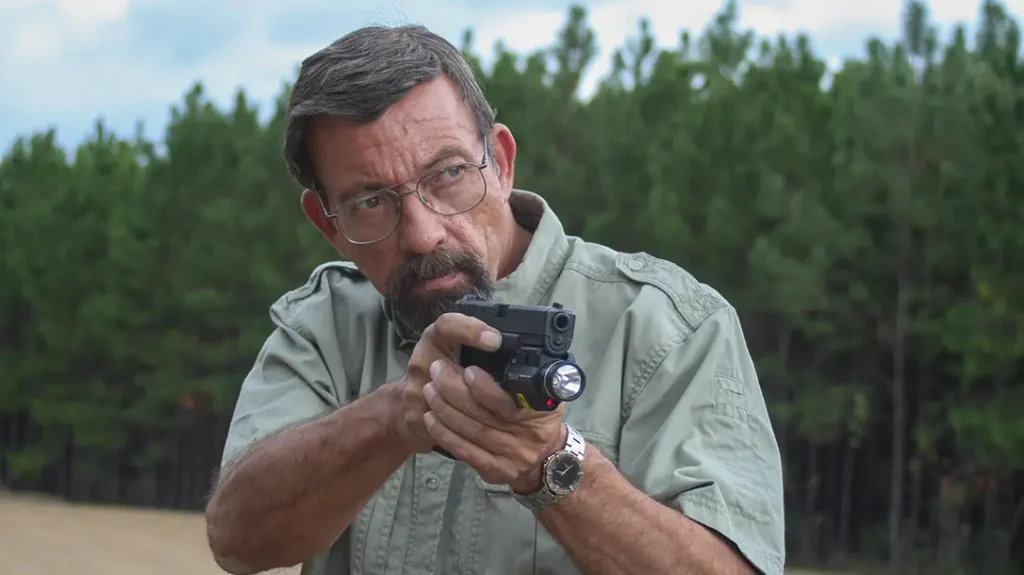
You’ll hear people say that it’s okay to point the light at a wall or ceiling, because the outer edges of the light beam will show where someone is, without the gun being pointed directly at them. There are two serious problems with this.
One is that when we realize the light has shown us someone, instinct tells us to point the beam directly at them, and the gun is aimed at them before we know it. The other is that the gun doesn’t have to be pointed directly at an innocent party to constitute felony aggravated assault, in most jurisdictions. It only needs to be held in a manner that puts them in reasonable fear of being killed or crippled.
The WML is a Useful Responsibility
In summary, the WML is a useful and potentially lifesaving piece of gear. If it wasn’t, it wouldn’t ride on so many police service pistols. But there are advantages and disadvantages—and therefore, choices to be made. We have the responsibility to choose and use wisely.