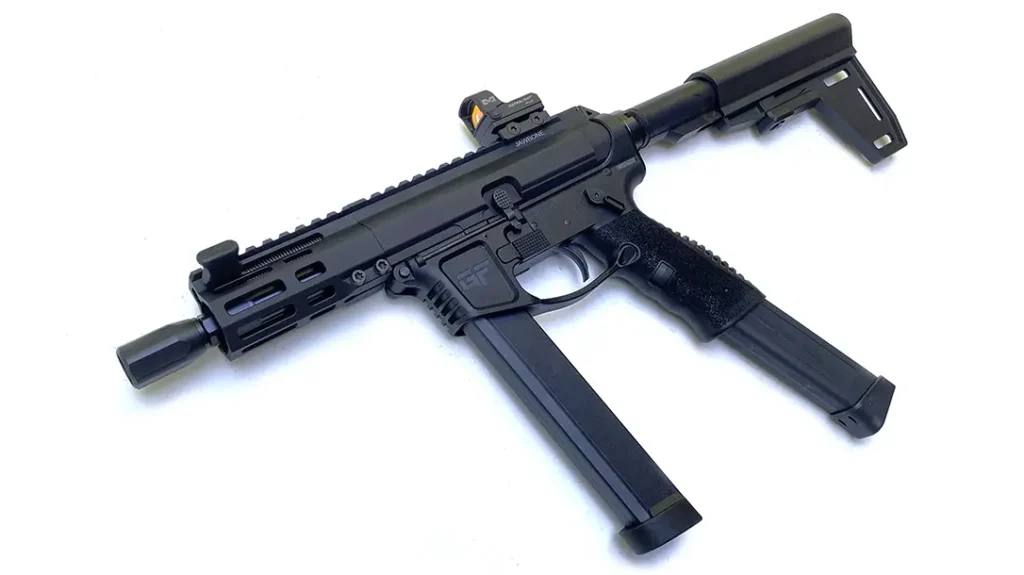
The Personal Defense Weapon (PDW) is designed for situations where a pistol isn’t enough and a rifle is too much. The new, American-made, GForce Arms 9mm Jawbone semi-automatic pistol would fall into that category if it were select-fire. It was developed in cooperation with Foxtrot Mike Products, drawing from their patented, sleek, Glock magazine-specific, lower receiver and 9mm bolt.
The GForce Arms 9mm Jawbone
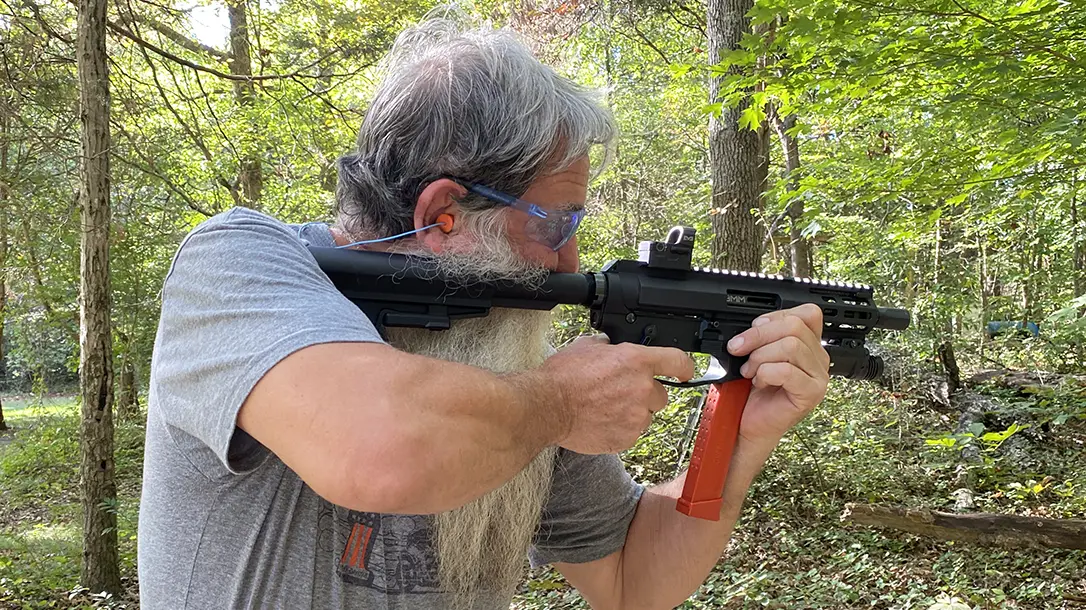
This is not your standard, clunky, overly heavy, 9mm AR platform. The Jawbone is more compact and weighs less than five pounds empty. You can actually shoot this pistol one-handed easily without strapping into the brace. Likewise, ambidextrous safety levers, magazine-release paddles, and bolt-lock releases let you shoot it with either hand.
The Jawbone features a five-inch barrel and is fitted with its factory 34-round magazine. It presents like a small submachine gun you’d find in the hands of grim-looking men working executive protection detail for a corporate bigshot. It also proved very accurate, punching five-shot, 25-yard groups from the bench with various ammo, averaging just over one inch.
Advertisement — Continue Reading Below
Clearly thoughtfully designed and well-made, the Jawbone is retailing at a really surprising $400. That low price is inconsistent with its features and capabilities, and initially made me think it had to be Turkish-made. (It’s made in the USA.)
After testing it, I think it represents a great value and should have strong appeal for the home-defense market. Its firepower could be a real asset when outnumbered. Likewise, its small size and lightweight make it easier for those with limited strength to handle. My wife or twelve-year-old daughter could use the Jawbone more effectively than most semi-auto handguns or revolvers.
Advertisement — Continue Reading Below
The Jawbone’s Action
The Jawbone is a simple blowback-operated semi-automatic. It is tuned to operate optimally with full-power ammunition at a minimum muzzle velocity of 1,100 feet per second when fired unsuppressed. When suppressed, they recommend using subsonic ammunition (less than 1,100 FPS) to prevent excessively high bolt velocity and backpressure.
I didn’t fire the Jawbone suppressed, but I did try some sub-sonic 135-grain bullet ammo and had no function issues. I suspect there’s room for some user fine adjustment with a suppressor by switching out the gun’s plain-steel 6.5-ounce buffer and round-wire recoil spring.
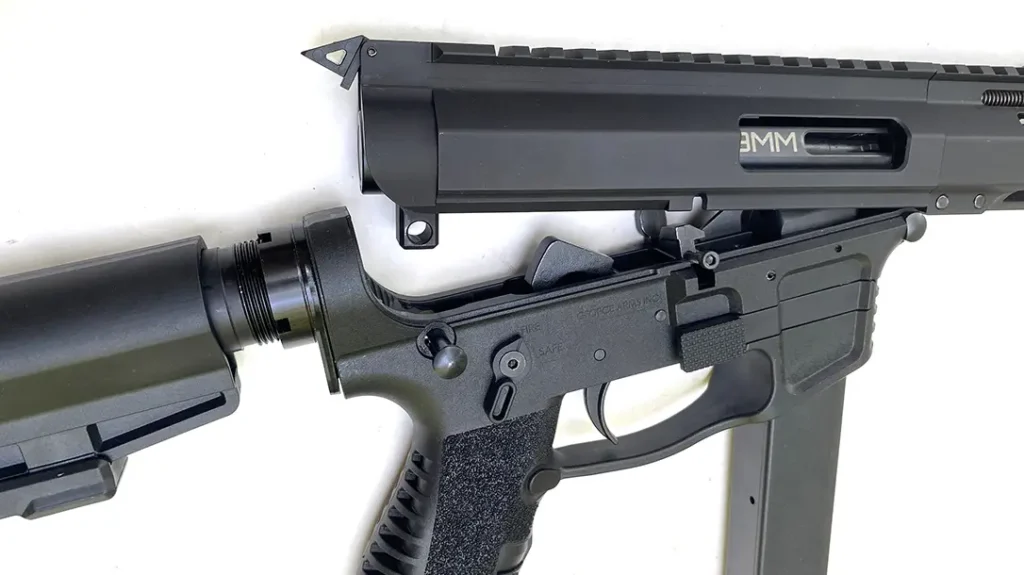
The conventional rear receiver-mounted charging handle is noticeably absent from the Jawbone. In its place, there’s a hinged triangular tensioning shim. It holds the aluminum upper and polymer lower receivers so tightly together that there is no apparent wiggle.
Advertisement — Continue Reading Below
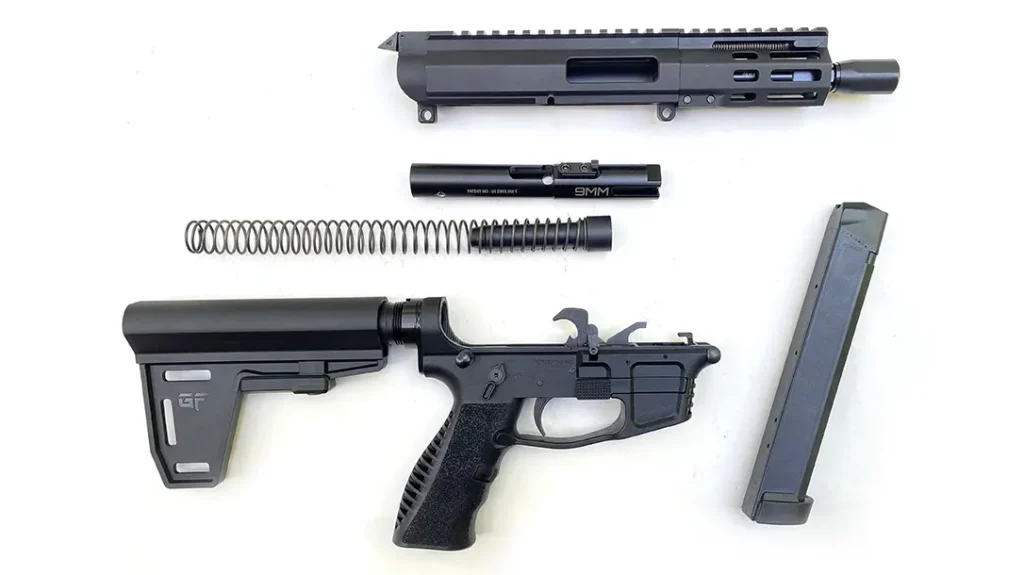
The Jawbone’s action cycles with a handguard-mounted, non-reciprocating charging handle that can be configured for right- or left-hand use. Operation of the little charging handle against the stiff recoil spring requires some hand and upper-body strength. If you lack that, there’s still hope for you.
I successfully experimented with loading/clearing the chamber by pressing the exposed handle against a hard surface (range bench top) and using my body weight to cycle the action open. It worked fine, and the handle appeared no worse for wear.
Advertisement — Continue Reading Below
The handle, like many small parts of the lower receiver, is polymer but appears robustly designed. That being said, I wouldn’t want to push my luck and smash it hard against concrete in cold weather. Despite its many merits, the Jawbone is not a battlefield-grade firearm.
Digging Into the Details
Inspection of the Jawbone’s upper showed it to be a very rigid setup. The barrel screws directly into the anodized aluminum upper receiver without a barrel extension or barrel nut.
Advertisement — Continue Reading Below
The first inch of the barrel that extends beyond the upper receiver also serves as the mounting base for a 3.75 inch long, octagonal, free-float, aluminum handguard with M-lok slots on the lower 7 sides and Picatinny rail along the top, which keys into the Picatinny rail on the receiver. This prevents any rotational movement.
The handguard can’t work itself forward under recoil either. Dual grooves around the circumference of the barrel anchor the handguard’s dual retaining screw in place.
The lower receiver resembles an aluminum Foxtrot Mike receiver in appearance and function. However, it is molded in polymer with an integral grip and internally reinforced in the buffer tube mounting ring and rear takedown pin hole area with a molded-in steel insert. It also has polymer magazine release paddles, safety levers, auxiliary magazine release button, and bolt hold-open lifter and cam.
Advertisement — Continue Reading Below
The pistol grip is aggressively stippled on the sides and is designed to hold an extra magazine at the ready. The release button, like the charging handle, can be configured for right- or left-hand use.
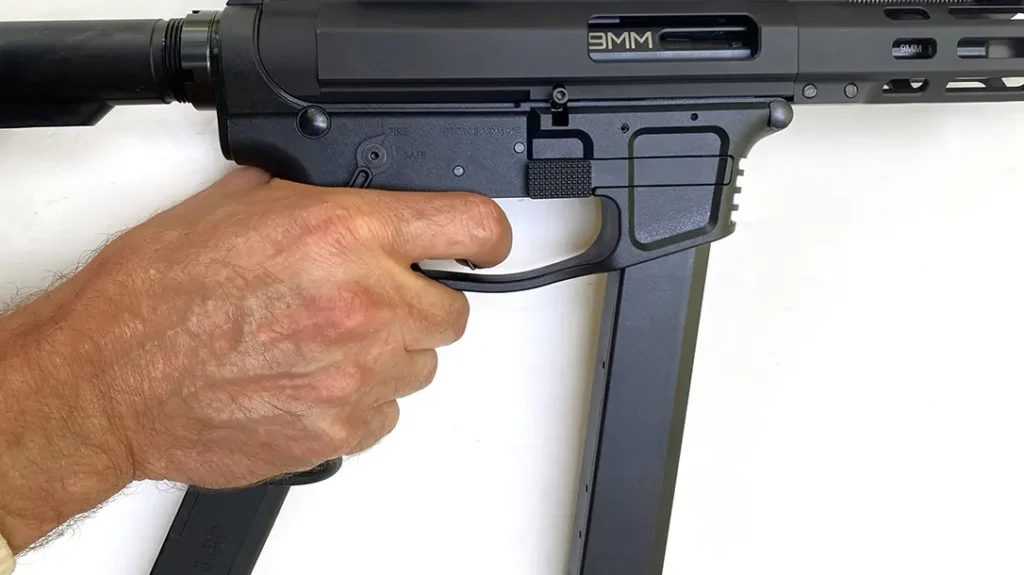
In concept, this feature is great because it allows you to have over sixty rounds at your immediate disposal. However, in practice, I discovered that my natural grip style was conducive to accidentally dropping the extra magazine until I trained myself out of it.
Adding an Optic and Light
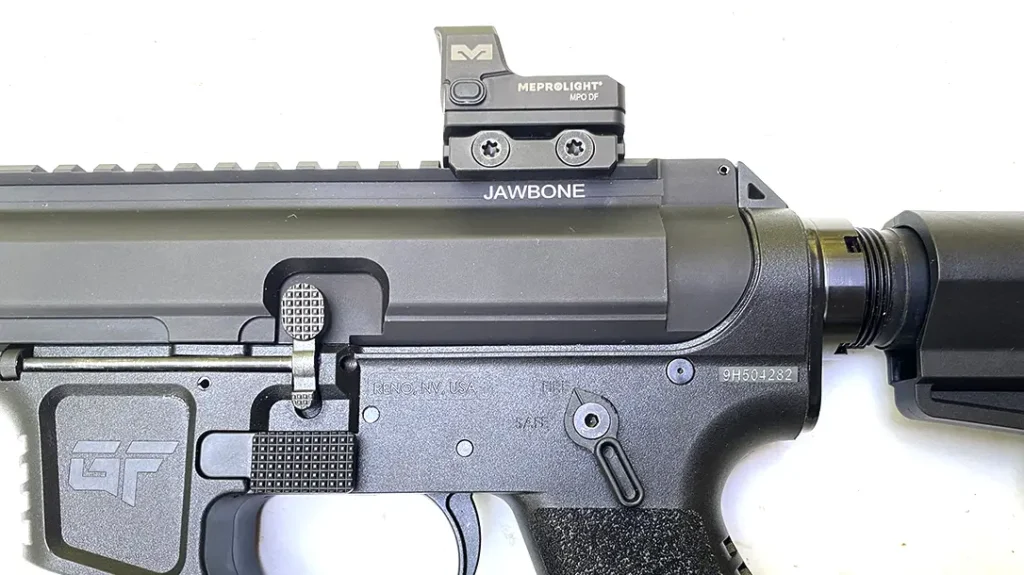
For accuracy testing, I fitted a 1.2-ounce Mepro MPO-DF open emitter red dot optic. This tiny optic has an RMR footprint but comes with a Picatinny rail adapter. Unfortunately, it sat a little low for my taste, so I substituted a Meprolight 0.40-inch-tall Picatinny rail riser.
Small but mighty, this combo offers IPX7-level waterproofing, a 3.5 MOA red dot with eight brightness settings that manually and automatically adjust, and a fairly large objective window measuring 0.89 inches wide and 0.68 inches tall. The protective casing and riser are anodized 6061-T aluminum. Correspondingly, the square stops prevent shifting forward or back on the rail under recoil.
It has a 15,000-hour estimated battery life on a single CR1632 battery. A sleep mode conserves battery, while a shake-awake feature lets you leave it on and ready to go the moment things go bump in the night. It’s a lot of optic for the $189 MSRP.
I don’t like the idea of shooting the fingers off my supporting hand. So, I installed a short piece of Picatinny rail at 6 o’clock on the handguard and mounted a Firefield Battletek Flashlight with Green & IR targeting laser to serve as a hand-stop.
Weighing 3.8 ounces and priced at around $75, it’s also a very lightweight and economical tactical light and targeting unit. The 150-lumen light has two hours of continuous run-time on a single CR-123A lithium battery. Its weakness is the polymer rail-clamping jaws, which are subject to breakage if abused or overtightened.
If you’re setting up a defense gun on a budget, as many will be, it’s a good option to consider.
Feeding the PDW
The Jawbone’s factory magazine is an all-polymer body, American-made, 34-round, Amend2. I also tested the Korean-made 33-round magazines available from Centerfire Systems. They are produced by IMG and appear to be of decent quality, made with a polymer-over-steel body in the fashion of Glock factory magazines.
These are available in more than a dozen colors for $20 each, or basic black for $16 each. If you love the organizational possibilities of colored file folder tabs, these colorful magazines will appeal to you.
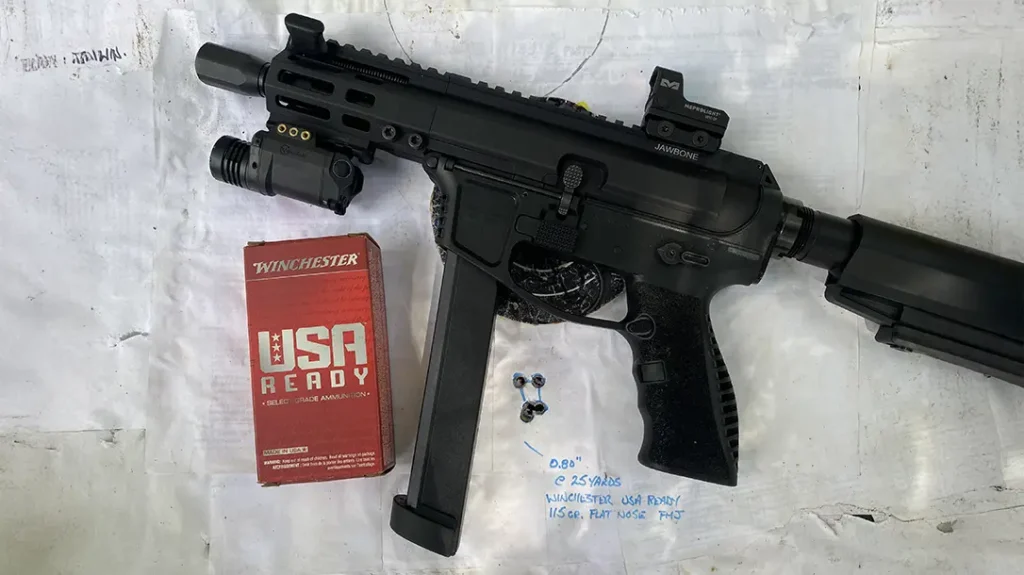
I had no failures to feed with the factory magazine. However, the IMG magazines locked the bolt open with one round remaining because their follower rose higher in the front. The problem is easily correctable with some trimming using a Dremel tool or X-ACTO knife. For the price and overall good quality, I don’t mind a little handwork.
I notice both the factory and IMG magazines had a rather tenuous hold on the top round when fully loaded. It would be easy to dislodge it when drawing the magazine from a pouch. Both magazines inserted and locked properly and dropped free with equal ease using either the left- or right-side serrated magazine release paddle.
Running the 9mm Jawbone
On the range, I tested several types of ball and self-defense loads and found the Jawbone functioned reliably. The single-stage trigger-pull was slightly heavier than advertised at about 6.5 pounds. It had the typical creep you would expect in a mil-spec AR trigger. However, it was immediately clear that the pistol showed above-average accuracy.
To judge just how accurate it was, I used standard NRA pistol 25-yard slow-fire bullseye targets set at that range and shot from a bench rest.
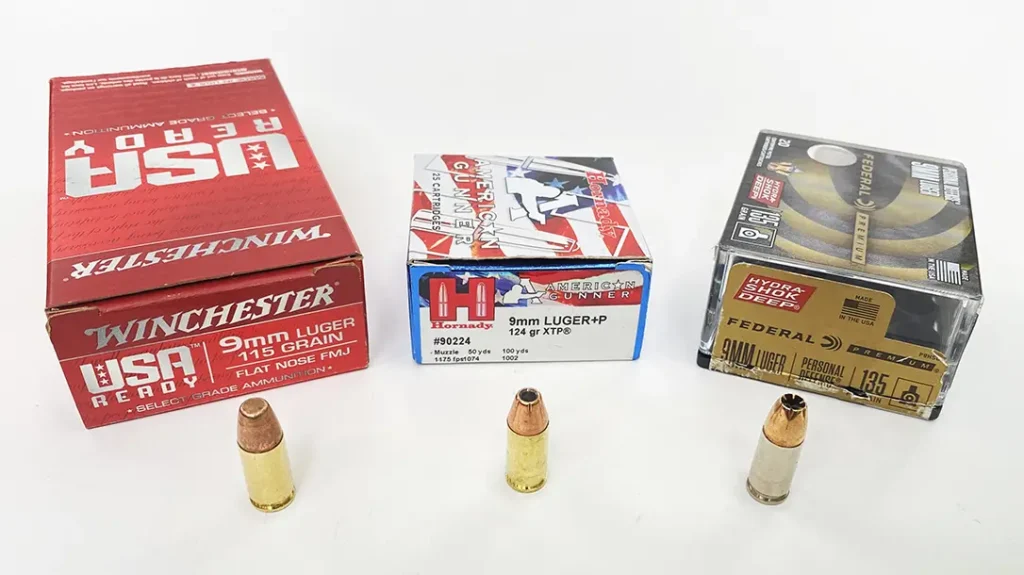
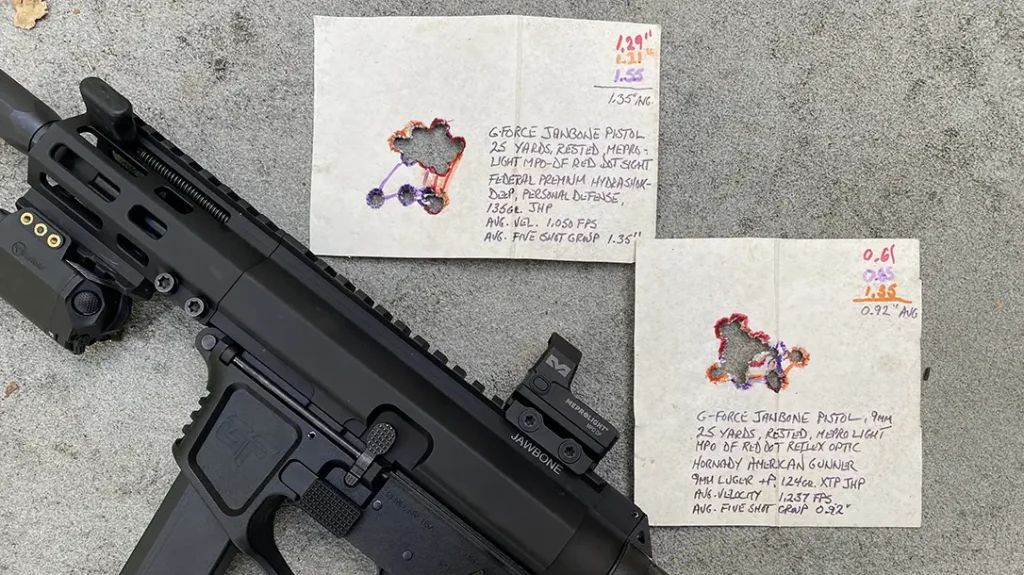
Hornady American Gunner 9mm +P 124 grain XTP JHP averaged 1,237 FPS and five-shot groups of 0.93 inches, measuring from center-to-center of the two most widely spaced bullet holes. Almost identically accurate was Winchester’s USA Ready Select Grade Ammunition 115 grain flat nosed FMJ, which averaged 1,218 FPS and groups of 0.94 inches.
Federal Premium 9mm Luger Hydra Shok Deep 135 grain JHP averaged a sub-sonic 1,050 FPS with no malfunctions and average groups measuring 1.35 inches. Using the minimalist, blade-style, 6-position brace, it was easy to shred soda cans with multiple hits from a standing position at 25 yards.
Accurate, reliable, and inexpensive, there was only one thing about the Jawbone that didn’t seem fully squared away to me. It’s a small thing, but when the ambidextrous safety lever is moved downward into firing position through its 60-degree arch, one side of it ended up uncomfortably underneath my shooting hand grip.
This annoyed me like having a stone in my shoe. My solution was to shorten the right side lever by about 60 percent so it cleared my hand.
G-Force 9mm Jawbone Pistol Specs
| Caliber | 9mm Luger |
| Capacity | 34 rounds Glock pattern Amend2 magazine included |
| Operation | semi-auto, simple blowback |
| Barrel | 5 inches, 1:10 twist, 1/2″-28 TPI threaded muzzle with muzzle blast diverter factory installed |
| Material | polymer lower receiver w/ steel reinforced buffer tube area, anodized aluminum upper receiver and handguard |
| Finish | black |
| Stock | blade style 6-position adjustable brace |
| Controls | right or left hand operation configurablenon-reciprocating charging handle in handguard, right or left hand operation configurable extra magazine release button in grip,ambidextrous magazine release, safety, and bolt hold open |
| Finish | black |
| Special Features | auxiliary magazine can be stored in the pistol grip, built-in upper & lower receiver tightening wedge |
| Length | 21.12 inches with brace collapsed, 24.25 inches with brace fully extended |
| Weight | 4 pounds 11.6 ounces empty |
| Triggerpull | 6.25-6.75 pound pull, single-stage |
| Sights | none, Picatinny rail |
| MSRP | $453 (Actual online retail price closer to $400.) |
Performance
| Hornady American Gunner 9mm +P | |
| Bullet Weight & Type Velocity | 124 XTP JHP |
| Velocity | 1,237 |
| Best Group | 0.61 |
| Winchester USA Ready Select Grade | |
| Bullet Weight & Type Velocity | 115 FMJ flat nose |
| Velocity | 1,218 |
| Best Group | 0.80 |
| Federal Premium Hydra Shok Deep | |
| Bullet Weight & Type Velocity | 135 Hydra Shok JHP |
| Velocity | 1,050 |
| Best Group | 1.21 |
Performance was tested with a series of five-shot groups fired at 25 yards from the bench with the MeproLight MPO-DF reflex red dot optic with 3.5 MOA reticle dot. A Competition Electronics Pro-Chrono Digital Chronograph was set 15 feet from the muzzle. Bullet weight is in grains, velocity in feet per second, and the group size in inches.
WHY OUR ARTICLES/REVIEWS DO NOT HAVE AFFILIATE LINKS
Affiliate links create a financial incentive for writers to promote certain products, which can lead to biased recommendations. This blurs the line between genuine advice and marketing, reducing trust in the content.