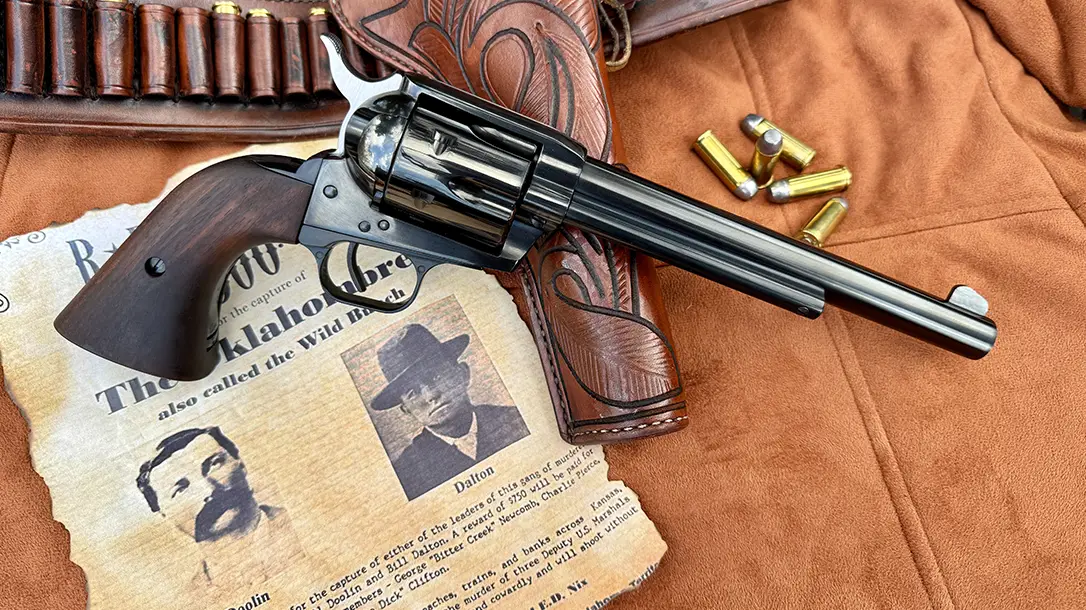
The BountyHunter. Anyone who has watched a few Old West movies or TV shows knows about the lone, shadowy gunslinger with a pocket full of wanted posters. He hunts fugitives for a living, claiming the reward offered for them, dead or alive. Truth be told, the Bounty Hunter is more myth than reality, born of dime novels and “Horse Operas.” While there were men, and perhaps a few women, who tracked down fugitives and outlaws, most of the time they were town marshals, deputy sheriffs, state rangers, or deputy U.S. Marshals.
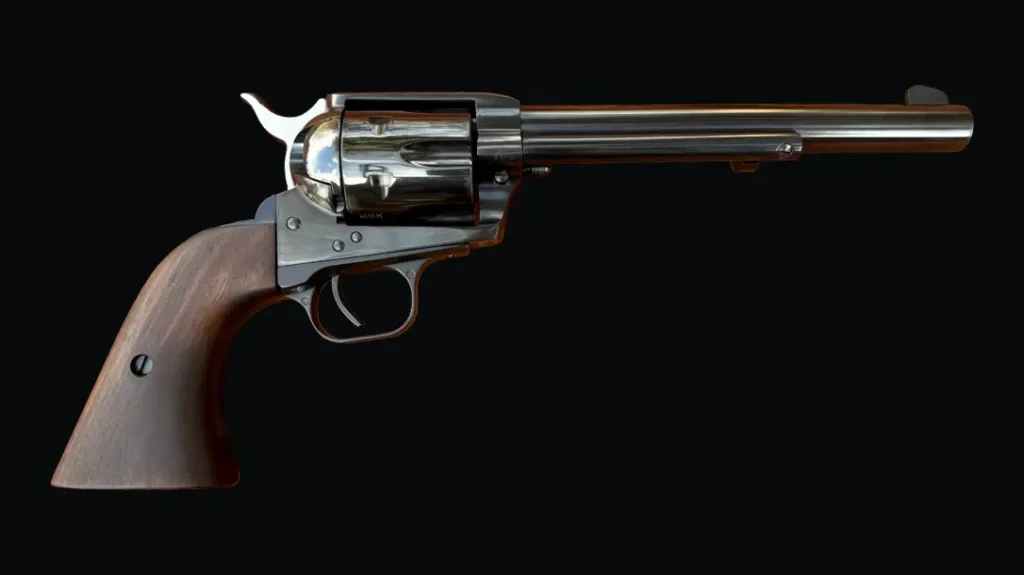
Bounty Hunter – Classic Six-Gun
These underpaid “law dogs” went after the criminals on wanted posters to supplement their meager salaries, and what they earned often depended on how many arrests they made. Another myth is the huge rewards offered; in reality, the average reward was around $100.00. That kind of money was a nice extra, but hardly what you could make a living on.
Advertisement — Continue Reading Below
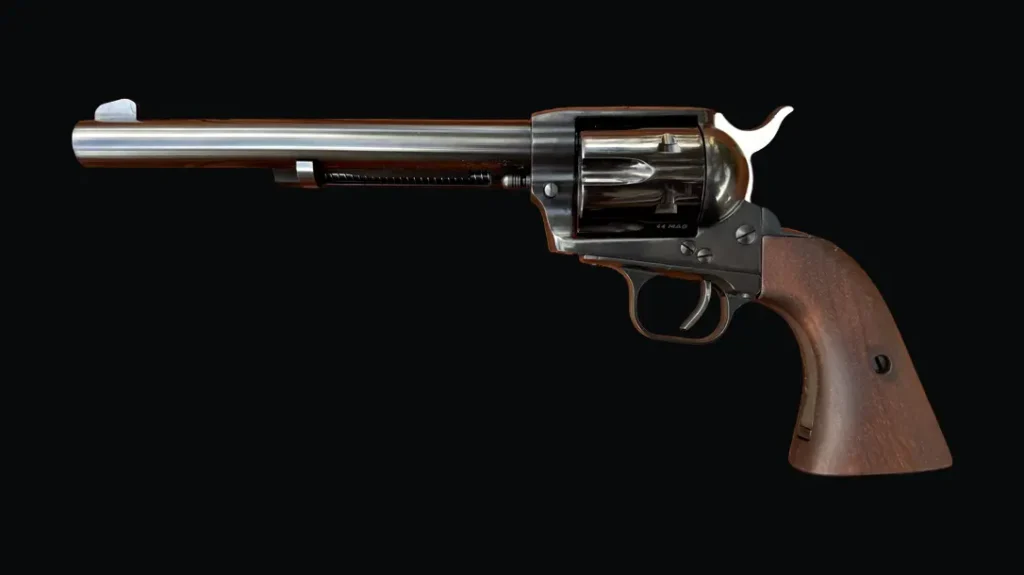
The Weihrauch Bounty Hunter
Unlike the mythical Bounty Hunter, this six-gun from importer European American Arms (EAA) is the “Real McCoy.” Made by Hermann Weihrauch Revolver (formerly Arminius), a leading German firearms manufacturer known worldwide for its precision-engineered sporting products, this platform in calibers ranging from .22 LR/.22 WMR, to .357 Magnum, and .45 Colt, has been in production for over two decades. The version that I chose to test is in .44 Magnum. I decided on this chambering as I intended to use only .44 Special and .44 Russian “cowboy” loads. I’m sure it will do fine in .44 Magnum, but this article is geared towards the Cowboy Action Shooter.
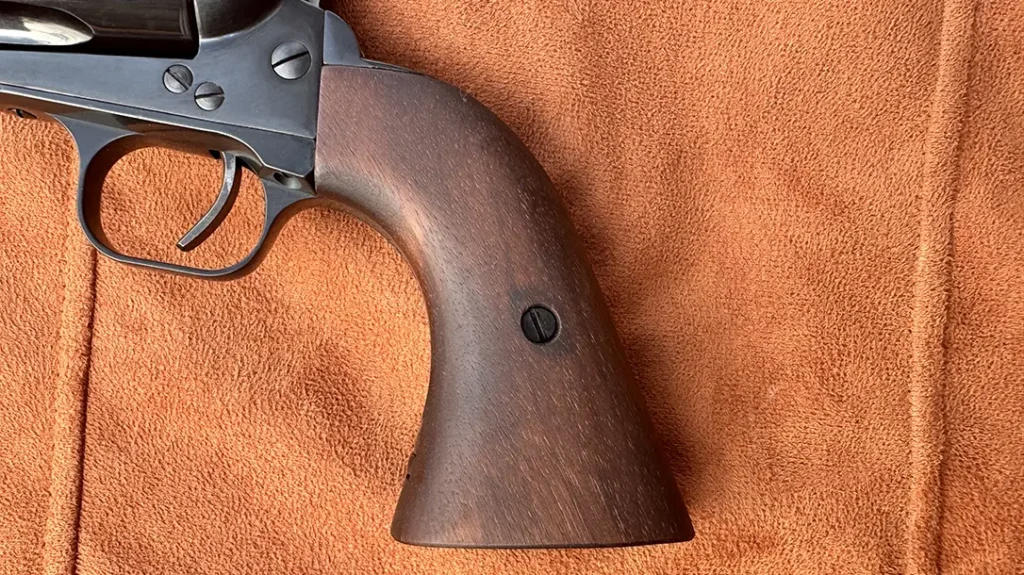
The test gun I received has a 7.5” barrel, which gives it an overall length of 12.7 inches, and a hefty 41.6 oz. empty weight. It came with an all-blue finish on the barrel, cylinder, and frame, while the aluminum grip frame/trigger guard assembly is anodized with a similar coloration. Sights are a blade out front and a fixed notch in the rear. Its walnut stocks are two-piece and somewhat unusual, as each panel is held in place by a separate screw, giving you slotted screw heads on each side.
Advertisement — Continue Reading Below
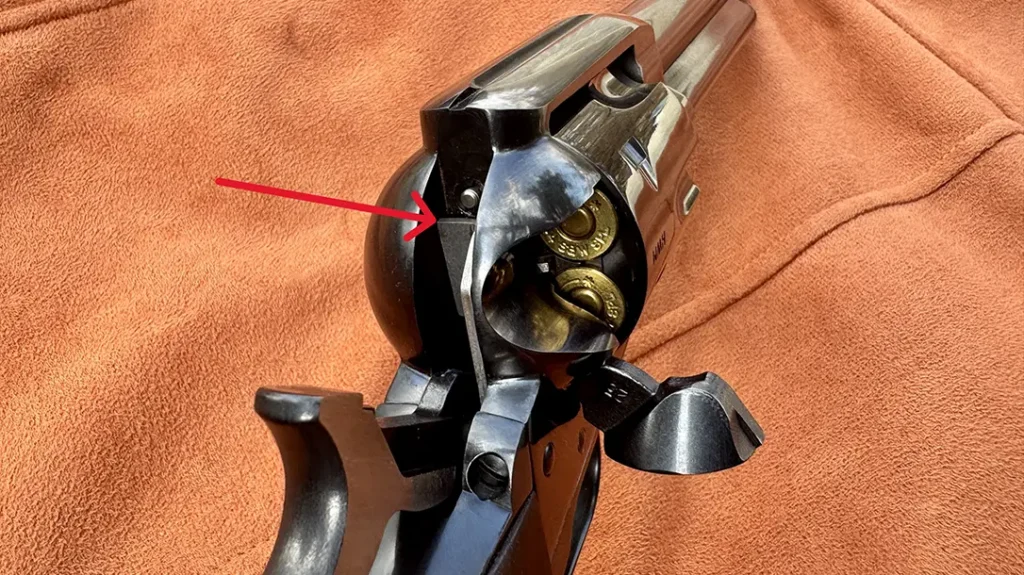
Flush Fit Cylinder
They also extend down 0.47 in. below the frame, giving grip dimensions like those found on the 1860 Army revolver. Unfortunately, the wood-to-metal fit isn’t as exacting as the metal-to-metal fit, but overall, the six-shooter gets high grades on the metal finish, but drops a few points with a flawed area on the backstrap of the grip frame.
Powered by leaf-type mainspring, my Bounty Hunter has a smooth-faced, 0.25-in wide trigger, with an average pull weight of 6.6 Lbs., plus no take-up, and little overtravel. The hammer is unfinished on the sides, and has a tall and checkered spur, and drops with sufficient force when the trigger is pulled, to set off even the hardest primer. While it looks like a traditional Single Action Army (SAA) replica, the action includes a transfer bar that should prevent an accidental discharge should the gun be dropped; so, it’s safe to carry all six chambers loaded. You’ll also note that the firing pin is not riveted to the hammer nose, but is mounted inside the frame. It is the inertia-type and retracts when the trigger resets. Another unusual feature is the recessed chambers in the cylinder.
Advertisement — Continue Reading Below
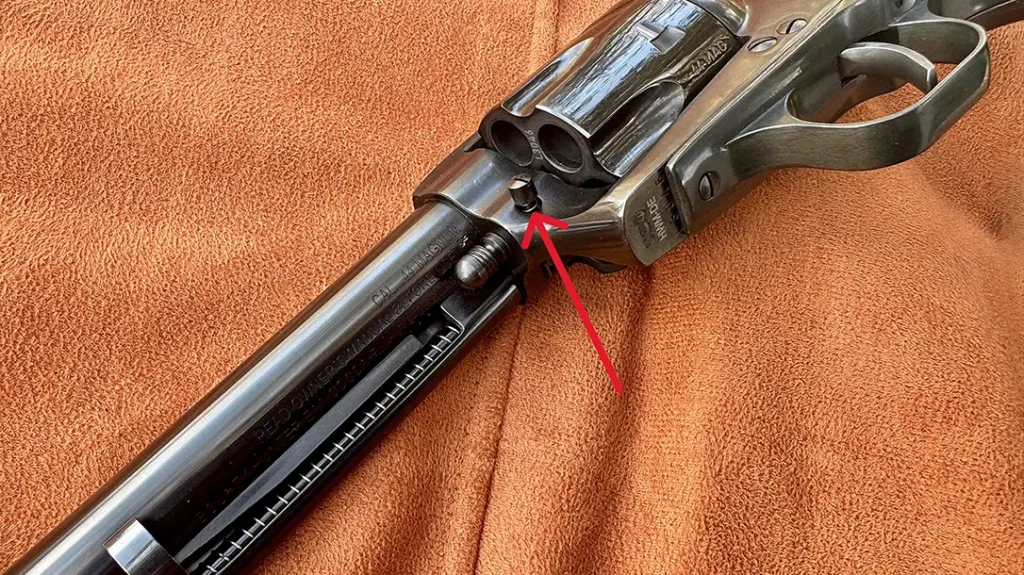
Balloon Head Rims
Years ago, when centerfire cartridges had balloon-head rims, which could rupture on firing, this might have been important, but with today’s solid-head cases, not so much. The reason behind this is that the quote,” …to improve frame strength by allowing the cylinder to fit flush with the loading gate, providing extra support when firing Magnum loads.” The Bounty Hunter is built on the post-1896 frame with the spring-loaded cylinder base pin latch for easier cylinder removal for cleaning. Loading and unloading is as in the original, through the loading gate in the right-side recoil shield.
Advertisement — Continue Reading Below
Lead ‘n Leather
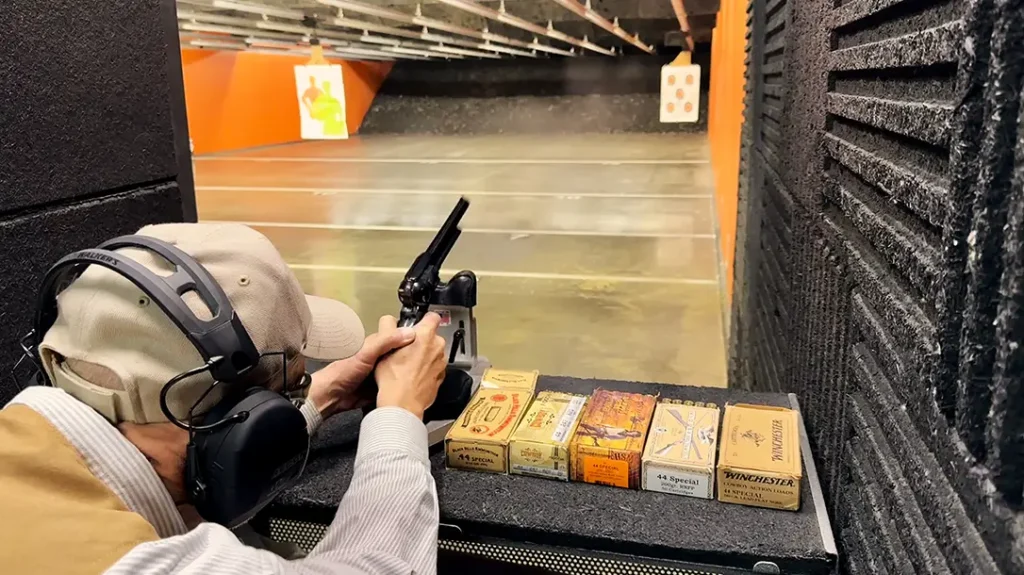
As I mentioned earlier, I didn’t plan to use any .44 Magnum ammunition in this T&E, as the emphasis is on a gun for CAS and not hunting or long-range shooting. While there are a couple of outfits that make .44 Magnum “cowboy” loads, I decided to stick with ammunition that I had on hand in my locker. From Black Hills I had their .44 Special load with a 210 flat-point lead (FPL) bullet. During a previous T&E article, Fiocchi had sent me some of their .44 Russian cartridges that have a 247 gr. round-nose lead bullet (RNL), so I decided to include it.
I also chose some HSM .44 Special Cowboy Cartridges with a 200 gr. round-nose, flat-point (RNFP). My locker yielded some vintage 10-X CAS cartridges in .44 Special, with a 200 gr. RNFP bullet. And lastly, I had a stock of Winchester .44 Special Cowboy Action Loads, with a 240 gr. lead flat-nose (LFN) bullet.
Advertisement — Continue Reading Below
Indoor Testing
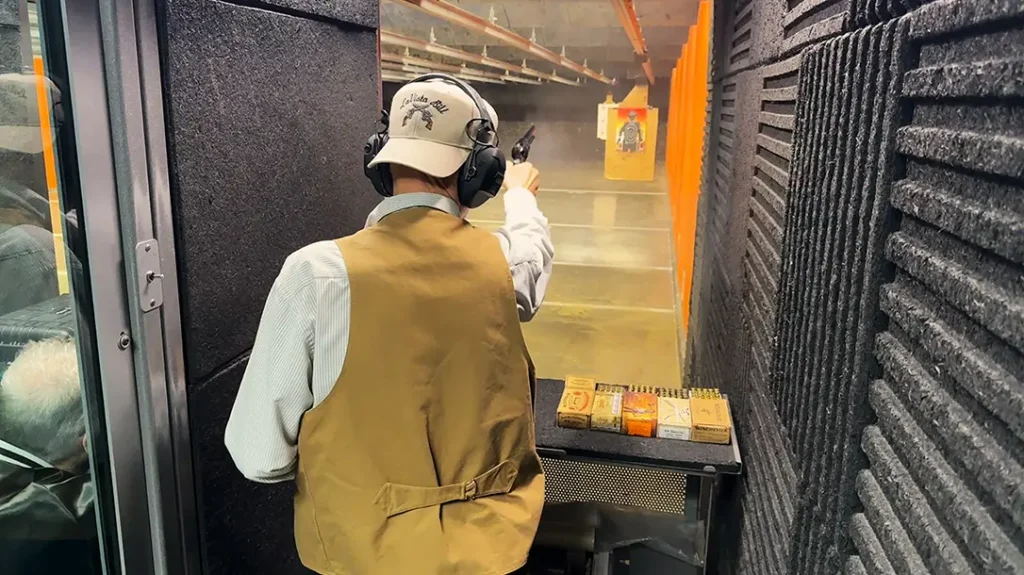
As it is mid-February presently, I was unable to find a CAS match to shoot in as I normally do with “cowboy” firearms, so all my range work was done at an indoor facility. I still wanted to have a holster/belt rig that would work with the Bounty Hunter, and a search through my Old West leather storage tubs revealed an outfit that filled the bill nicely. Made by El Paso Saddlery, it’s called the “Jesse James,” and for good reason, it’s a replica of a leather outfit used by the famous outlaw in the 1870’s.
It features a “Tear Away” carving that was popular on the frontier and usually done with crude tools like a nail. The 3-inch money belt has loops that cover the entire cartridge, as fixed ammunition was more fragile in that era. The finish is a special hand patina process that gives the leather a beautiful antique look. It worked just fine with the Bounty Hunter and .44 Special cartridges.
Taking Care of Business
Small snow mountains in the Range USA parking lot reminded me of our heavy snowstorms a couple of weeks previous, which had left the ground a morass. I got there shortly after opening, so I’d have open lanes near me while I did my chronograph work. The velocity figures you see in the Performance Table are averages from my Garmin Xero C1 Pro chronograph. While getting the velocity figures, I sent a large Shoot-N-C bullseye target downrange to 10 yards, so I could see how well the Bounty Hunters’ sights were regulated. I was pleasantly surprised that all five different loads’ point of aim/point of impact were so close that the large ragged group stayed in the 10-X zone of the target.
Advertisement — Continue Reading Below
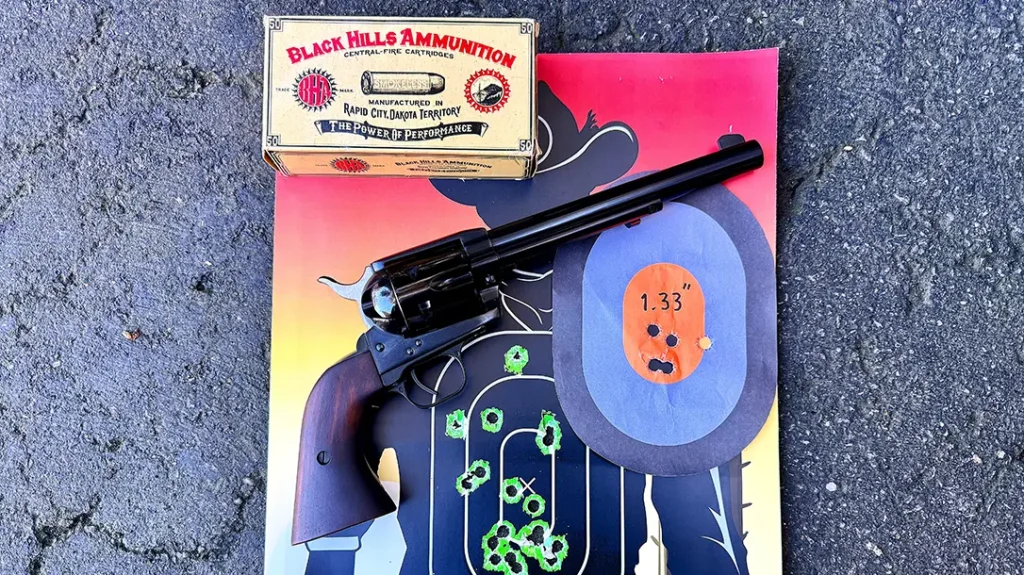
Next, I used some large-sheet targets that have five oval bullseyes per sheet, and these were sent down to the 15-yard line. Using my Ransom Steady Rest, three 5-shot groups were fired with each of the test loads. I used the test cartridges in alphabetical order, so first up was Black Hills. I had a 4-shot group going that was 0.59-in. until a flyer opened it up to 2.14-in. Black Hills still won first place with a 1.33-in group. Right on its heels was a 1.39-in. group with the Fiocchi .44 Russian load. Of the 75 rounds fired, none of the groups were over 2.37 in., and most were well-centered.
Simulated Stage
For a simulated cowboy shoot handgun stage, I put up a “Gun Slinger” reduced-size silhouette target and sent it down to about 8 yards. I loaded the Bounty Hunter cylinder with 5 rounds, keeping the chamber under the hammer empty per CAS rules. I used one of each of the test cartridges. Then, using my best “Duelist” stance, I shot one-handed, as fast as I could cock the hammer, fire, and re-acquire my sights. Somehow, I managed to keep my 20 bullet impacts within the oval-shaped 4.5×7.5-in. scoring area. The whole target sheet is about the size of a typical steel CAS handgun target.
At the End of the Trail, How it Shakes Out
My most positive comment would have to be on the accuracy. Despite the somewhat heavy trigger pull and the rock-crushing hammer falls, it performed better than anticipated. When I was punching paper at 15 yards, the end of my trigger finger got sore due to the odd angle of the trigger, which put the end against my finger tip. I’d like to see that trigger straightened out a bit. The heavy mainspring also makes cocking the hammer one-handed slow and difficult. CAS competitors who are serious about their match scores will be looking for an action job.
I also like the sights. The front sight is flat-faced towards the shooter and 0.10-in. wide, making it easy to see in the square-notch rear sight. The Bounty Hunter is also heavy, as I mentioned earlier, so this 71-year-old couldn’t hold it out and steady for very long. One other note, at CAS matches, you load your firearms at a loading table just before you shoot. When your revolver(s) is/are loaded, you hold it/them up so the cowpoke manning the loading table can see that the chamber under the hammer is empty.
Bounty Hunter
You can’t easily do this with the Bounty Hunter and its recessed chambers. At home, it was easy to disassemble for cleaning due to its German engineering, and while I often have trouble re-inserting the cylinder pin, this one slid right on in. To me, the positives outweigh the negatives, and the price point on this EAA six-gun makes it very attractive.
EAA Bounty Hunter Specifications
| MECHANISM: | Single-action revolver |
| CALIBER: | .44 Magnum (accepts .44 Special/Russian) |
| CAPACITY: | 6 cartridges |
| BARREL: | 7.5 in. |
| OA LENGTH: | 12.7 in. |
| EMPTY WEIGHT: | 41.6 oz. |
| SIGHTS: | Fixed notch rear, blade front |
| FINISH: | Polished blue steel, frame anodized aluminum |
| STOCKS: | Two-piece walnut |
| MSRP: | $579.00 |
EAA Bounty Hunter Cartridge Performance
| Cartridge | Ave. Velocity | Best Group | Average Group |
| Black Hills .44 Spl. 210 gr. FPL | 760 FPS | 1.33” | 1.69” |
| Fiocchi .44 Russian 247 gr. RNL | 724 FPS | 1.39” | 1.74” |
| HSM .44 Spl. 200 gr. RNFP | 799 FPS | 2.19” | 2.34” |
| Ten-X .44 Spl. 200 gr. RNFP | 615 FPS | 2.16” | 2.37” |
| Winchester .44 Spl. 240 gr. LFN | 746 FPS | 1.02” | 1.52” |
NOTE: Bullet weight measured in grains, velocity in feet per second, 15 inches from the muzzle by a Garmin Xero C1 Pro chronograph, and accuracy in inches for three 5-shot groups at 15 yards.
For more information, visit EAA.
WHY OUR ARTICLES/REVIEWS DO NOT HAVE AFFILIATE LINKS
Affiliate links create a financial incentive for writers to promote certain products, which can lead to biased recommendations. This blurs the line between genuine advice and marketing, reducing trust in the content.