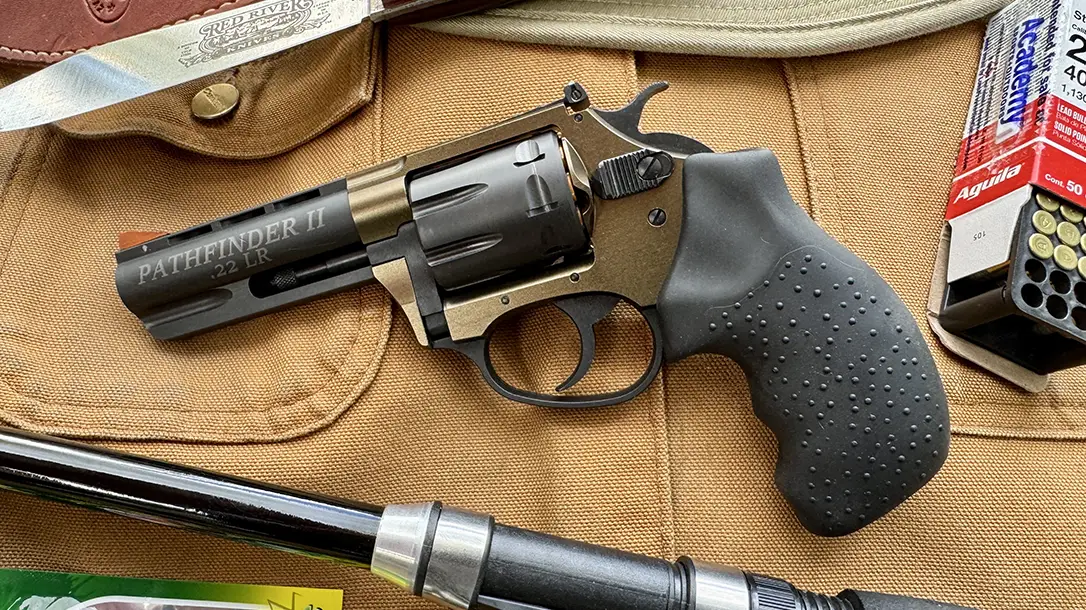
For more than 60 years, Charter Arms has been manufacturing affordable, 100% American-made double-action (DA) revolvers from 100% American parts, which are covered by a lifetime warranty. The company has had ups and downs, closed its doors for a couple of years, and had a few name changes. Today, Charter Arms has regained its reputation for quality control and reliability. It offers dozens of centerfire and rimfire revolvers in a dazzling array of configurations and finishes. One such revolver from Charter Arms is the Pathfinder II in .22 LR.
The Charter Arms Pathfinder II .22 LR
When it was introduced in 1970, it was originally called the Pocket Target .22. Within a year, the name was changed to the Pathfinder. This was Charter’s version of a “kit gun” and came with a 3-inch barrel, adjustable rear sight, and a six-shot cylinder. It could be had with service-type or “Bulldog” grips and had a blue finish. It’s been a staple in the Charter line for 55 years.
During its production span, there have been many variations of the Pathfinder. The first was in 1971 when the Dual-Pathfinder was debuted with an interchangeable .22 WMR cylinder. Since then, versions have come and gone.
Advertisement — Continue Reading Below
In recent years, the six-shot cylinder was replaced with an 8-shot cylinder. Barrel lengths are 2 inches for the Pathfinder and 4.2 inches for the Pathfinder Target.
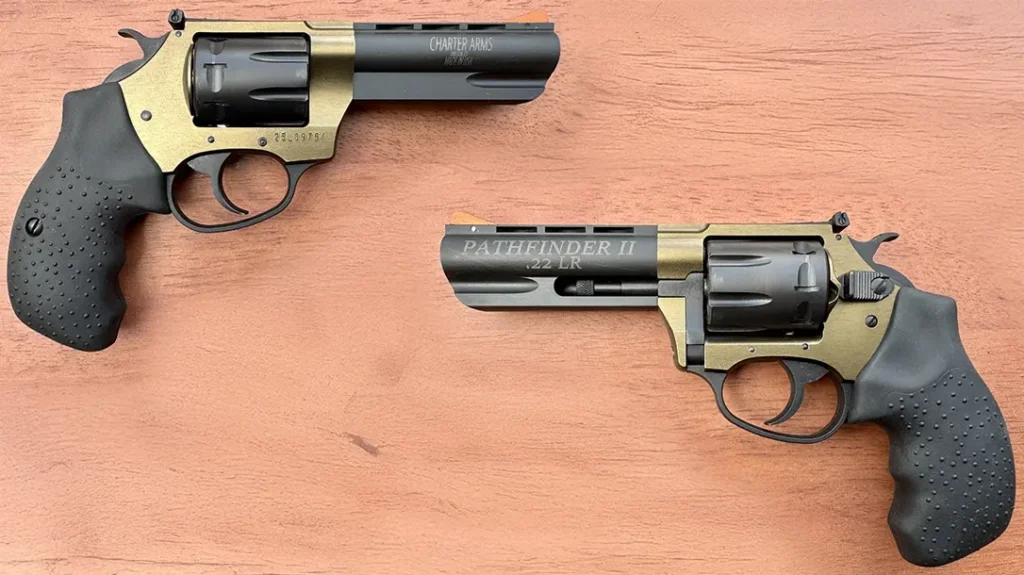
There are 18 models cataloged in the Pathfinder line. First announced just over a year ago, the Pathfinder II series includes three versions that differ only in finish. These finishes are listed as “Black Passivate, Stainless Steel, OD Green & Black Passivate.”
Advertisement — Continue Reading Below
All are in .22 LR, have 3.5-inch barrels, adjustable rear sights, and an aluminum ramp front sight with an orange anodized finish, made by TK Custom.
The Pathfinder II in Detail
I tested the version with the OD Green and Black Passivate finish. The frame is made of 7075 aircraft billet anodized aluminum, while the barrel and cylinder are extruded stainless steel. It has 8-groove rifling, which is touted to provide for higher bullet velocities. A “vent” rib and full underlug are integral with the barrel, and the front sight is secured with a steel pin.
The cylinder is fluted and radiused in front. It rotates clockwise, has a “4-point lockup,” and is released to swing out by pushing the thumb-latch forward.
Advertisement — Continue Reading Below
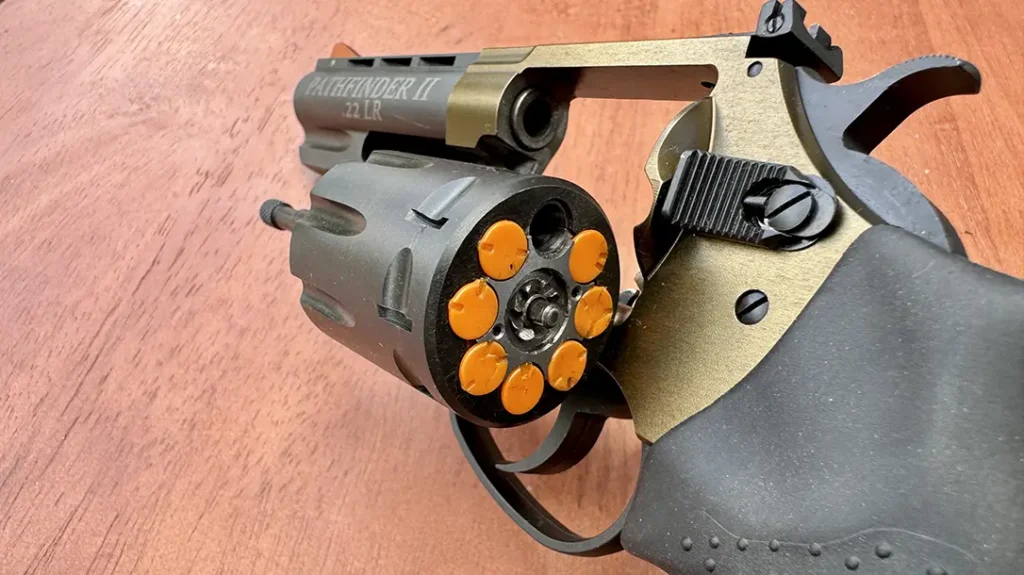
Powered by a coil mainspring, the action has a hammer block safety, and the rebounding firing pin is mounted in the frame. The hammer spur is serrated, while the trigger is smooth-faced, and about 0.25 inches in width.
Typical of Charter revolvers, the trigger pull is serviceable, but nothing to write home about. My Lyman Trigger Pull Gauge indicated that the single-action (SA) pull weight averaged 5 lbs. 12.5 oz. It broke clean, with just a hint of overtravel. The DA pull weight exceeded the capacity of my electronic gauge. However, given my years of experience with revolvers of this type, I’d say it’s at least 14-15 lbs.
Advertisement — Continue Reading Below
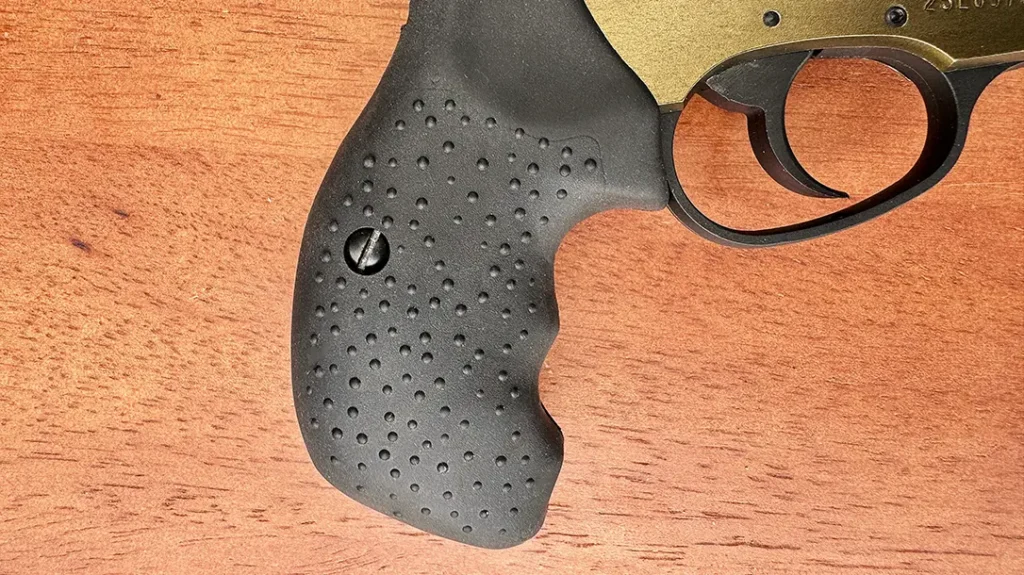
The Pathfinder II comes with compact black rubber grips with finger grooves and pebble-grain texturing. Fit at the backstrap left something to be desired. Finish and metal-to-metal fit were quite good, with no external blemishes.
The wheelgun comes in a lockable plastic carrying case that is lined inside with foam rubber. Inside is a trigger lock, operating instructions, and other printed matter covering sight adjustments, cleaning, and safety.
Advertisement — Continue Reading Below
Interestingly, my test gun came with 8 orange plastic .22 cartridge look-alike snap-caps. These should always be used when dry-firing a rimfire revolver to prevent damage to the firing pin and cylinder.
Square Range Workout
Before taking the Pathfinder II to the range, I browsed through my ammo locker and came up with five different .22 LR test cartridges. I see this gun as more of an understudy for a centerfire revolver or as a trail or field companion. So, I based my ammunition selection on that basis.
Going alphabetically, from Aguila is the standard velocity 40gr. solid lead bullet load. A varmint load from CCI is the Mini Mag with a segmented 40gr. HP bullet. Federal provided me with its Premium Hammer Down loads that have a 40gr. copper-plated HP bullet.
Advertisement — Continue Reading Below
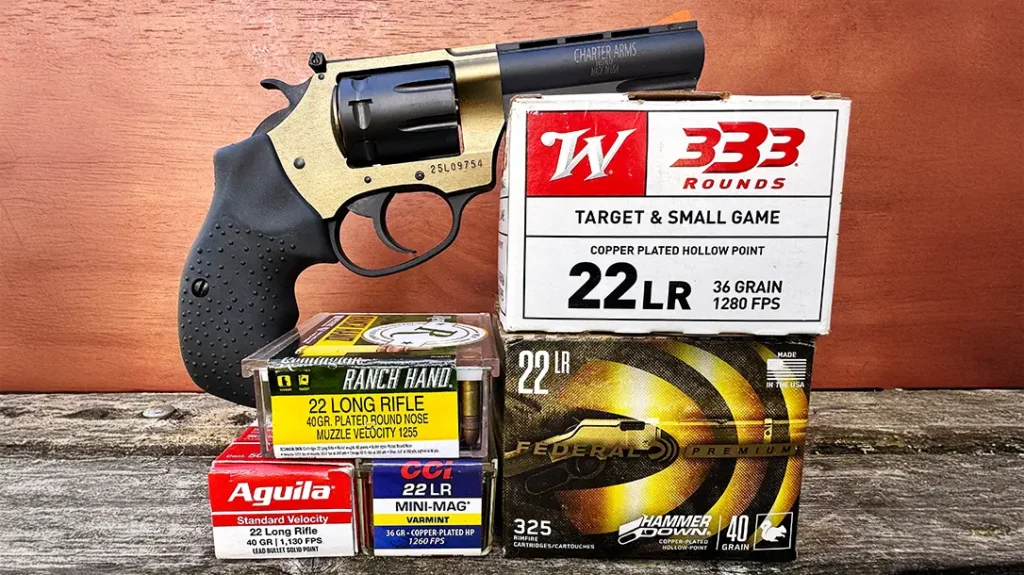
From Remington came the Ranch Hand; it has a 40gr. plated, solid-nose bullet. I also grabbed a box of Winchester Target & Small Game loads that have a copper-plated 36gr. HP bullet. With the trail gun idea in mind, I also included a box of Winchester Super-X shot cartridges that are loaded with #12 lead pellets.
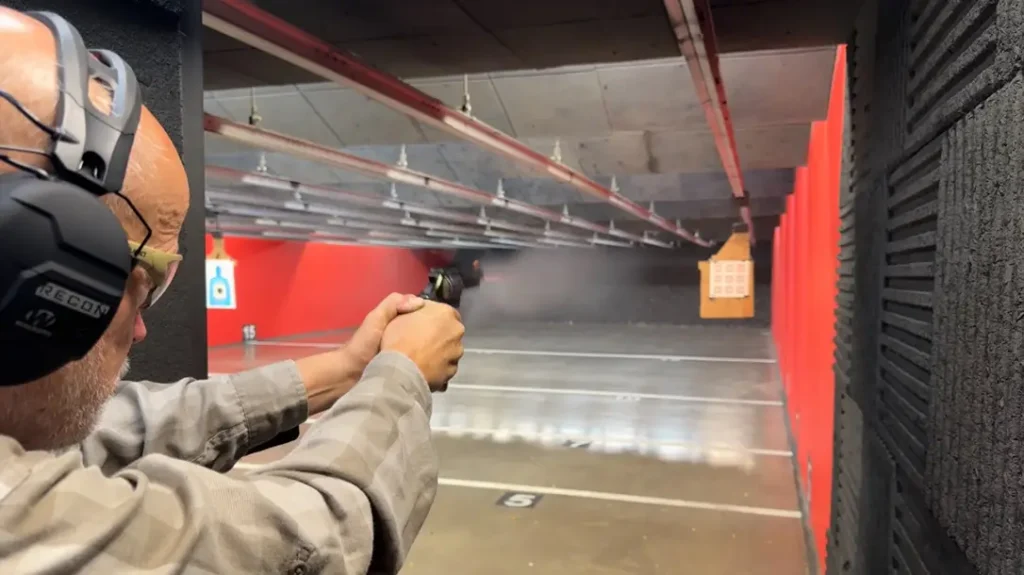
I arrived at my local Range USA shortly after it opened, checked in, and got my shooting lane. First order of business was to set up my Garmin Xero C1 Pro chronograph and measure bullet velocities. I also sent a bullseye target to the 10-yard line to check the sight setting at the same time. Then, I performed 5-shot groups.
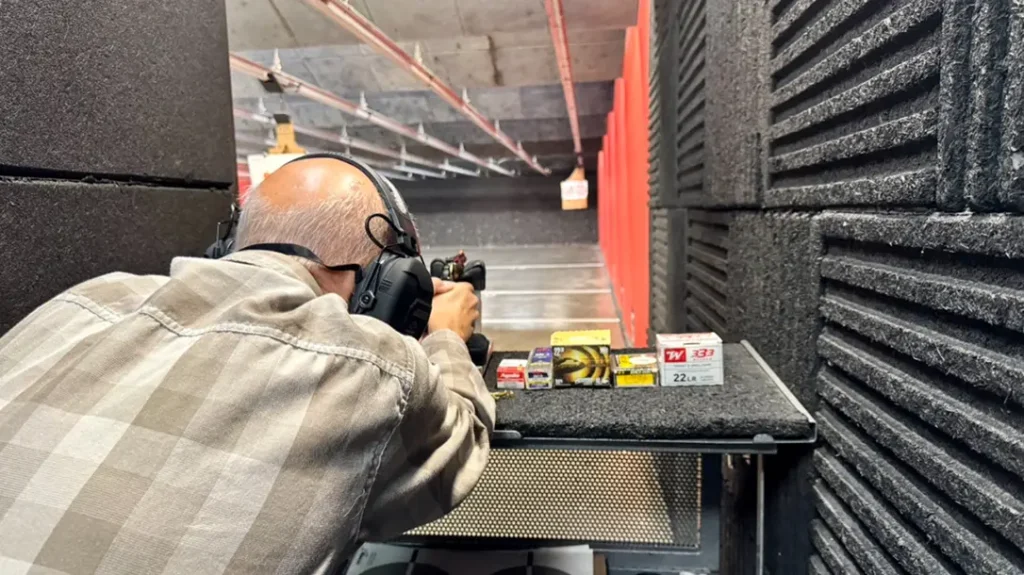
You can see the bullet velocity data in the performance table (below). I held a center hold on the bullseye target and kept all five shots within the 9 and 10 rings. The Winchester loads with their lighter HP bullets landed in the 7 and 8 rings from 7 to 8 o’clock. I did not change the rear sight setting.
Testing the Wheelgun’s Accuracy
Next, I performed an accuracy potential evaluation. A double bullseye target with grey outer rings and a red aiming circle was sent to the 15-yard line. Three 5-shot groups were fired SA, from the bench, with each of the .22 LR test cartridges. Here, things got interesting, as .22 rimfire guns are known to be finicky about ammunition.
The Pathfinder II seemed to prefer the low-cost Aguila cartridges, producing a best-group of 1.41 inches. Second place went to the CCI Mini Mags with a 1.57-inch cluster. I only got one actual 5-shot group with the Federal Hammer Down loads.
The other two targets had bullet impacts and “keyholes” scattered about the target paper. These couldn’t be realistically measured, so this load has no group average. I also had a few keyholes with the Remington and Winchester cartridges, but was able to get measurable groups.
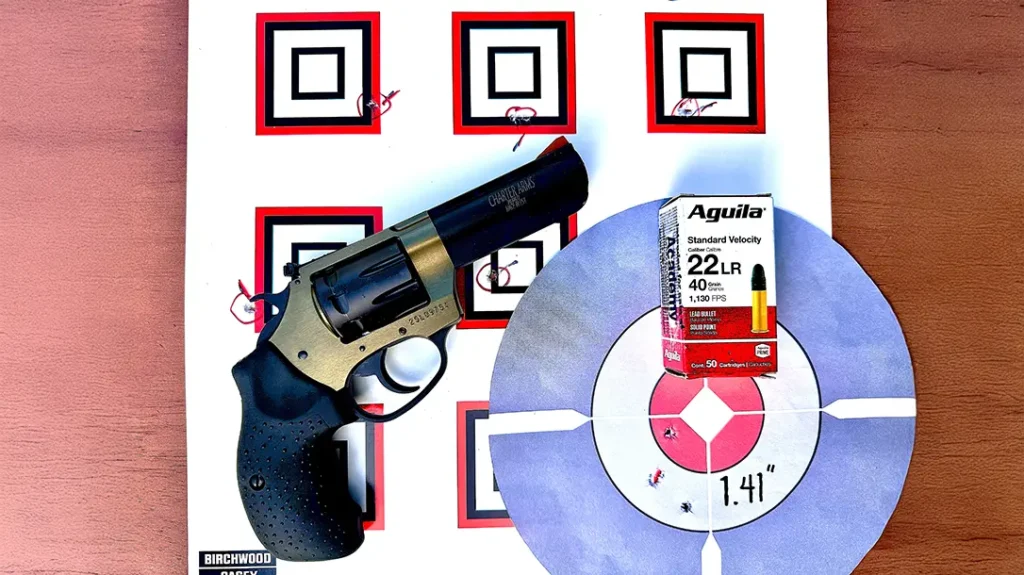
For DA shooting, I sent RIDID Precision Square targets down to the 7-yard line. Each target has nine 2.25” x 2.25” squares that have red and black “rings.” I loaded the Pathfinder II with eight .22LR cartridges and engaged the targets from a standing position, using a two-handed, isosceles hold.
I sighted and fired one shot at each target, left to right, top to bottom, as quickly as I could. Target #9 was not used. This was repeated with each of the five test cartridges. This is where the 14–15-pound DA trigger pull had its effect.
The winner of this exercise was the Aguila cartridges again. I managed to hit five of the eight squares. I got four hits with the Remington Ranch Hand, three each with the Federal and Winchester, but then the CCI bullets decided to keyhole, and I scored only one hit.
On the Trail
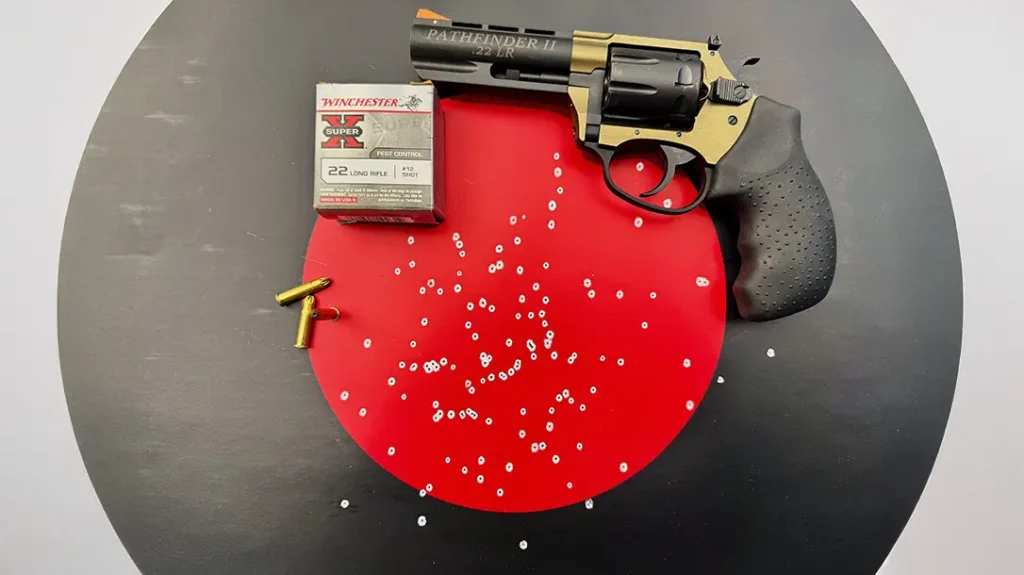
I envision the Pathfinder II as a trail or tacklebox companion. So, I wanted to see how a .22 RF shot cartridge would perform at snake-strike distance. In my neck of the woods, you need to keep an eye peeled when bank-fishing or hiking for copperheads and water moccasins, or maybe a timber rattler.
I sent a large red-and-black Dirty Bird target out about 6-7 feet and shot it DA, using a center hold. The Winchester Super-X .22 LR shell with its charge of #12 shot did a fine job. It delivered good pellet dispersal inside the red center circle, and just 6 impacts low, in the black outer circle. This would be good medicine for a pesky snake.
Where Does the Pathfinder II Fit?
I believe you can gather from the foregoing narration that the Charter Arms Pathfinder II is not the gun to take to Camp Perry. I think it is most useful as a fun gun or for the woods and water, as I’ve already mentioned.
If you confine most of your shooting to the SA mode and use the ammunition the gun likes, you can have hours of fun plinking and improving your revolver-handling skills. The DA pull is daunting, but it may lighten up a bit with use.
I hope Charter can do a better job with those grips. In the “prawl” area of the backstrap, they could abrade the web of the hand with stouter loads over a long shooting session. It did run without any malfunctions during the T&E, and the ejector rod easily knocked out spent cases. For the price, I think it’s a pretty good deal.
If you have any experience with the Pathfinder II, please share your opinion of it at Rotten Gun Reviews.
Charter Arms Pathfinder II Specs
| Mechanism | Traditional DA/SA revolver |
| Caliber | .22 LR |
| Capacity | 8 cartridges |
| Barrel | 3.5 inches |
| Overall Length | 7.45 inches |
| Empty Weight | 20 ounces |
| Sights | Fully adj. rear sight, serrated aluminum anodized ramp front sight |
| Finish | Frame OD green anodized, barrel and cylinder Black Passivate |
| Stocks | Compact black rubber |
| MSRP | $510.61 |
Performance
| Aguila Standard Velocity 40gr. RN | |
| Average Velocity | 857 FPS |
| Best Group | 1.41 inches |
| Average Group | 2.05 inches |
| CCI Mini Mag Varmint 40gr. Segmented HP | |
| Average Velocity | 952 FPS |
| Best Group | 1.57 inches |
| Average Group | 2.37 inches |
| Federal Hammer Down 40gr. HP | |
| Average Velocity | 845 FPS |
| Best Group | 1.77 inches |
| Average Group | None* |
| Remington Ranch Hand 40gr. RN | |
| Average Velocity | 883 FPS |
| Best Group | 2.22 inches |
| Average Group | 2.43 inches |
| Winchester 333 Target & Game 36gr. HP | |
| Average Velocity | 947 FPS |
| Best Group | 1.87 inches |
| Average Group | 2.11 inches |
NOTE: Bullet weight measured in grains, velocity in feet per second, 15” from the muzzle by a Garmin Xero C1 Pro chronograph, and accuracy in inches for three 5-shot groups at 15 yards. * See narrative
WHY OUR ARTICLES/REVIEWS DO NOT HAVE AFFILIATE LINKS
Affiliate links create a financial incentive for writers to promote certain products, which can lead to biased recommendations. This blurs the line between genuine advice and marketing, reducing trust in the content.