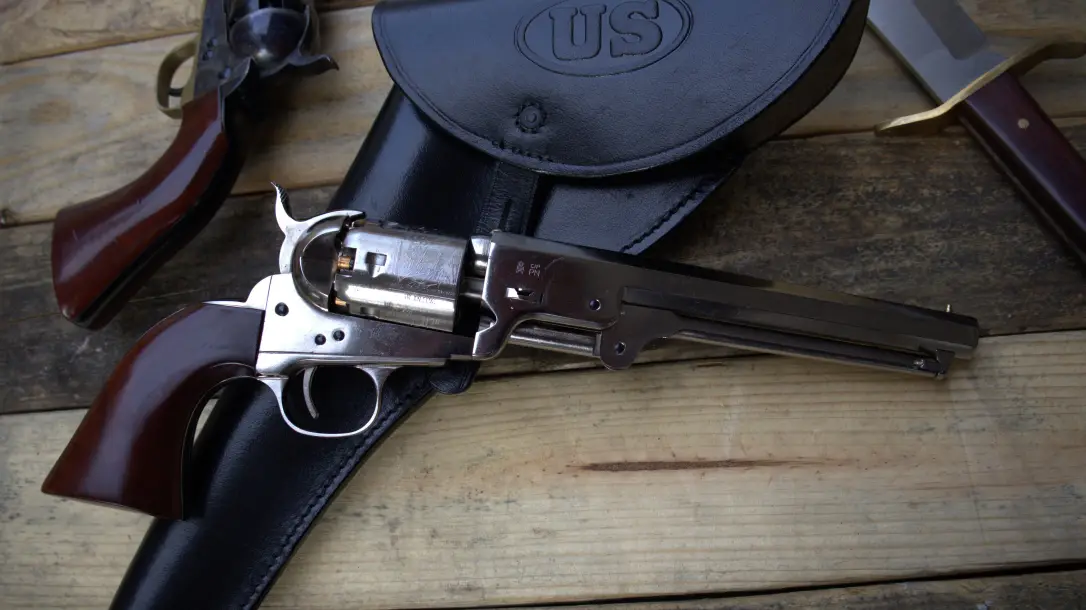
The Colt 1851 Navy revolver made its debut when the single-shot muzzleloader was still the most familiar firearm on the market. This mid-sized six-shooter was large enough for fighting but compact enough for carry. This made it a good balance for both civilian and military markets. Its success and that of its successor model, the Colt Peacemaker, sealed the Navy Colt as, perhaps, the first fighting pistol as we would know it. That legacy has been reflected in the Western and generations of replicas that fill the hands of actors and shooters alike. One of the flashier but substantive takes on the model is Cimarron’s nickel-plated Colt Navy.
Cimarron’s Colt 1851 Navy – A New Take
Cimarron Firearms of Fredericksburg, Texas, has long partnered with Uberti of Italy to produce versions of the 1851 and 1861 Navy models. An all-blued model with a color-case-hardened frame and loading lever is standard fare. But Cimarron also offers a nickel-plated model. Nickel plating is the original corrosion-resistant finish. In the 19th century, it was a smart option to protect a pistol from moist weather and black powder fouling.
Advertisement — Continue Reading Below
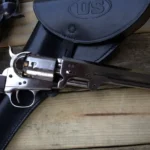
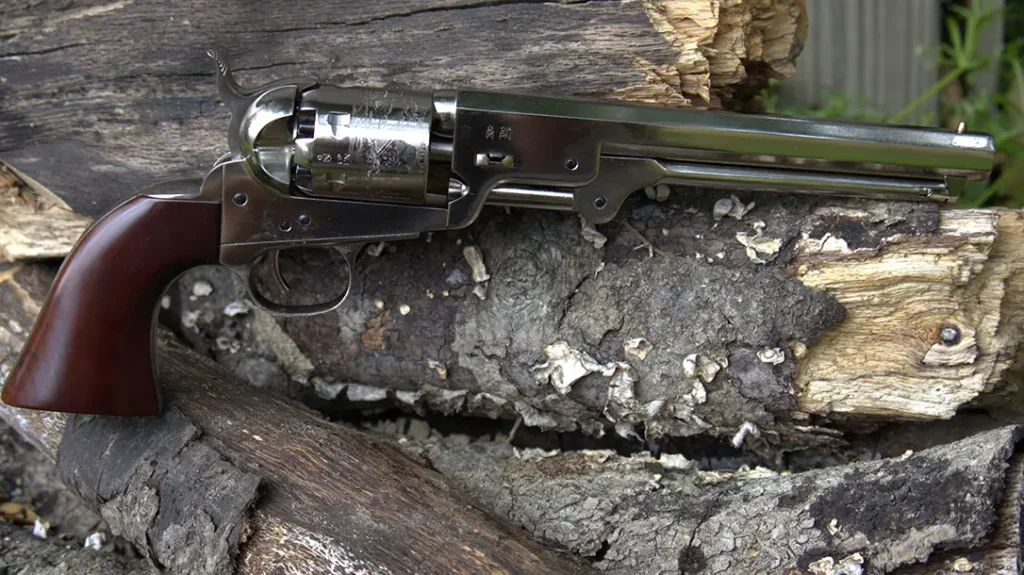
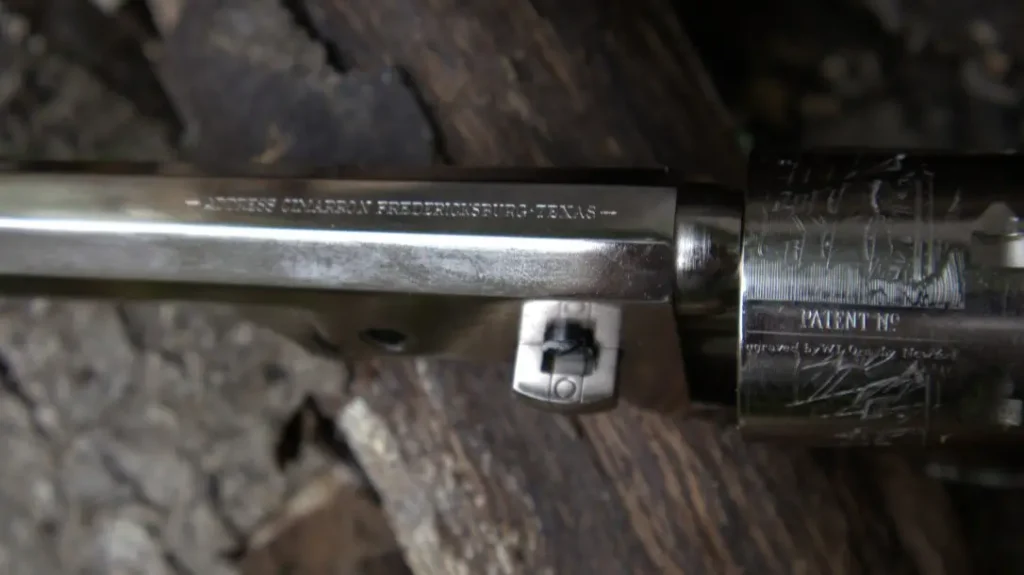
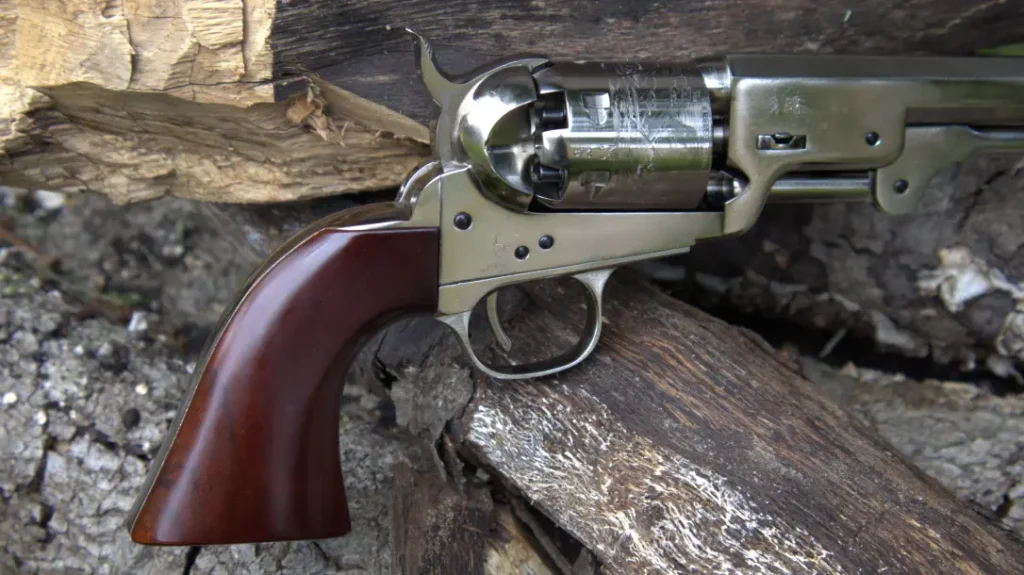
The nickel plating on Cimarron’s Navy pistol is the most distinct and distracting feature. It is both highly reflective and smooth. The plating covers the barrel, cylinder, loading lever, grip frame, and major action parts, such as the hammer and trigger. To further set off the pistol, this version features a pair of handsome oiled walnut grips. This is in lieu of the usual red varnish found on other Uberti-produced handguns.
Six-Shot .36 Caliber
Aside from these improvements, the nickel-plated Navy is like any other from Cimarron. It is a six-shot .36 caliber revolver, an all-steel handgun made for belt carry. It features a 7 ½ inch octagonal barrel and a laser-engraved cylinder. The engraving is a depiction of the Battle of Campeche on the cylinder, hence the Navy designation. There are no safeties except for six safety pins to allow the user to rest the hammer between chambers for carry.
Advertisement — Continue Reading Below
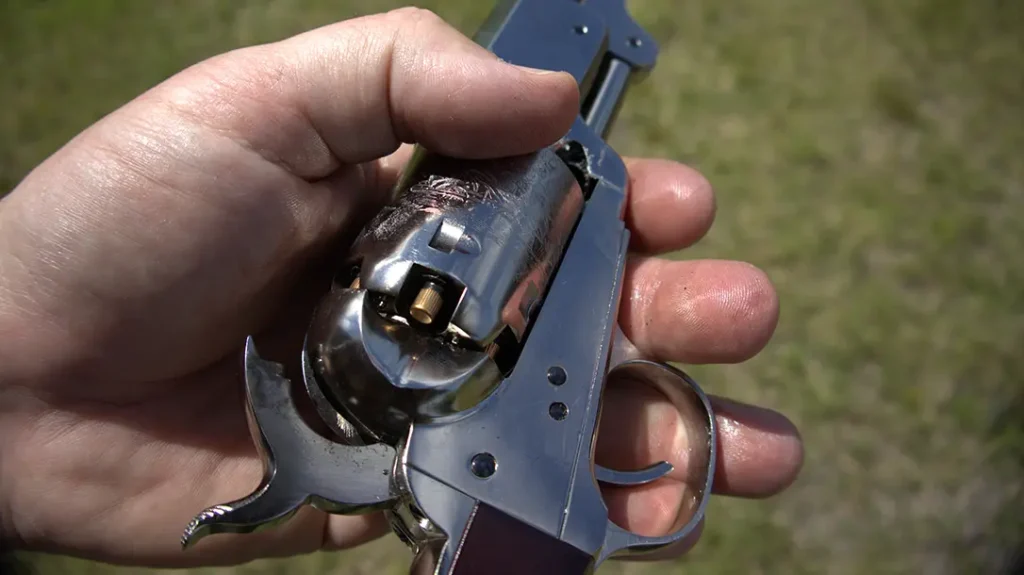
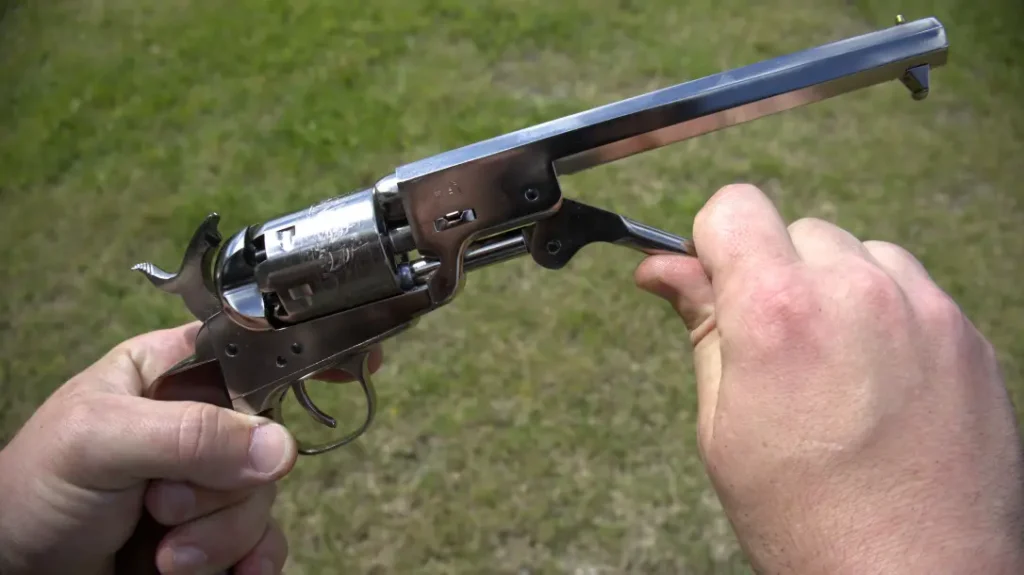
In terms of sights, the Cimarron Navy is no different from any other Colt. The front sight is an immovable brass bead that is paired with a v-notch ground into the face of the hammer. The revolver is a muzzleloader and uses an old-style hinged loading lever housed under the barrel for loading. The recoil shield is relieved for priming the handgun with No. 10 percussion caps. The Colt Navy is an open-top design that has a large arbor pin with grease grooves to retain the cylinder to the frame. The barrel is secured with a captive wedge that can be driven out for cleaning.

Range Time with the Cimarron’s Nickel-Plated Navy Pistol
The Colt Navy and I go way back. In fact, the first handgun I owned was an inauthentic brass-framed .44 caliber Navy model. Later, I had my hands full with authentic .36 caliber blued models from both Uberti and Pietta. The Cimarron Nickel Plated Navy has the same mechanical features. It also has the same legendary balance and grip that went into the Single Action Army .45, but in terms of workmanship, this version is the nicest I have put my soot-covered hands on. In no time, I loaded up my powder, cast some bullets, and headed to the range to give it a test run to see if that extra shine is a benefit.
Advertisement — Continue Reading Below
Loading Procedure and Accuracy Test
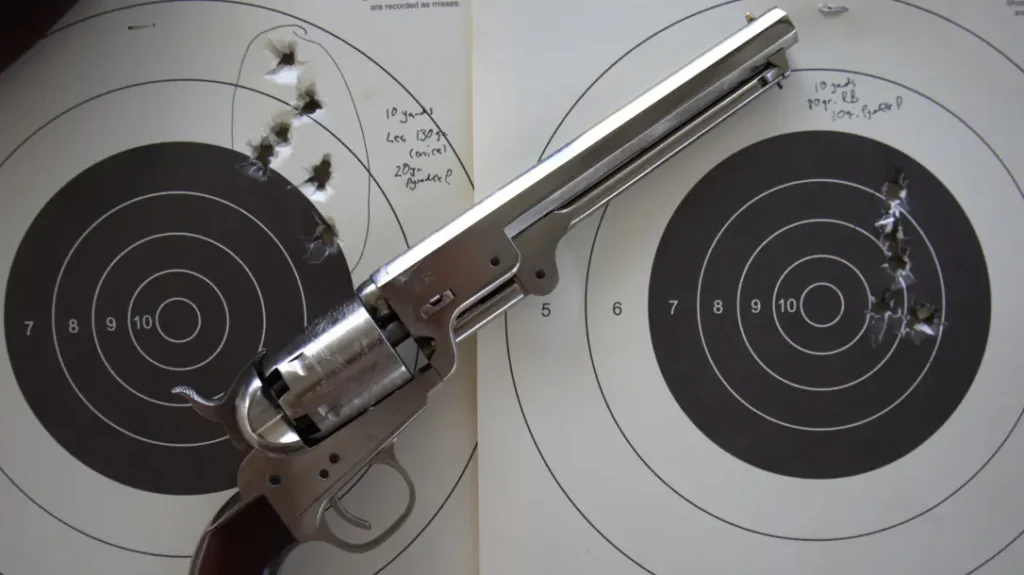
I took my first shots with the Cimmaron Nickel Plated Navy by putting it on paper at ten yards offhand. This was done to get a feel for where the fixed sights would hit with different loads before stretching the distance. It also gives me the feel for the loading procedure. Loading is the same as with any other black powder revolver, but varies in ease from platform to platform.
The Colt Navy debuted as a cap and ball revolver that required loading from the front of the cylinder and priming from the back. It is loaded by drawing the hammer back to half-cock to free the cylinder to spin. From there, a premeasured charge of powder is dropped into a chamber. A bullet is then put on top and pressed home with the loading lever. The process is repeated until all the chambers are loaded. With the cylinder still free spinning, No. 10 percussion caps are pushed onto each nipple at the back of the cylinder face. From there, the pistol can be cocked and fired. Otherwise, the hammer can be dropped on an empty chamber or on one of the safety slots between chambers for carry.
Advertisement — Continue Reading Below
Ammunition
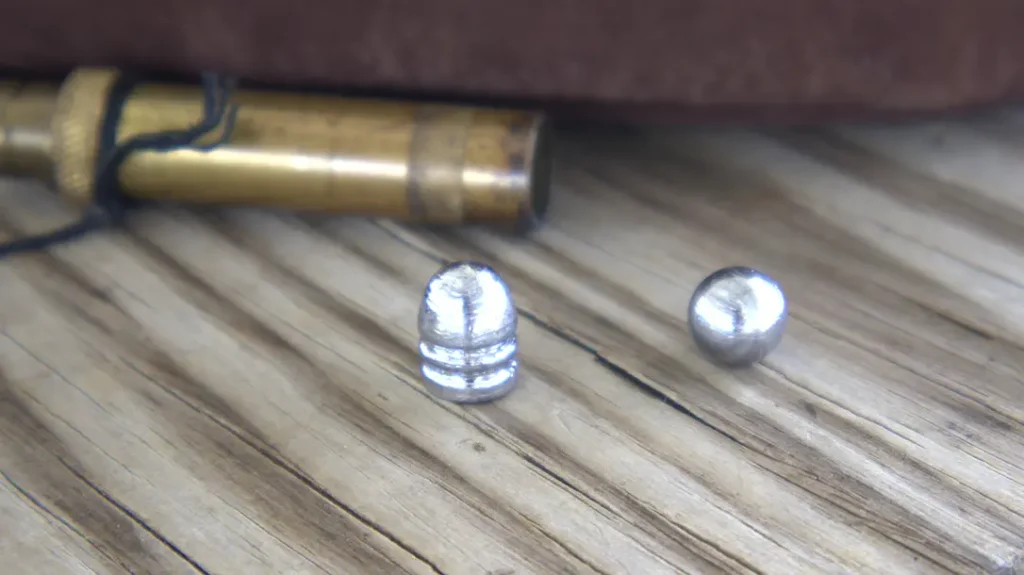
The ammunition I shot with the Navy included Lee 130-grain conical bullets and .380-inch diameter 84-grain round balls. During the Civil War, combustible paper cartridges were used to speed the loading process. But loading was done with loose components here. The balls are easy to drop and seat. The longer conical bullets require starting in the chamber mouths before rotating under the loading lever. I like to use Schuetzen FFFg, but I also brought along a flask of Pyrodex P black powder substitute to burn up. I stuck with my pet 20-grain load of each with the Navy pistol.
My first shots at ten yards favored right, as I was putting too much finger on the trigger. But the round balls were printed into a respectable 2-inch pattern. Without fail, the conical bullets shot three inches high and yielded groups ranging from 3-4 inches. These revolvers have tall rear sights that generally hit dead on at 75 yards. At closer distances, it is not uncommon for these guns to shoot six inches high or more. This one is quite a bit closer with either load. Recoil with either load is moderate, but more pronounced in the hand with the heavier conical load.
Advertisement — Continue Reading Below
Ringing Steel
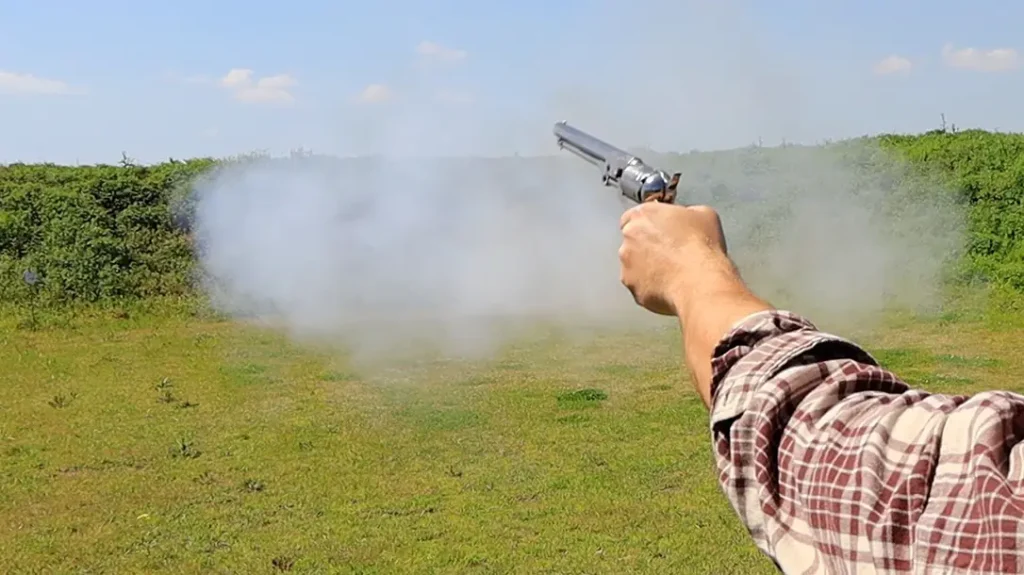
While I have yet to run the Navy in my local SASS match, I gave it plenty to work with at my steel range. The distances ranged out to fifty yards on ½ sized D28 silhouettes to closer eight-inch swinging round plates. I primarily shot round ball ammunition due to both ease of loading and its hitting to the point of aim.
The Cimarron Colt Navy and its long 7 ½ inch barrel will draw ungainly when carried in the conventional way. I wore the Navy butt-first and employed the cavalry twist draw. This technique clears leather quickly, and the balance of the Navy drops the front sight on target like pointing a finger.
Advertisement — Continue Reading Below
The Navy gunfighter grip is not as long as an Army grip, but it is easy to get a full firing grip with larger hands. The pistol is just big enough not to feel cramped, and the narrow-faced trigger breaks at 3 ½ lbs. Ergonomically, the only issue for a modern shooter will be the sights. They are small and fine, and you don’t get a rear sight until the hammer is cocked. But the balance of the Navy saves it, and the eye readily finds the sights. The nickel plating can pick up sun glare and affect shooting, but it proved not to be the case in the sweltering spring days on which I tested the Navy.
From the Draw
It took a little bit of time to draw and shoot with one paw on those small eight-inch plates out to fifteen yards. It took a moment to find my sight picture. But as the distances increased and the target became larger, it was easy to take a center-mass hold and get corresponding hits.
With my final rounds, I put an FBI Q target out at seventy-five yards to see if I could replicate the famous Hickok-Tutt shot. Wild Bill Hickok famously used his Navy Colt to fell Davis Tutt in 1865 with a single heart shot at that distance. I switched back to my conical bullet loading and managed three out of six in the preferred area of the target. Not bad for a thoroughly average shooter.
The Cimarron Colt Navy: Worth the Shine?
I have lost track of the number of Colt Navy variants I have handled over the years. The Cimarron Nickel Plated Navy had close to a perfect run and is, perhaps, the most forgiving black powder revolver you can buy that still fits the period.
Like with any open-top Colt, the Navy powered through a hundred rounds of black powder fouling. I also did not have a single cap jam or other issue. Some replicas run well right out of the box, while others require some time apart with a stone. My luck with the Navy design holds out. I did have the loading lever’s latch pin back out on me under recoil. It never separated from the lever, and I later found it had not been fully seated. A good wrap with a rubber hammer, and the pin was in place and not moving.
Cimarron’s Colt 1851 Navy
As with any other Navy, the mild shooting .36 caliber is forgiving on the shooter but has plenty of power to have fun with. The pistol’s legendary balance and feel outweigh the vintage sights. But perhaps the best feature of this model is the nickel plating. It not only looks good but serves a functional purpose. It is a barrier between fouling and steel, allowing you more forgiveness against moisture and fouling. The appeal of the Colt Navy is strong, both historically and ergonomically. Adding nickel plating keeps the history and makes it more practical for more environments and more shooters than a standard blued model.
For more information, visit Cimarron Firearms.
WHY OUR ARTICLES/REVIEWS DO NOT HAVE AFFILIATE LINKS
Affiliate links create a financial incentive for writers to promote certain products, which can lead to biased recommendations. This blurs the line between genuine advice and marketing, reducing trust in the content.