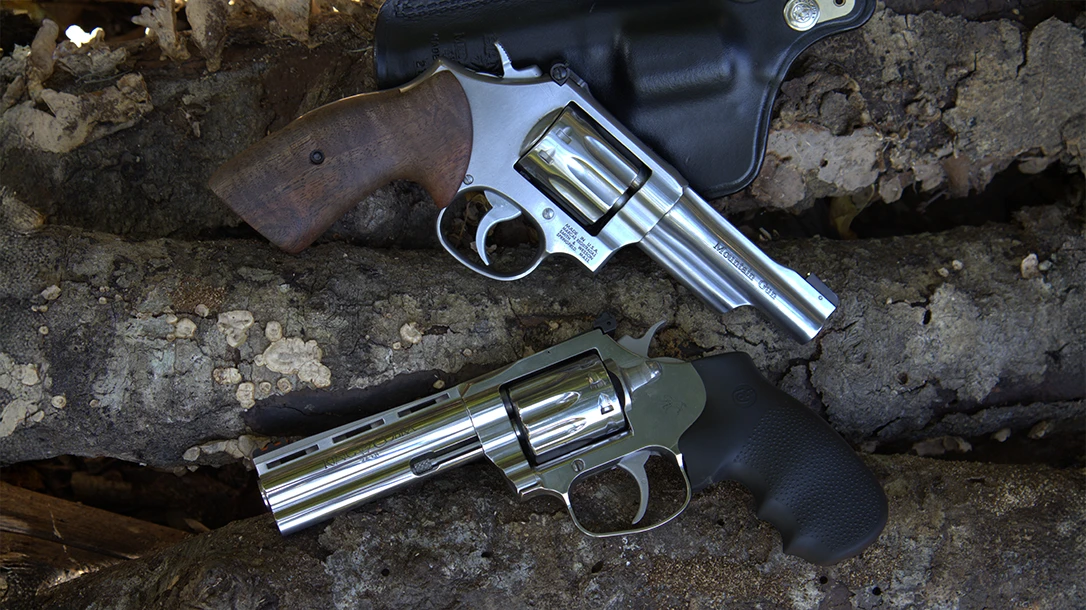
The Smith & Wesson 617 and Colt King Cobra are two familiar names in the revolver world. The 617 is the latest version of Smith’s famous Model 17 or K-22 revolvers in .22 LR that dates all the way back to the late 1940s.
The Colt King Cobra started life as a cost-effective version of the Colt Python in the late 1980s. However, with its relaunch, it is now a smaller-framed handgun. It is offered in .357 Magnum, like its predecessor, but it is also available in .22 LR. Between the two, how do the Smith 617 and Colt King Cobra .22 compare?
The Smith & Wesson 617 and Colt King Cobra Go Head-to-Head
Features and Quirks
The Colt King Cobra .22 and the S&W 617 compete on relatively even terms. Both can be loosely classed as medium-frame revolvers. They are double-action/single-action platforms that can be fired by either pressing the trigger all the way through or thumb cocking the hammer for a lighter trigger press.
Advertisement — Continue Reading Below
Both are stainless steel and feature adjustable target-style sights. Finally, both are made by two iconic revolver makers whose rivalry needs little introduction. But there are appreciable differences in features that affect shootability and usability.
Colt King Cobra
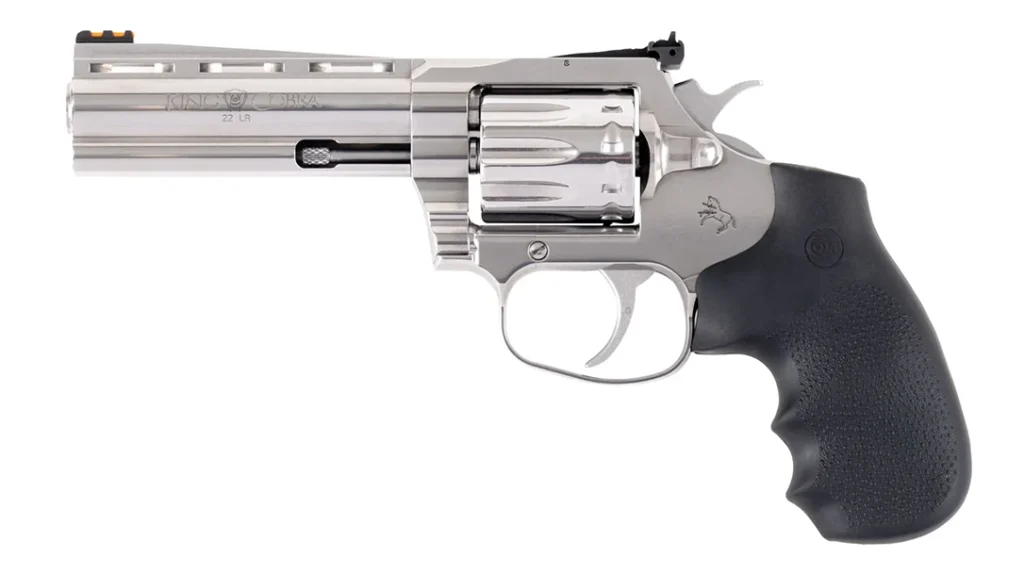
The Colt King Cobra .22 debuted in 2022 with either a 4.25-inch or 6-inch barrel. However, the lineup has since expanded to include both 2-inch- and 3-inch-barreled snub-nosed models.
Advertisement — Continue Reading Below
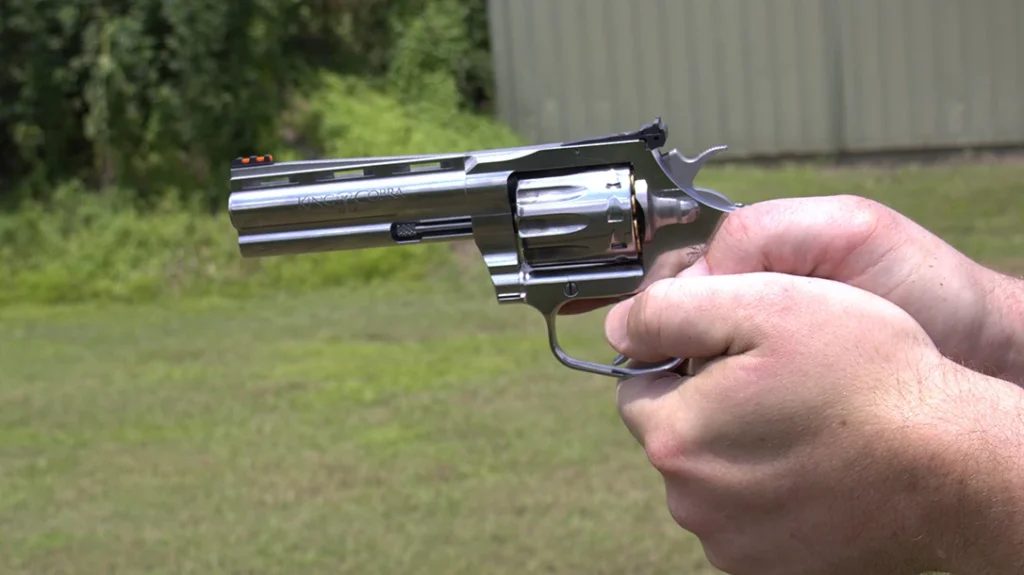
The King Cobra is built on Colt’s small D-frame, albeit with a beefier cylinder top strap, to better handle .357 Magnum ammunition. This same frame carries over to the .22 rimfire model. So does the iconic full-underlug one-piece barrel and vent rib as seen on the old King Cobras and Pythons.
The underlug gives the King Cobra better balance while protecting the ejector rod. The classic Colt clamshell cylinder release on the left side is used. Instead of getting six shots of .357 Magnum, the capacity is now upped to ten rounds of .22 Long Rifle.
The King Cobra .22’s sights include a pinned red fiber optic front sight and a blacked-out square notch rear sight that is adjustable for windage and elevation.
Advertisement — Continue Reading Below
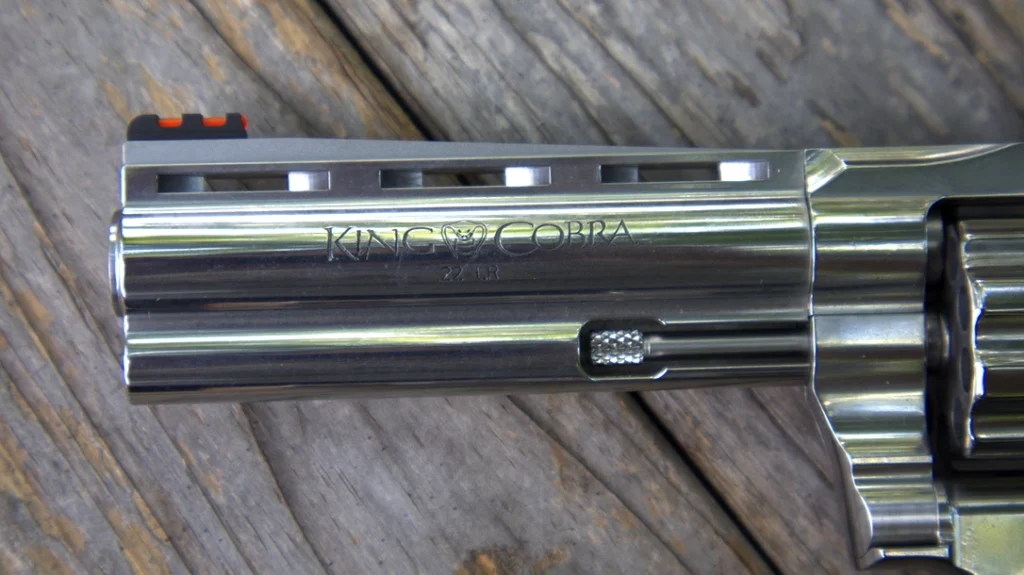
Although ostensively marketed as a target pistol, the King Cobra 22 uses the same narrow, smooth face trigger and low-profile hammer as the .357 models. It also ships from the factory with standard wrap-around rubber grips.
For this comparison, we are using a standard 4.25-inch barreled model.
Advertisement — Continue Reading Below
Quick Specs:
| Caliber | .22 LR |
| Capacity | 10 |
| Barrel Length | 4.25 inches |
| Overall Length | 8.75 inches |
| Height | 5.5 inches |
| Width | 1.75 inches (cylinder) |
| Weight | 2 lbs. 2.8 oz. (loaded) |
Smith & Wesson 617
The Smith & Wesson 617 is built on Smith’s .38 caliber K-frame. Like the King Cobra .22, it holds ten rounds of .22 LR. It also comes with a full underlug barrel with a 4-inch or 6-inch variant to choose from. It lacks a vent rib, but the sighting plane is milled to knock down sun glare.
Advertisement — Continue Reading Below
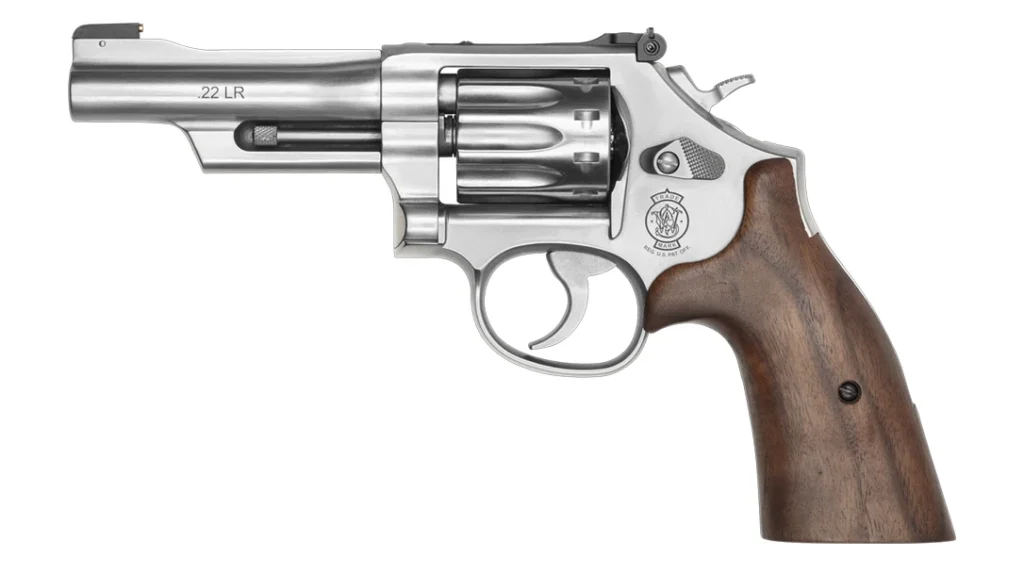
The standard 617 ships with rubber grips not dissimilar to the King Cobra. Likewise, the sights consist of a blacked-out square-notch rear sight, similarly adjustable for windage and elevation. Correspondingly, the front sight is a serrated blade. The 617 uses Smith & Wesson’s push-forward cylinder release latch, and most models come with a keylock safety.
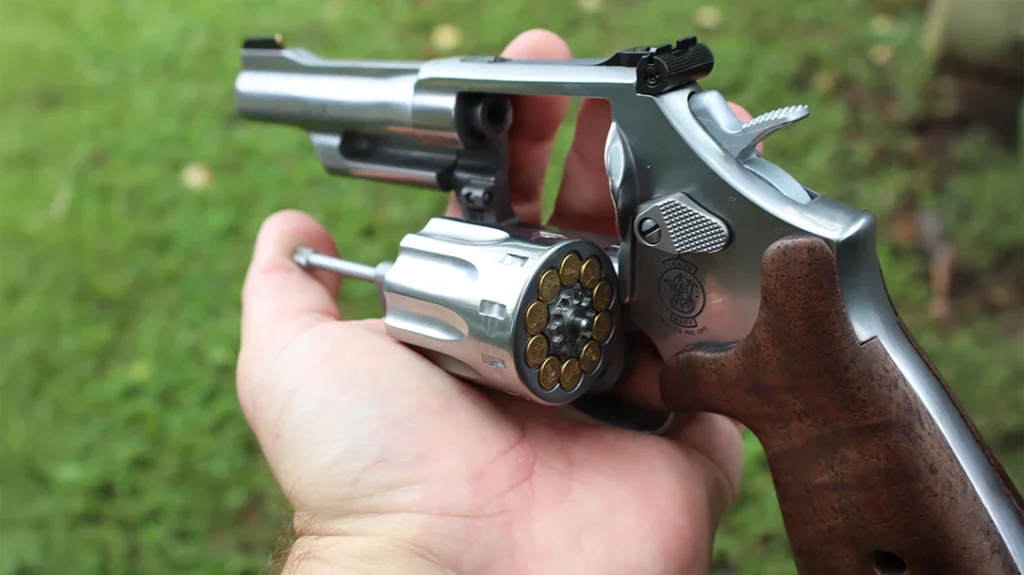
The model for our consideration is a Lipsey’s exclusive Model 617 Mountain Gun. It uses a 4.1-inch tapered half-lug barrel and a gold-beaded pinned front sight. The Lipsey’s gun wears a pair of handsome Bear Hug walnut grips from Tyler Gun Works and dispenses with the keylock safety. An enlarged target hammer and trigger are an added bonus.
Advertisement — Continue Reading Below
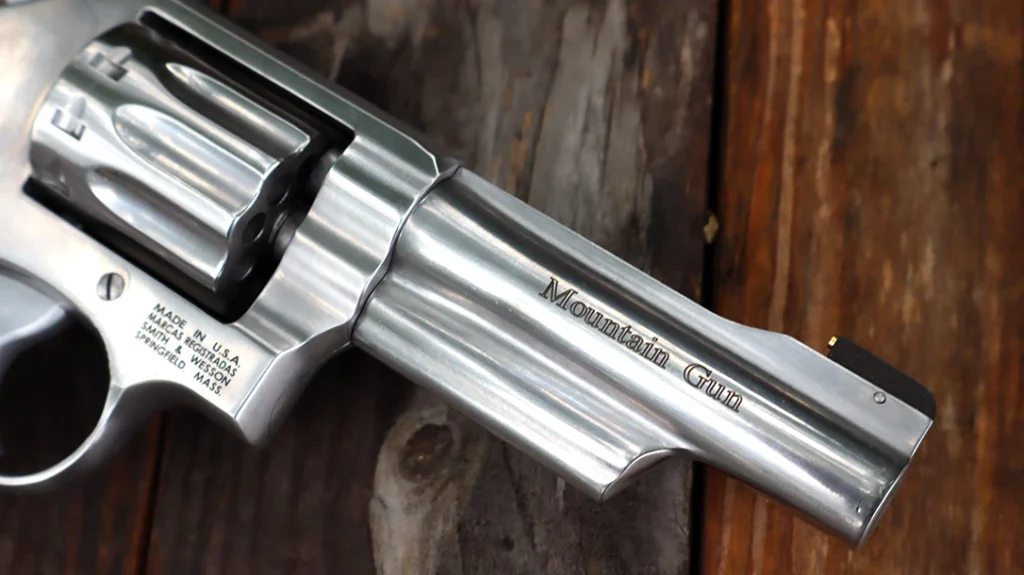
Quick Specs:
| Caliber | .22 LR |
| Capacity | 10 |
| Barrel Length | 4.1 inches |
| Overall Length | 9.1 inches |
| Height | 5.5 inches |
| Width | 1.75 inches (cylinder) |
| Weight | 2 lbs. 4.5 oz. (loaded) |
Side by Side
The differences between the S&W 617 and Colt King Cobra go beyond the surface level. Size, mechanics, and build quality vary.
Side by side, the King Cobra is a slightly smaller gun overall, even with its slightly longer 4.25-inch barrel. The cylinder frame from the crane to the backstrap is ½ inch shorter overall. This makes the King Cobra more compact overall.
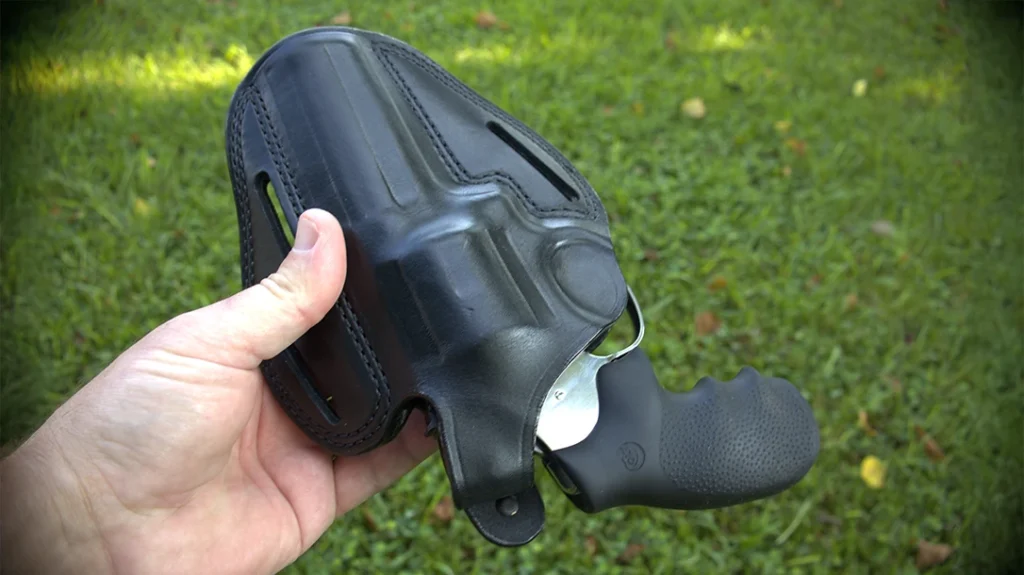
Interestingly, this difference is not enough for the new King Cobra to fit some K-frame holsters. The Bianchi Shadow II I fielded with both gave just a touch of up-and-down play with the King Cobra, but otherwise held it securely.
In terms of construction, both use industry 17-4 stainless steel in their frame, cylinder, and barrel construction. Internally, the lion’s share of the 617’s parts are MIM pieces. The Colt has MIM parts, such as its stirrup link between the hammer spring and hammer. However, the trigger and hammer are completely machined units.
On the face of it, the King Cobra is the more compact and better-built of the two handguns. Although the 617 seemed best suited for target work. But how does that square on the firing line?
Comparing Operation
As with all modern Smith & Wesson revolvers, the cylinder of the 617 rotates counterclockwise. Additionally, lockup is achieved by the cylinder stop before the trigger is pulled. The stop, in conjunction with the rear of the ejector rod and a ball détente in the crane, locks the revolver up completely when the cylinder is closed. A hammer block safety helps to prevent accidental discharge.
The King Cobra operates differently but effectively. Its cylinder turns clockwise, and the hand, with the final movement of the trigger, ensures a tight lockup in conjunction with the cylinder stop. The King Cobra uses a transfer-bar safety rather than a hammer block to accomplish the same goal.
The key mechanical difference is the lack of lockup at the front of the cylinder, where the ball détente accomplishes that goal for the 617. But for .22 rimfire pressures, both handguns are overbuilt.
Shooting Impressions
I began my testing with a bias toward Smith & Wesson revolvers, but with a growing awareness that the Colt guns are back and apparently better than ever. Since then, I have put several hundred rounds between the Colt King Cobra 22 and the S&W 617 Mountain Gun. I came away in favor of the Colt if I were forced to pick one.
Loading and Unloading
Both revolvers are fairly simple to load, and there are a few different speed loading options available. I simply fed loose ammunition in my testing.
The Colt opens up by pulling back on the cylinder latch and swinging the cylinder out for loading. Hitting the ejector rod knocks out the empty cases after firing.
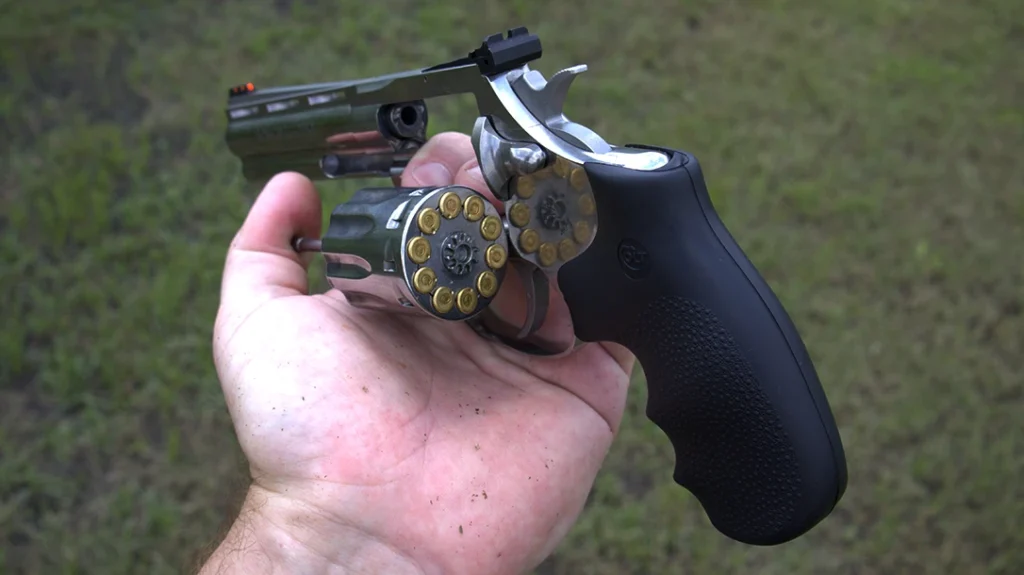
The Smith operates similarly, except the cylinder release is pushed forward with the thumb. The thumb-release is more intuitive to use with a firing grip still on the revolver. However, the 617’s ball detent at the crane makes the cylinder stickier to pull out and replace. There is no resistance with the Colt.
Accuracy
I started out by getting on top of the sights and benching both revolvers for accuracy. .22 handguns are something of an odd animal in the handgun world. For little rhyme or reason, some handguns will simply shoot some ammunition better than others and be more reliable with some over others.
The red fiber-optic front sight of the King Cobra is somewhat easier to see in both bright and low-light conditions than the gold-beaded front sight. However, it tended to cover more of my target over the gold-beaded post of the 617 Mountain Gun.
For the 617’s part, I could readily turn in 4-inch groups firing single-action from the bench at 25 yards. This ranged from my pet load, CCI Blazer 40 grain RNL ammunition, to Winchester 36 grain HPs, Remington Viper 33 grain solids, and CCI 36 grain Mini Mags.
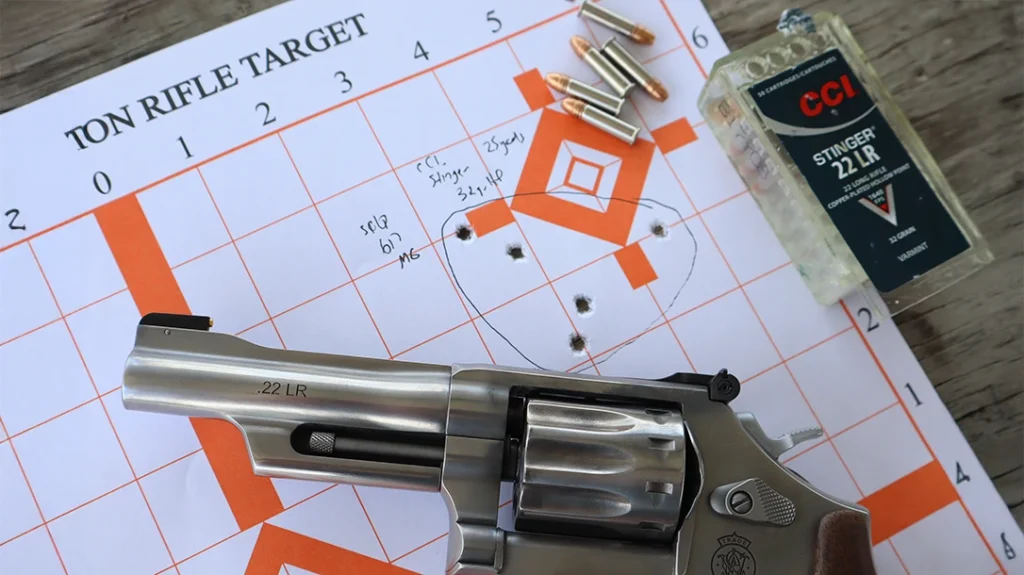
The round known least for handgun accuracy, CCI 32 grain Stingers, was well-loved by the 617. I could get five rounds inside of two inches at 25 yards.
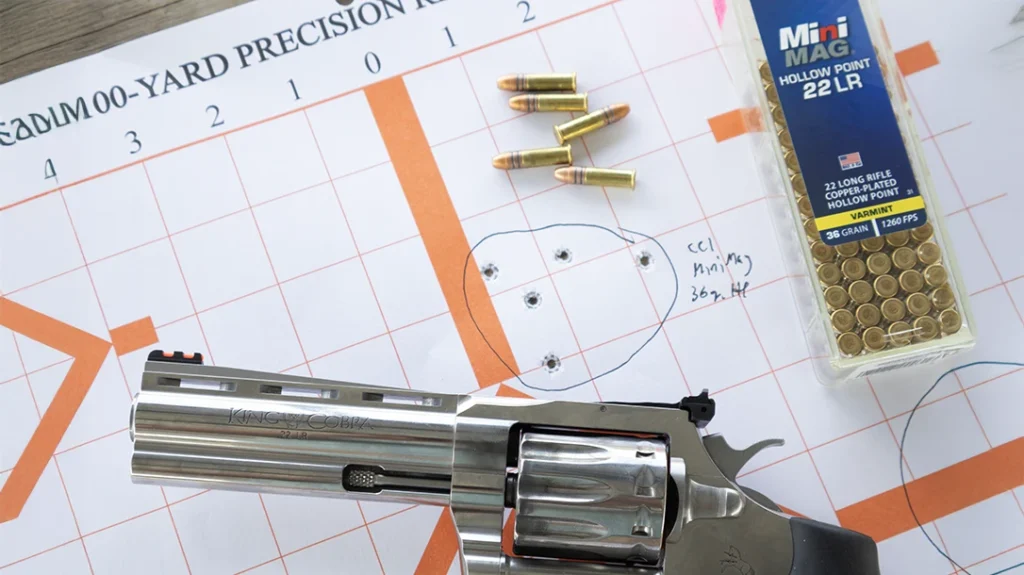
The Colt King Cobra consistently printed groups of 3 ½ inches with these ammunitions, as well as Federal Target and Federal HV Match 40 grain lead loads. The best of the bunch was the CCI Mini Mag 36gr hollow point load. It turns in groups just shy of two inches.
In spite of the sight setup, I found the King Cobra to be a little more accurate.
Reliability (And What It Costs)
With rimfire revolvers, the hammer needs to be well powered to hit the rim of the case reliably to fire the round. This is normally accomplished with heavier springs than seen on centerfire revolvers. This, mixed with good ammunition, is key to getting the revolver to go bang when you need it to.
The Smith & Wesson’s hammer spring is certainly stout, but the trigger has a manageable double-action pull weight of 9 ½ lbs. However, the single-action pull weight is only 3 lbs. 11 oz.
Typical of Smith’s triggers, the single action is crisp with no mush, and the double-action stacks heavy before suddenly lightening before the final break. I am much more accustomed to this, so I was taken aback by the King Cobra.
The triggers on Colt revolvers are known for their smoothness but tend to stack heaviest as they break. Some like it, some don’t, but the lockup on new Colts sacrifices an ultra-light single-action for a light double-action.
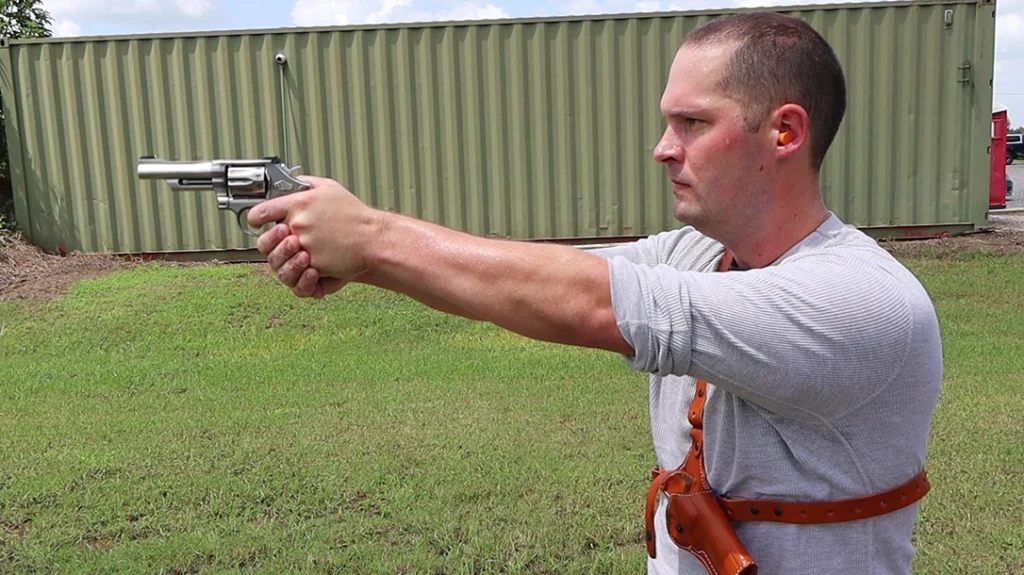
This King Cobra has a shorter trigger press than the 617 and stacks like a typical Colt. But I was surprised to pull the King Cobra’s trigger weight in double action at only 6 lbs. The single action measured 4 lbs. 4 oz. As an added measure, I pulled the weights on a 2-inch King Cobra in inventory and got similar results.
On the range, you can feel the difference between the triggers. However, what is surprising is the lighter pull did not seem to cost in reliability. Of two hundred rounds, I had no failures to fire and no dud rounds.
The Smith & Wesson ate a similar amount of ammunition. But I had to deal with several failures to fire caused by light strikes.
And the Winner Is…
The Colt and Smith & Wesson rivalry goes back to the very first cartridge revolver in Smith & Wesson’s No. 1 back in 1857. Since then, the companies have risen, fallen, and traded shots along the way. However, in the first quarter of this century, Smith & Wesson held steady while Colt has burst back onto the scene in a meaningful way.
If you are in the market for a higher-end, high-quality .22 revolver, you can find satisfaction with either the S&W 617 or the Colt King Cobra. The 617 is particularly compelling as a K-frame gun with plenty of holster and some parts support.
After testing these, this sample size of one reviewer says that the Colt King Cobra is the better of the two. Both in terms of build quality, accuracy, and reliability.