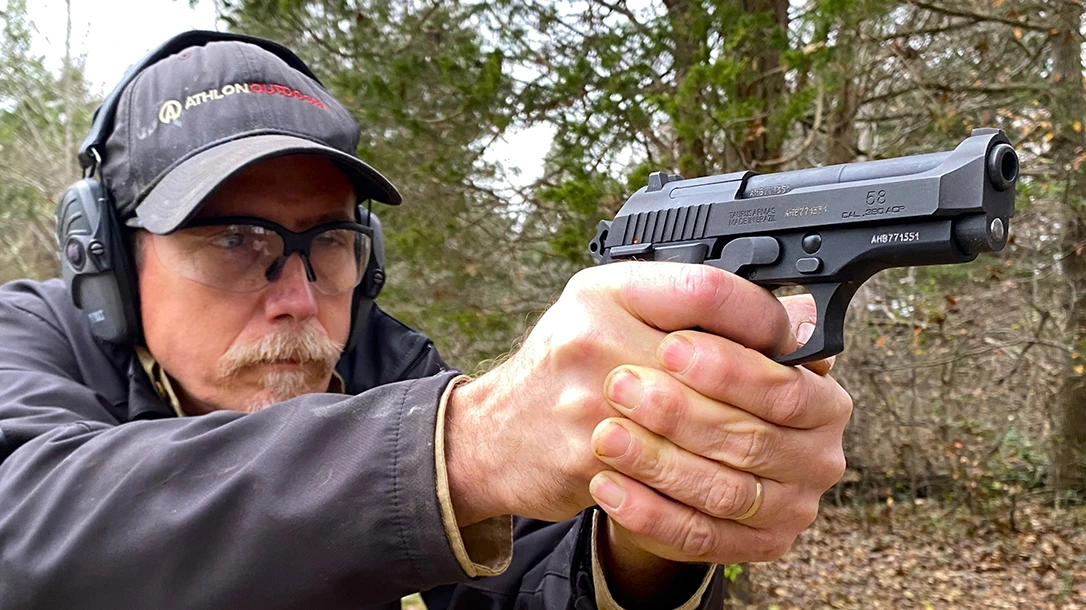
Attention fans of the 9mm Beretta 92FS, its American military brothers the M9 and M9A1, or the many clones produced in Brazil by Taurus since the early 1980s. You may find the 15-shot, .380 ACP, Taurus Model 58 especially interesting. It is yet another variant of this family of excellent pistols.
The Taurus Model 58
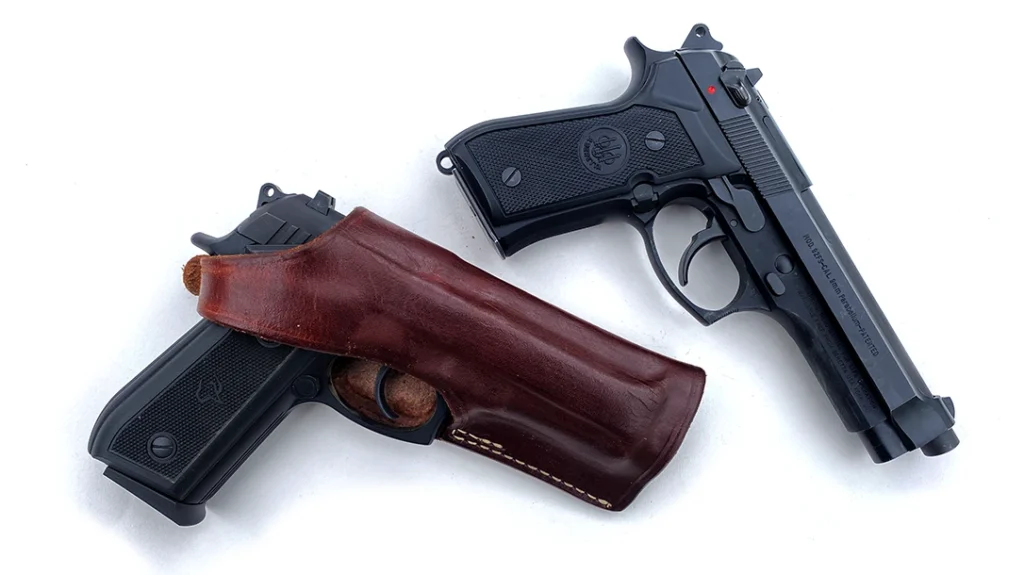
If you love the full-size 9mm frame, the Model 58 will feel natural for you. It even fits the same holsters as the full-length 9mm. It differs from the Taurus 92 series in its lighter caliber, 0.90-inch shorter barrel, and simple blowback operating system rather than the short-recoil delayed locking-block operating system found on the 9mm. In addition, it is also 4 ounces lighter and lacks an accessory rail on the frame’s dust cover.
Its SA/DA trigger with ambidextrous manual safety/decocking lever (on the frame in the Taurus 92/U.S. military M9 style) allows cocked and locked carry with a round in the chamber. Likewise, comes instant readiness with the hammer down over a loaded chamber waiting for a double-action trigger pull.
Advertisement — Continue Reading Below
The magazine and slide lock release are configured for right-hand use. However, it appears the magazine release button can be reversed by tapping out a roll pin in the triggerguard. The frame is aluminum alloy with grasping grooves on the front and back straps, a hooked triggerguaurd, and checkered plastic grip panels.
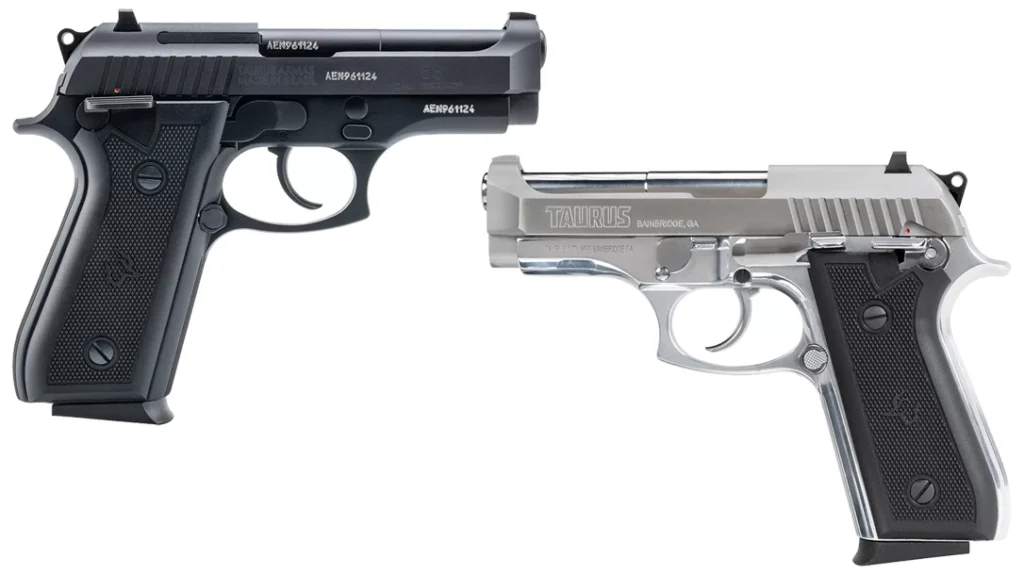
The steel slide has wide grasping grooves at the rear only and is open-topped in the classic Beretta style. This reduces the likelihood of stovepipe jams. The non-illuminated three-dot sights are also rugged steel. The front blade is fixed while the rear sight is drift-adjustable in its dovetail.
Advertisement — Continue Reading Below
When a round is in the chamber, the extractor stands proud of the slide, exposing a thin red line on the top edge. It serves as a tactile and visual loaded chamber indicator.
The pistol comes with two 15-round steel body magazines. Each has a plastic base plate/pinky rest, and 5-, 10-, and 15-round witness holes on the spine. Magazines drop freely from the pistol when the release button is depressed.
The Model 58 In Hand
As the world’s early Wonder-Nines go, the Beretta 92 family was always big boned. The grips on the Model 58 are slightly thicker than the military M9. This makes it even more difficult for all but the longest thumbs to reach the magazine release button without shifting the shooting hand grip. On the upside, fans of the platform will say it isn’t prone to accidental magazine drops.
Advertisement — Continue Reading Below
The 4-inch barrel Model 58 measures 7.2 inches long, 5.59 inches high, and 1.61 inches thick. So, it is clearly not a compact pistol, despite what you may have read elsewhere. If you’ve got big hands, this is a .380 you’ll have no trouble holding onto.
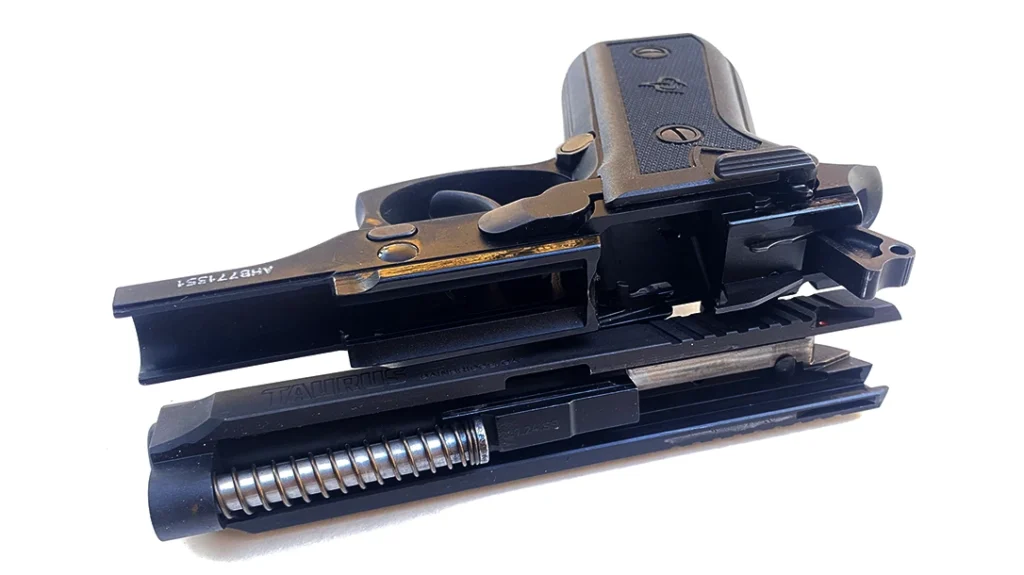
The downside is that this is not a .380 that offers any significant concealment advantage or weight savings over a full-size 9mm pistol. By virtue of the M9 pistol’s long service to the U.S. military, veterans will find the Model 58 (as well as the Taurus 92) comfortably familiar to the handgun they trained with.
Advertisement — Continue Reading Below
My test pistol was finished in a tactical matte black. It’s not a paint. The aluminum is anodized, and the steel is chemically blued. For about $30 more, you can have a Model 58 with a very striking matte finish stainless steel slide and bright polished frame and barrel.
“Muito elegante,” as they would say in Brazil.
Shots Fired
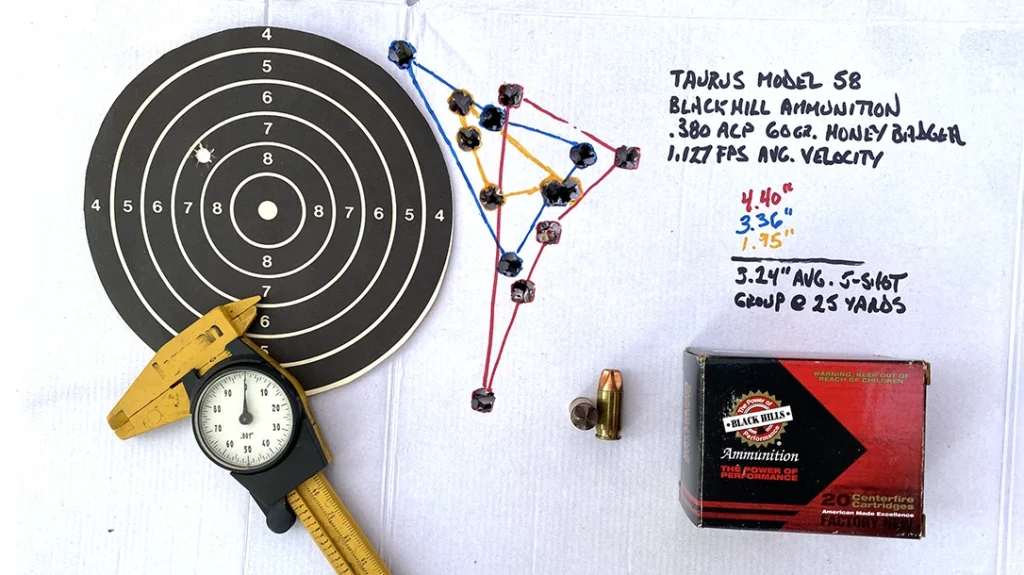
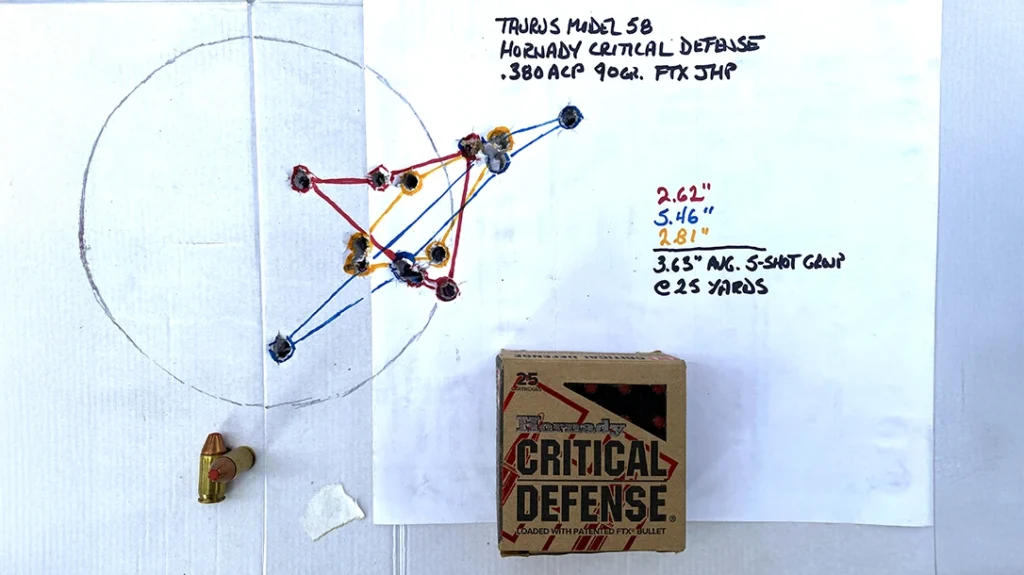
Accuracy testing was done at 25 yards from a bench rest at standard NRA 25-yard bullseye slow-fire pistol targets. Five shot groups were fired in single action mode with measurements taken from center-to-center of the most widely spaced shots. Accuracy was decent with all three self-defense loads tested, all groups averaging within 0.40 inches of each other.
Advertisement — Continue Reading Below
I had no failures to function of any kind, and the controls operated easily and positively under medium thumb pressure. The full-sized grip frame provided all the real estate my average-sized hands could make use of.
Curiously, recoil seemed somewhat heavier than expected for such a large pistol. It felt to me more like a 9mm than a .380 ACP. I’m not entirely sure why the recoil impulse seemed subtly heavier than other smaller and lighter .380 pistols I’ve shot. I suspect it has something to do with the mass of the large slide (9.3 ounces), the higher bore axis, and unlocked blowback action.
Advertisement — Continue Reading Below
Ballistic Testing
The fastest and most accurate load tested was Black Hills Ammunition’s barrier-blind, light-for-caliber 60-grain Honey Badger. The amazing monolithic copper alloy self-defense projectile was developed by Lehigh Defense. It relies on hydraulic displacement rather than expansion to violently disrupt tissue.
Shooting it at pumpkins, I noticed it made as big a hole going in as it did going out. A conventional hollow point only made a big hole going out. This bullet’s peculiar Phillips screwdriver-like nose fed perfectly in the Taurus 58. This load averaged 1,127 feet-per-second (FPS) velocity and groups of 3.24 inches. Remember, this is at 25 yards, not 21 feet!
Next most accurate was Winchester’s classic Silvertip 85-grain jacketed hollow point. It averaged 981 FPS and groups of 3.45 inches.
Hornady Critical Defense 90-grain FTX jacketed hollow points were a close third, averaging 976 FPS and groups of 3.63 inches. This patented elastomer-plugged, star-crimped jacket nose, bullet is the only .380 jacket hollow-point I’ve tested that reliably expanded after penetrating heavy clothing.
It’s not as barrier blind as the Honey Badger. However, it is a good overall performer at the .380 ACP’s marginal velocities.
Carrying the Model 58
As I mentioned, holster options for your full-size Model 92 should work fine with the Model 58, leaving an inch of empty space at the nose.
The leather holster shown here is a TripleK #196 Carrylite, a thumb-break, outside-the-waistband style that fits 2.25-inch-wide belts and holds the pistol securely while still allowing a fast draw. The retention strap just happens to back up the manual safety when it’s in the safe position, too. In a plain walnut-oiled finish, as shown here, this all-American-made holster retails for $67.50.
Well-made, reliable, and accurate, the Model 58 has an MSRP of $648. However, an online survey of current retail pricing shows it sells for around $130 less.
Taurus Model 58 Specs
| Maker | Taurus Armas |
| Action | hammer-fired, simple blowback, semi-automatic |
| Caliber | .380 ACP |
| Capacity | 15-round steel magazine with polymer pinky rest floorplate (2 included) |
| Barrel | 4.00 inches, stainless steel, 1:16 RH twist |
| Length | 7.2 inches |
| Height | 5.59 inches |
| Width | 1.61 inches wide with large grip panels |
| Weight | 29.6 ounces unloaded |
| Sights | steel, three-dot, w/ dovetailed. windage adjustable, rear sight, and fixed front sight |
| Controls | ambidextrous slide-mounted manual safety/de-cocking lever, user-reversible magazine release button, left side slide lock release lever |
| Material | frame-aluminum alloy, slide & barrel-steel |
| Trigger | SA/DA (5.5-6 pound & 11-12 pound pull respectively) |
| Finish | black anodized frame, matte black finish on slide & barrel |
| Grips | black polymer, checkered, Taurus logo grips |
| MSRP | $648 |
Performance
| Hornady Critical Defense .380 ACP | |
| Bullet Weight & Type | 90 FTX JHP |
| Velocity | 976 |
| Best Group | 2.62 |
| Winchester Silvertip .380 ACP | |
| Bullet Weight & Type | 85 Silvertip JHP |
| Velocity | 981 |
| Best Group | 2.46 |
| Black Hills Ammunition .380 ACP | |
| Bullet Weight & Type | 60 Honey Badger |
| Velocity | 1,127 |
| Best Group | 1.95 |
Performance was tested with a series of five-shot groups fired at 25 yards from a bench rest with a Competition Electronics Pro-Chrono Digital Chronograph set 15 feet from the muzzle. Bullet weight is in grains, velocity in feet-per-second, and the group size in inches.
WHY OUR ARTICLES/REVIEWS DO NOT HAVE AFFILIATE LINKS
Affiliate links create a financial incentive for writers to promote certain products, which can lead to biased recommendations. This blurs the line between genuine advice and marketing, reducing trust in the content.