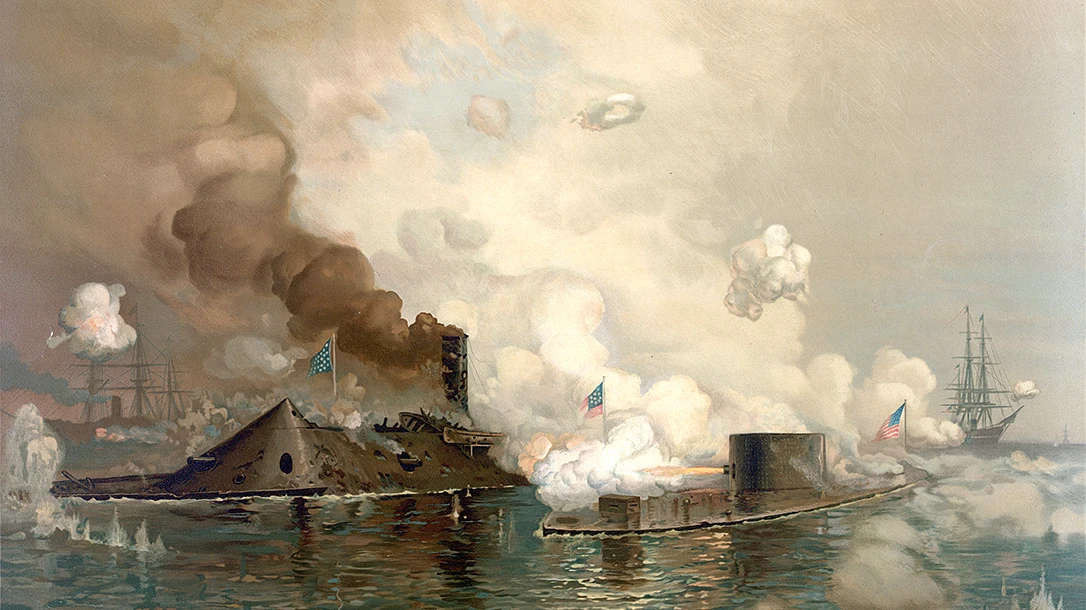
The world remembers the first clash of ironclad warships on March 9, 1862, as the battle between “Monitor and Merrimac.” Technically, their duel was part of the Battle of Hampton Roads and the Merrimac was renamed the CSS Virginia; but in fairness, “Monitor and Merrimac” is appealing to the ear and it was documented at the time that the Confederate ironclad was frequently referred to by her old U.S. Navy name in the press, and even among her own crew.
Monitor And Merrimac Early On
Like a lot of boys in my generation, I became intimately interested in Monitor and Merrimac through a Lindberg plastic model kit they introduced in 1962 on the 100th anniversary of the battle. They were delightful for bathtub combat and the Merrimac even had a little battery powered motor.
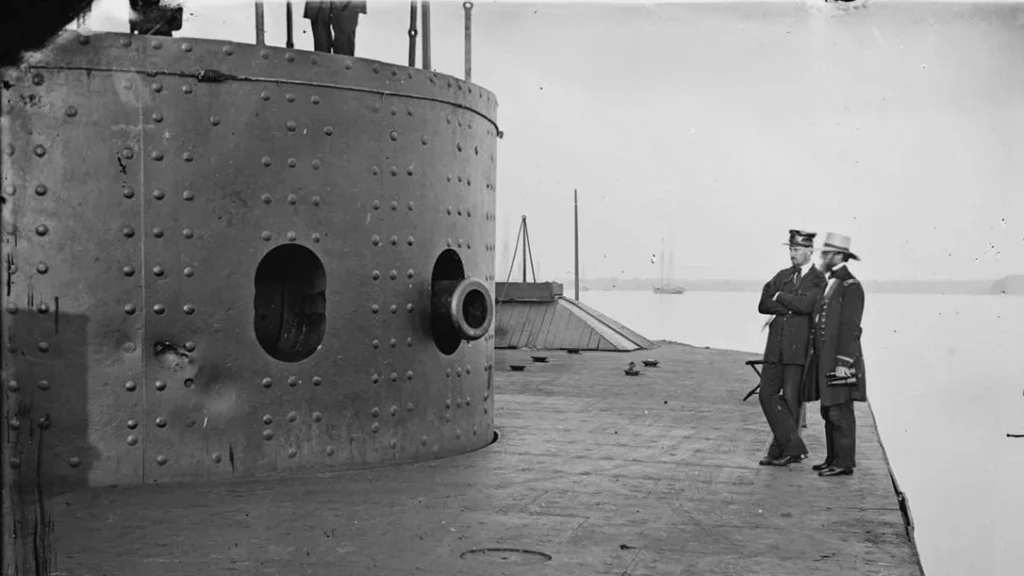
When the wreck of the Monitor was discovered in the early 1970s and documented in National Geographic magazine, I poured over the montaged photos of its collapsing 5/8” thick hull plating and broken ribs through a magnifying glass with profound disappointment. She lay upside down, the rear of her port side resting on her dislodged turret with her starboard side buried. Though only 213 feet down, the vessel that once sailed through more than a score of hits from the Merrimac’s 9-inch smoothbore and 7-inch and 6.4-inch Brooke rifled guns hardly worse for the wear, appeared too delicate from deterioration to be raised from her watery grave.
Advertisement — Continue Reading Below
Monitor Recovery Efforts
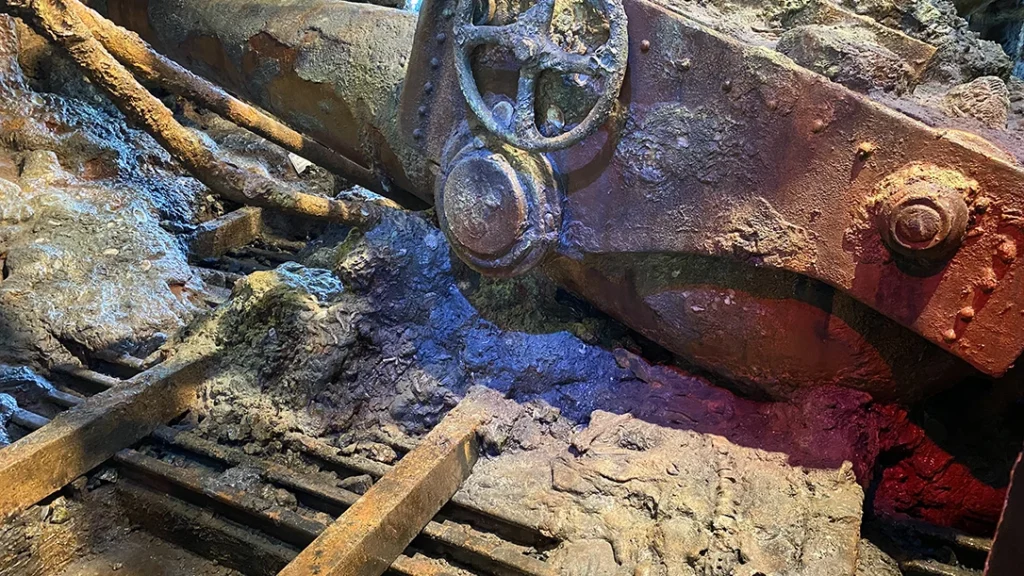
Fortunately, some people love history so much, they can’t take no for an answer. They concluded that if they couldn’t recover the whole Monitor, they should at least recover some of it. To date, over 1,500 artifacts have been brought to the surface! You can see her 9-foot tall screw still attached to a section of the propellor shaft, and the bronze engine register bearing her name that recorded its revolutions. Monitor was the first U.S. Navy vessel to have flushing toilets, five in total (two for officers, two for enlisted, and a private one for the captain) and the plumbing for one is on exhibit. A mistake in the sequence of valve opening demonstrated to the ship’s surgeon that the toilet could become a most unsanitary fountain.
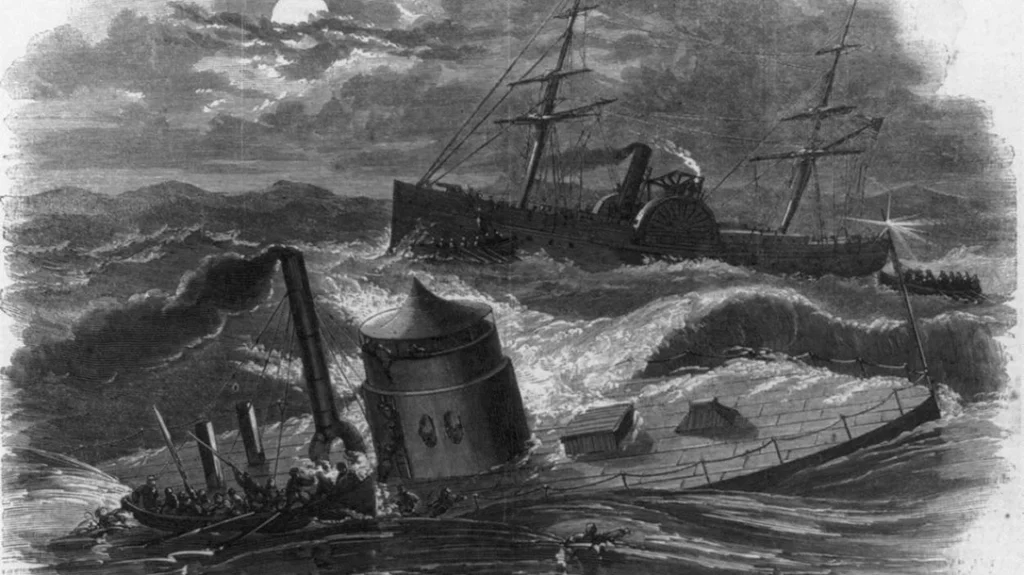
Also on display is the anchor and chain that her captain dropped in desperation on the night of December 30, 1862, in a vain attempt to stabilize the flat bottomed vessel as it pitched and rolled through the heavy waves in a severe storm 16 miles off Cape Hatteras, North Carolina. You can see the red lantern that signaled the Monitor’s tow ship, the USS Rhode Island, that the ironclad was sinking. Hours after the surviving crew were rescued, witnesses recalled that red lantern atop the turret mast tossed around by the violent sea, disappearing under the waves, then reappearing again and again, until finally disappearing for good.
Advertisement — Continue Reading Below
Personal Effects
Sixteen of the Monitor’s crew were lost. The remains of two of them were discovered entombed in the turret, one possibly crushed under the cannon when the vessel capsized. You can see their personal effects: a pocket knife, wedding ring, mismatched shoes, perhaps hastily pulled on in the dark before that unlucky sailor began his life or death transit of the ship’s flooding interior, praying to reach the turret and escape out its roof hatch.
Mariners Museum
The Mariners Museum at Newport News, Virginia, in addition to being a first class nautical museum, is home to the USS Monitor Center and responsible for the care of over 200 tons of artifacts recovered from the wreck of the Civil War ironclad, including its massive revolving gun turret, 11-inch Dahlgren cannons, and steam engine. The preservation of these artifacts at the co-located,15,000 square foot, state-of-the-art, Batten Conservation Complex, is the world’s largest marine archaeological metals conservation project. Because the process of desalinization can take decades, the big and most spectacular pieces in this collection won’t be on display for years to come. However, I can say from experience, I found their Ironclad Revolution exhibit so engaging I didn’t even realize the real turret, cannons and engine weren’t on display until I saw them through the windows of the conservation complex submerged in their desalinization tanks.
Advertisement — Continue Reading Below
Ironclad Revolution Exhibit
Whatever your level of scholarship, the multi-faceted Ironclad Revolution exhibit offers engaging insights into the technological, economic, political and strategic forces that shaped naval combat into the first year of Civil War, and ultimately led to the frenzied construction of the ironclad Monitor and Merrimac. These completely new and untested vessels went from drawing board to battle in about 10 months, and both went to the bottom before the end of 1862.
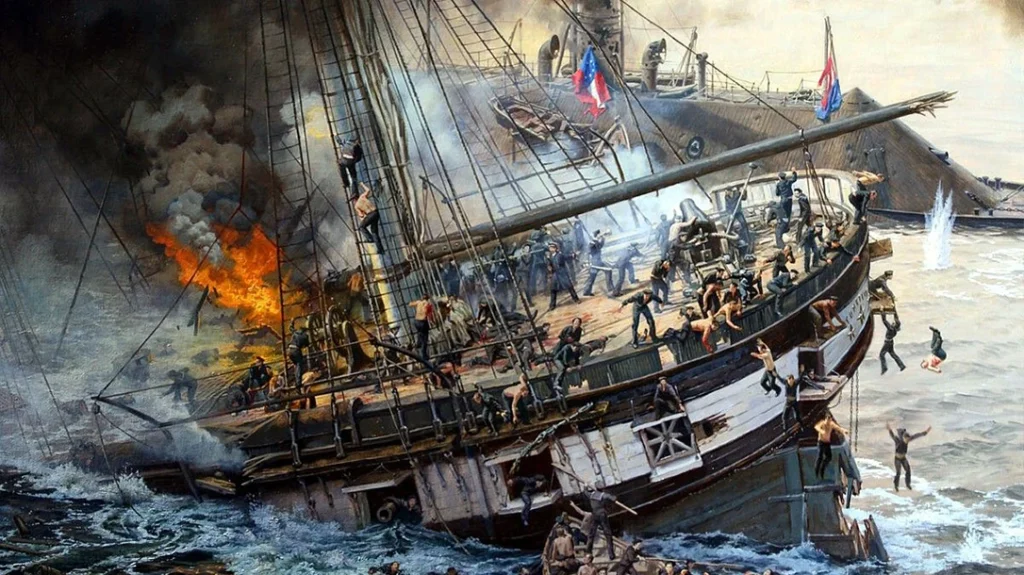
Their two days in battle demonstrated that wooden warships, whether propelled by wind or steam, were no match for armored ships (the Merrimac destroyed the USS Cumberland and Congress with ease), and armor protected revolving gun turrets (Monitor had the first) made all previous gun mountings obsolete. The exhibit also explains the who’s-who of this story. From presidents, engineers, and admirals down to common sailors and cooks, you’ll find just the right amount of biographical information enhanced with their actual words (drawn from records and personal correspondence) to humanize this larger-than-life legend and allow visitors to connect with the people who lived it. I stayed four hours (it seemed like one) and could have stayed the whole day.
Advertisement — Continue Reading Below
Full-Scale Replica
If your time is limited, start your visit by walking around the full-scale replica of the USS Monitor displayed outside to the left of the lobby doors. The 1720foot long, 41.5-foot wide, iron hulled ship had only 18 inches of freeboard above the water and its most notable feature was a cylindrical turret, about 20 feet in diameter, protruding above its flat, 1-inch thick, iron deck plates. Confederate sailors mockingly described it as a “Yankee cheese box on a raft.”
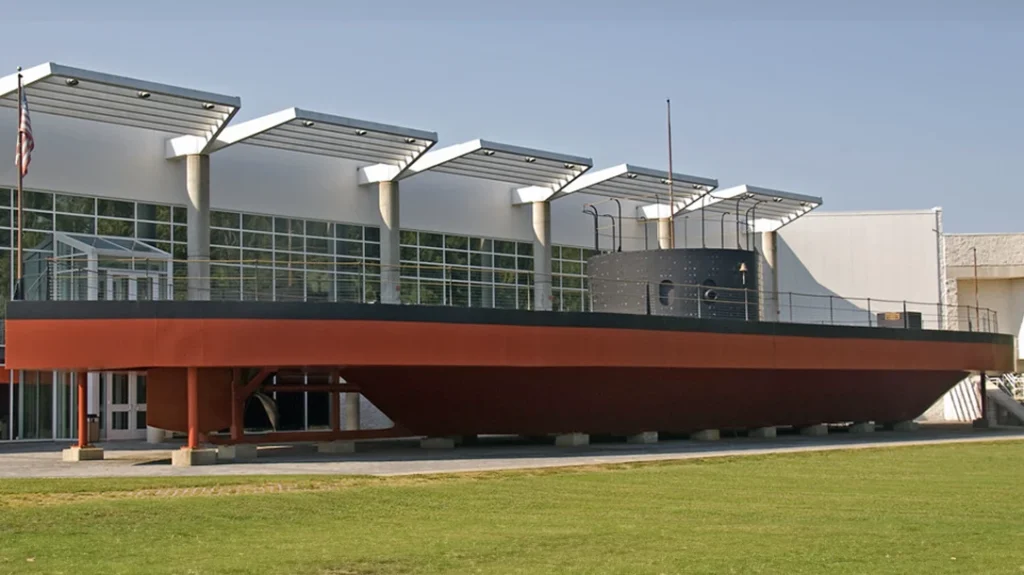
What we can see, and they couldn’t, is the Monitor had half the draft of the Merrimac allowing her more room to maneuver in the shallow harbor. The draft of Merrimac’s keel, nominally 21 feet, confined her to the narrow shipping channel which at its broadest point was just over two and half miles wide. Merrimac needed a mile to make a 180 degree turn. The Monitor sailed rings around her.
Advertisement — Continue Reading Below
Seeing the Monitor replica outside gives you a frame of reference for the inside exhibit. Pay the $1 admission and find out when the next Battle of Hampton Roads documentary is playing in the theater. While you wait, check out the 9-inch Dahlgren smoothbore cannon with its muzzle shot off at the exhibit entrance. It was on the Merrimac, and the muzzle was shot away by the valiant crew of the USS Cumberland on the first day of the battle.
Battle of Hampton Roads
The 15 minute documentary is an excellent, dramatic, overview of the two day battle. You’ll see the havoc the Merrimac caused among the wooden ships on the first day, including how she sank the USS Cumberland with her 1,500 pound iron bow ram, set the USS Congress ablaze with red hot cannon projectiles heated in a furnace installed just for that purpose, and caused the remaining frigates to run aground before withdrawing from Hampton Roads for the night ahead of the falling tide that would have surely immobilized her.
Monitor was on its way to Hampton Roads before the battle began. Delayed after nearly sinking in rough seas while sailing from New York, it dropped anchor around 1am, in time to witness the spectacular explosion of the USS Congress. The ironclads met the next morning, and fought each other to a confused draw four hours later. U.S. Navy casualties numbered over 261 dead and 108 wounded, nearly all from the first day. The Merrimac had only 25 wounded among her 320 man crew. Monitor had three.
Advertisement — Continue Reading Below
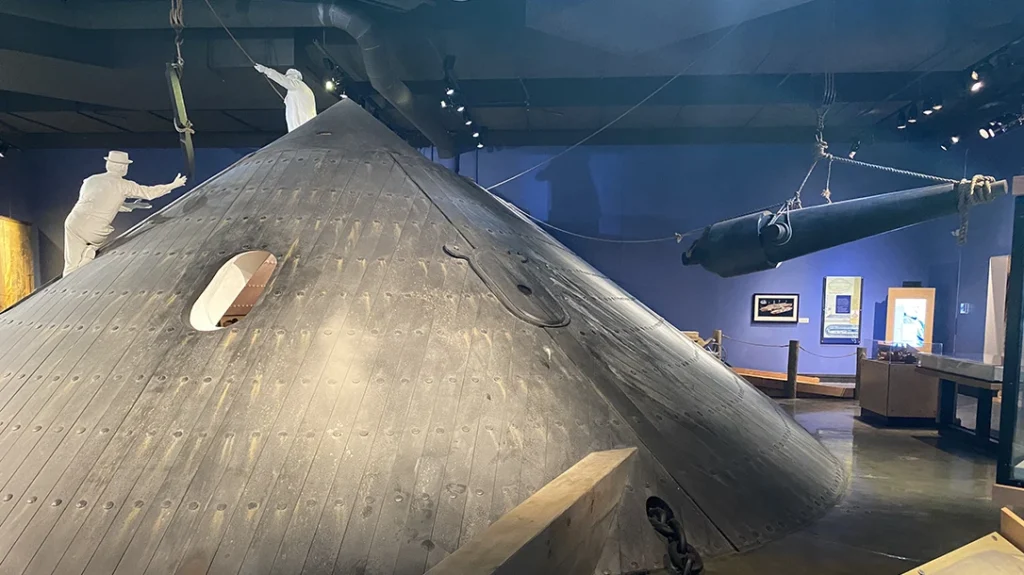
Parts Of The Monitor And Merrimac
After the film, explore the life-size, cutaway, replicas of parts of the Monitor and Merrimac. The real meaning of the term ironclad is readily apparent. Both vessels made extensive use of wood. Merrimac’s entire hull was salvaged from the sunken USS Merrimack, and the new casement was 24 inches of wood with 4 inches of iron plating outside. The Monitor, though of more advanced design with an iron lower hull, had a wooden upper deck sheathed in heavy protective armor.
In these exhibits, you can appreciate how imaginative and technologically advanced these vessels were, and also how deeply flawed. The submerged hull of the Merrimac was a tremendous strain on the engines and leaked so badly, one has to wonder if it was always a failed bilge pump away from sinking. Monitor’s steam powered turret turned easily, but proved near impossible to stop on target, forcing the gun crew to fire on the fly. In addition, though nearly impervious to enemy fire, it was apparent immediately that the Monitor was not seaworthy.
A great side trip if you plan on visiting Colonial Williamsburg or Yorktown Battlefield, The Mariner’s Museum, located at 100 Museum Drive, Newport News, Virginia, 23606, is open daily from 9-5pm.