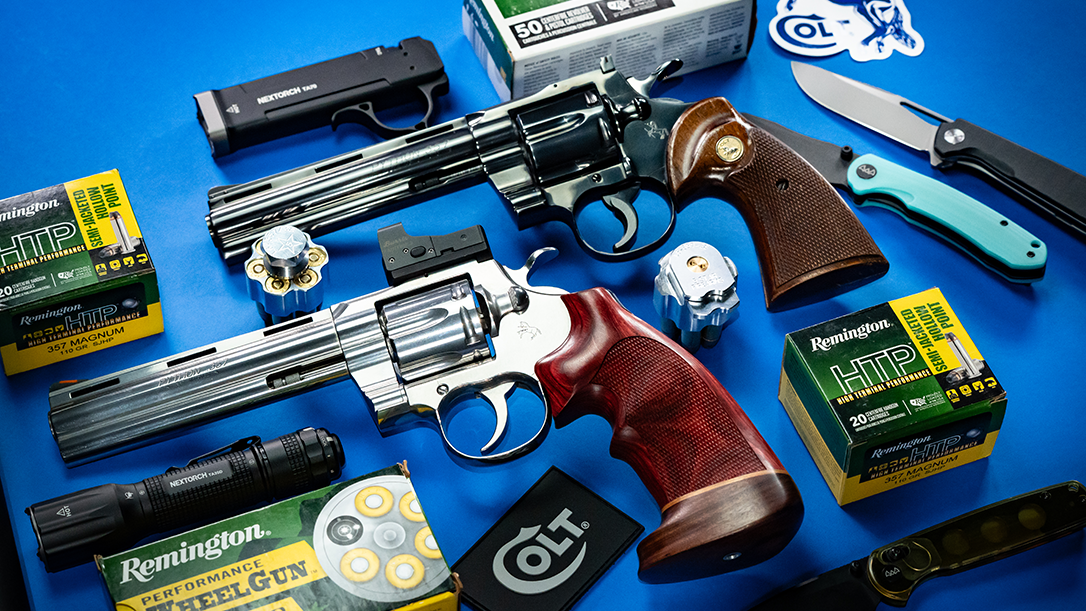
There are very few firearms that transcend their function and become cultural artifacts. The Colt Python is one of them. Even among people who do not shoot revolvers, the name carries weight. It implies craftsmanship, precision, and a kind of mechanical dignity that feels increasingly rare in a world of polymer frames and disposable consumer goods. For decades, the Python has represented the high watermark of American double action revolver manufacturing. It was never intended to be common or cheap, it was intended to be exceptional.
That is why comparing a vintage Python to the modern reintroduced Python is not a simple head to head. They share a name, a silhouette, and a lineage, but they exist for very different purposes, in very different eras, and under very different economic and regulatory realities. This is not a story about which one is better. It is a story about what each one represents, what each one asks of its owner, and why both deserve respect for very different reasons.
Original Colt Python
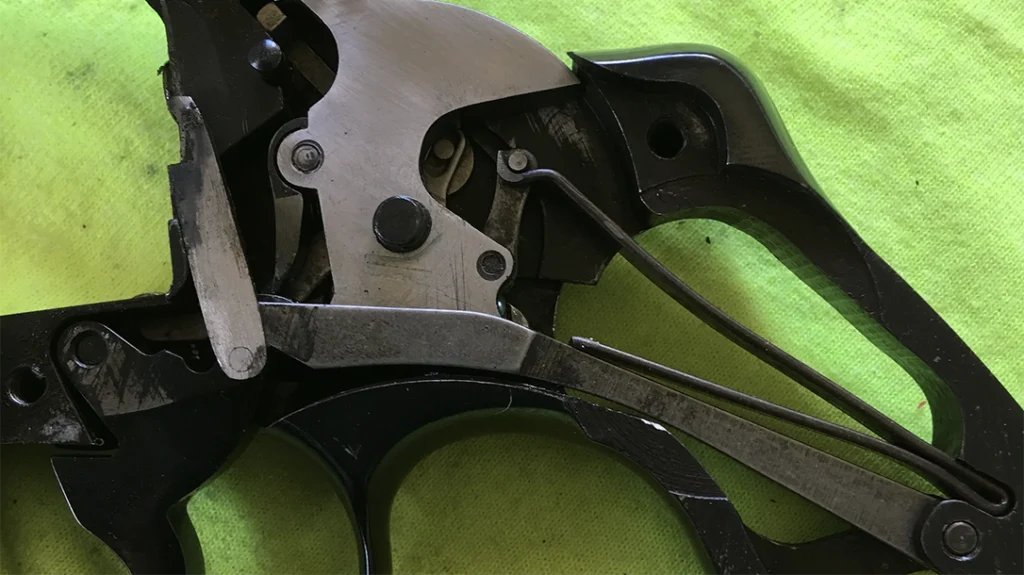
When Colt introduced the Python in 1955, it was not trying to build a service revolver. It was trying to build a flagship. Built on Colt’s large I frame and chambered in .357 Magnum, the Python was meant to showcase the absolute best of what Colt could do when cost and labor were not the primary constraints. The Royal Blue finish was not just attractive. It was a demonstration of surface preparation, polish, and finishing that required hours of skilled human labor. The action was not merely assembled. It was tuned by hand. Internal parts were polished, stoned, and fit together by craftsmen who understood how steel behaves when surfaces move against each other under spring tension and rotational load.
Advertisement — Continue Reading Below
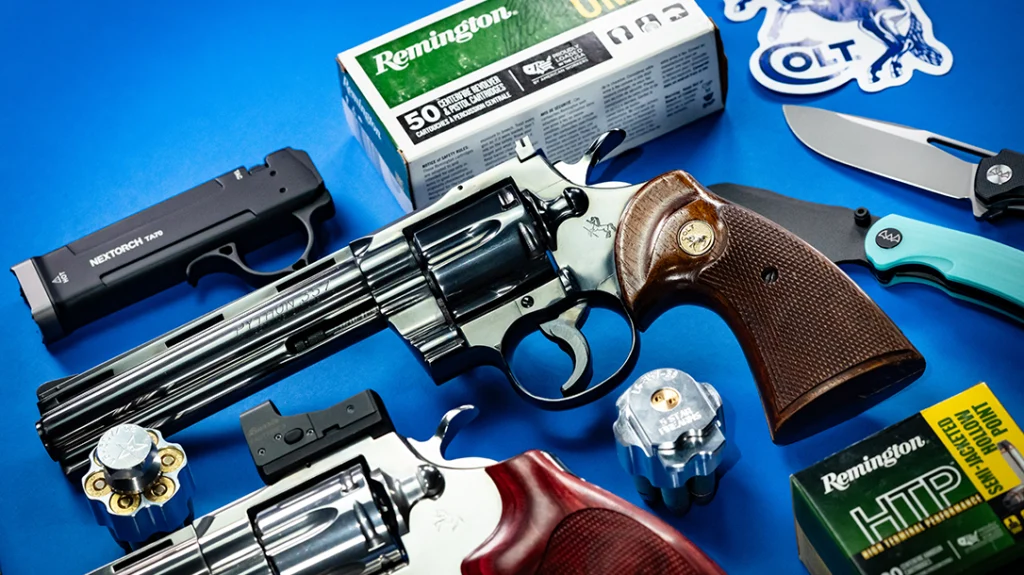
The result was a revolver with an action that felt alive. The double action pull was smooth, consistent, and almost hydraulic in character. The single action break was crisp and light. The barrel with its ventilated rib and full underlug gave the gun a distinct visual identity while contributing to excellent balance and recoil control. Accuracy was outstanding, not because of any single innovation, but because every interface inside the gun was refined.
Refinement
This level of refinement came with a cost that was invisible to the end user at the time but becomes very visible decades later. The same hand fitting that made the gun exceptional also made it sensitive. Timing was precise but not forgiving. Running the gun hard, especially with full power .357 Magnum loads, could accelerate wear. Many shooters sensibly chose to practice primarily with .38 Special and reserve magnum loads for occasional use or carry. Over time, the Python developed a reputation not for fragility but for requiring respect. Like a prized racehorse, it would reward careful ownership and wilt with neglect or abuse.
Advertisement — Continue Reading Below
When production slowed in the 1990s and eventually ceased in 2005, the Python transitioned from premium tool to cultural icon. Values climbed. Guns went into safes. Shooting them became emotionally and financially expensive. The Python did not just become rare. It became precious.
The Modern Colt Python
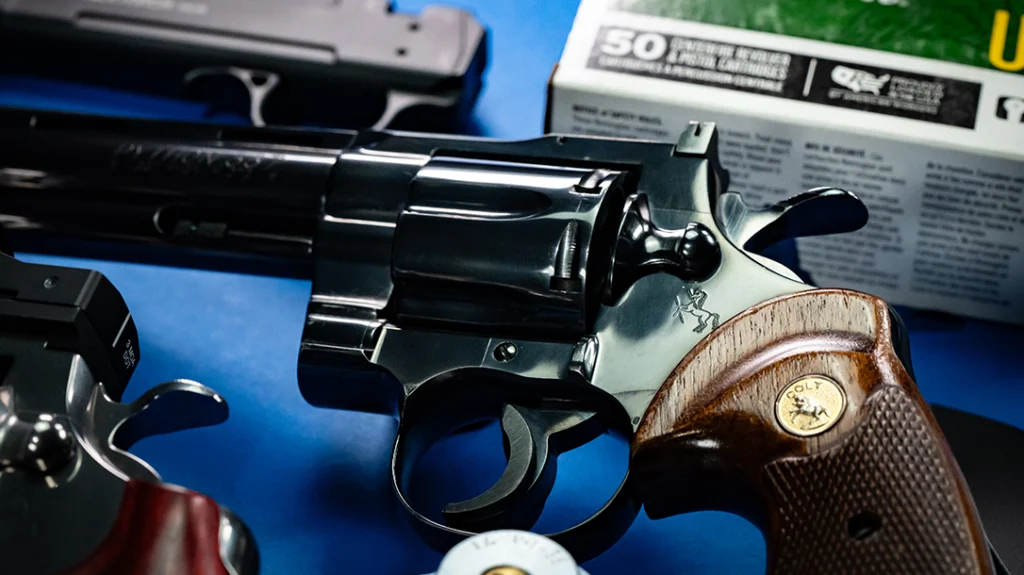
The reintroduced Python, launched in 2020, was never intended to recreate the past exactly. Colt did not attempt to rebuild the old manufacturing environment because that environment no longer exists. Skilled labor at that scale is economically unviable. Regulatory requirements are stricter. Consumer expectations around durability and service life are different. The new Python is not a tribute piece. It is a reinterpretation.
Advertisement — Continue Reading Below
The modern Python retains the external lines and proportions that define the model, but internally (though nearly identical) it’s a different machine. Contemporary CNC machining replaces much of the manual fitting. Internal geometry is revised to be more tolerant of wear. Modern metallurgy improves consistency and strength. The action is designed to be more robust over high round counts and less sensitive to timing drift. The revolver is built to pass modern drop safety standards required for sale in all fifty states. These are not cosmetic changes. They fundamentally alter what the gun is optimized to do.
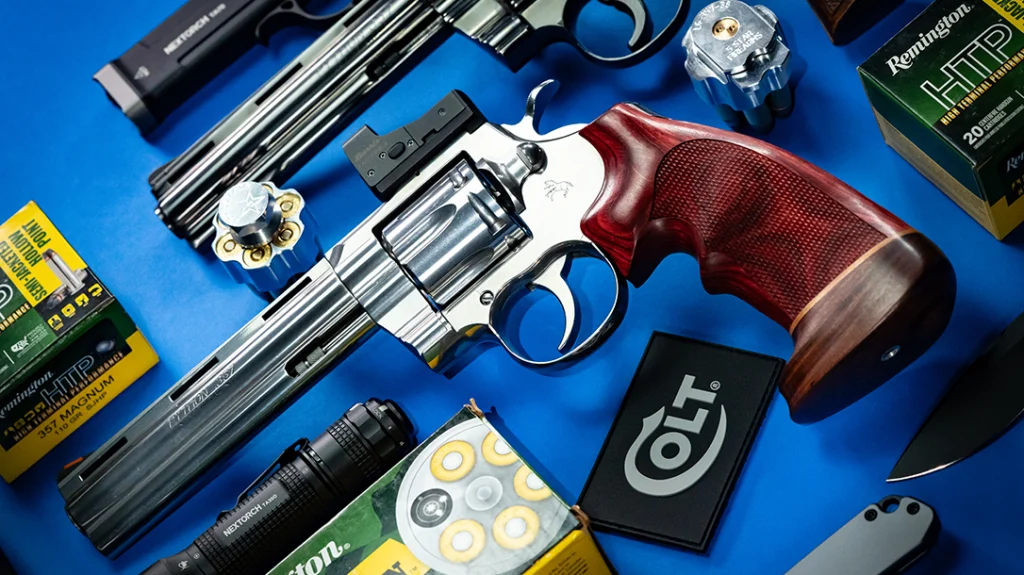
The result is a revolver that feels like a Python in the hand and on the belt, but behaves like a modern working firearm. It is, albeit slightly heavier. The Colt Python has more material in critical stress areas like the top strap. Though colt is now making these Blued. It is stainless steel rather than carbon steel, which dramatically improves resistance to corrosion and wear. It is designed to be shot often, cleaned casually, and maintained by contemporary armorers rather than specialized craftsmen whose numbers are shrinking every year.
Advertisement — Continue Reading Below
The Python is not less of a revolver, it is a revolver for a different world.
Old Vs New Test
For this comparison I used two 6-inch guns. The vintage Python is a mid-1970s shooter grade revolver that was mechanically confirmed by an independent gunsmith who specializes in vintage Colts. The gun is mechanically factory correct. It has a trigger shoe installed, which widens the trigger face and adds serrations, but the internal action is correct to factory spec.
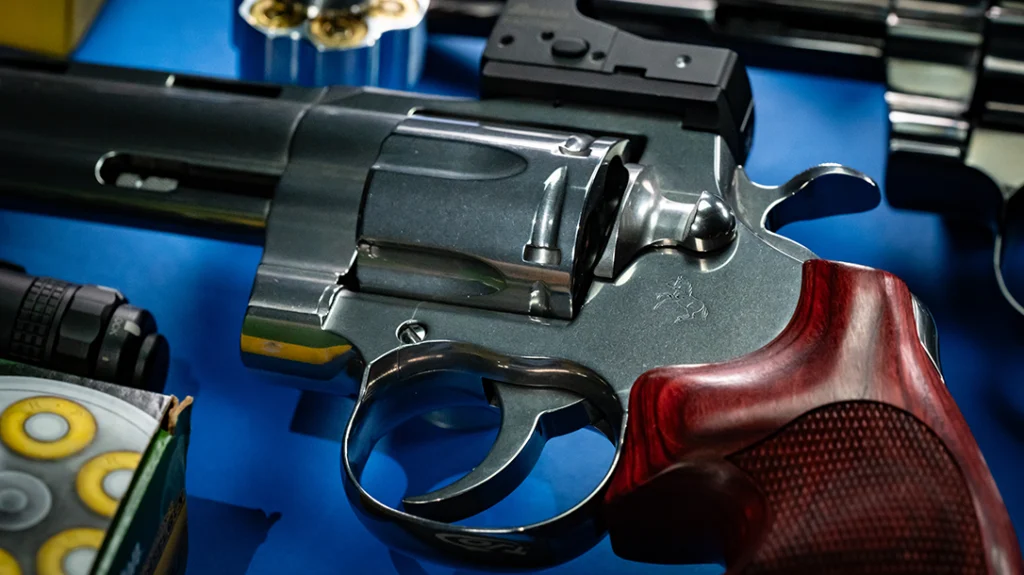
The modern Python is my own. It wears a Hogue Monogrip and a Burris FastFire optic. The action is factory. I have substantial time on this gun both with its original configuration and its current setup, so I am well acquainted with its behavior.
Advertisement — Continue Reading Below
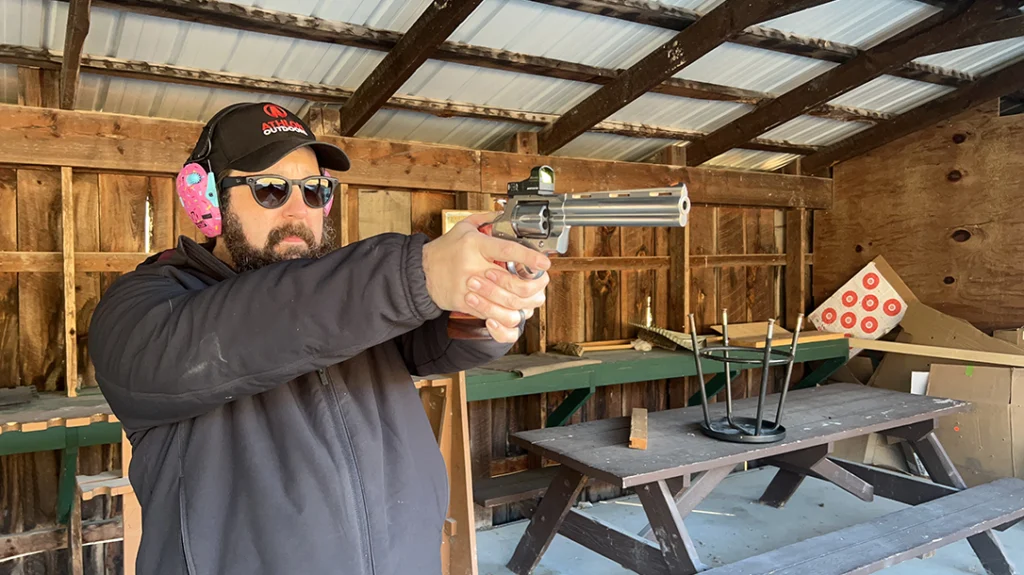
Targets were set at 21 feet on paper, 50 feet on an 8-inch steel plate, and a USPSA steel plate at 82 yards.
On The Range With The Colt Pythons
I began with the vintage gun using .38 Special FMJ to warm up. The old Python feels exactly like its reputation suggests. The double action pull is smooth with minimal stacking. The gun tracks well. The balance is excellent. It feels refined in a way that is difficult to quantify and impossible to fake. Moving from .38 to hotter .357 loads, the gun remained controllable and accurate. At 82 yards, I landed five out of six hits in double action. That is not trivial for any handgun and speaks to both the gun’s mechanical precision and its shootability.
Advertisement — Continue Reading Below
The modern Python has a distinct personality. It feels new, tighter, and more like a contemporary machine than a handcrafted instrument. The trigger is lighter overall but has more perceptible stacking at the top of the trigger stroke. That is a direct consequence of internal safeties and revised geometry rather than poor execution. At 82 yards I landed four out of six hits in double action. The misses were close. The gun is absolutely capable; I needed to do my job better. I would call them even.
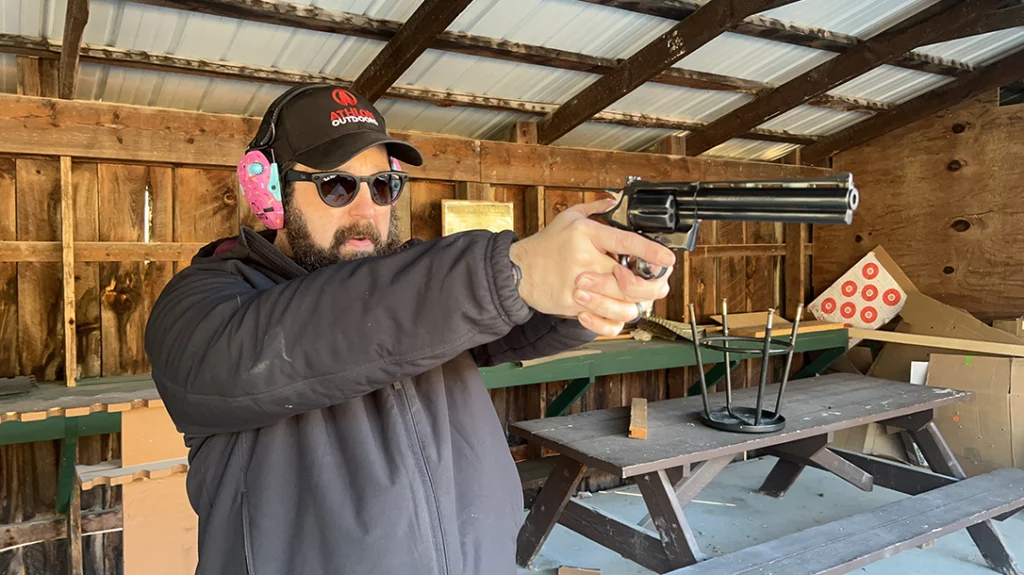
Both guns performed exceptionally. Neither felt outclassed by the other.
Advertisement — Continue Reading Below
Measured Differences
On the bench, the differences become clearer.
The vintage Python weighed 2 pounds 9.7 ounces as configured. Its single action pull measured 2 pounds 12 ounces. Its double action pull measured 11 pounds flat.
Advertisement — Continue Reading Below
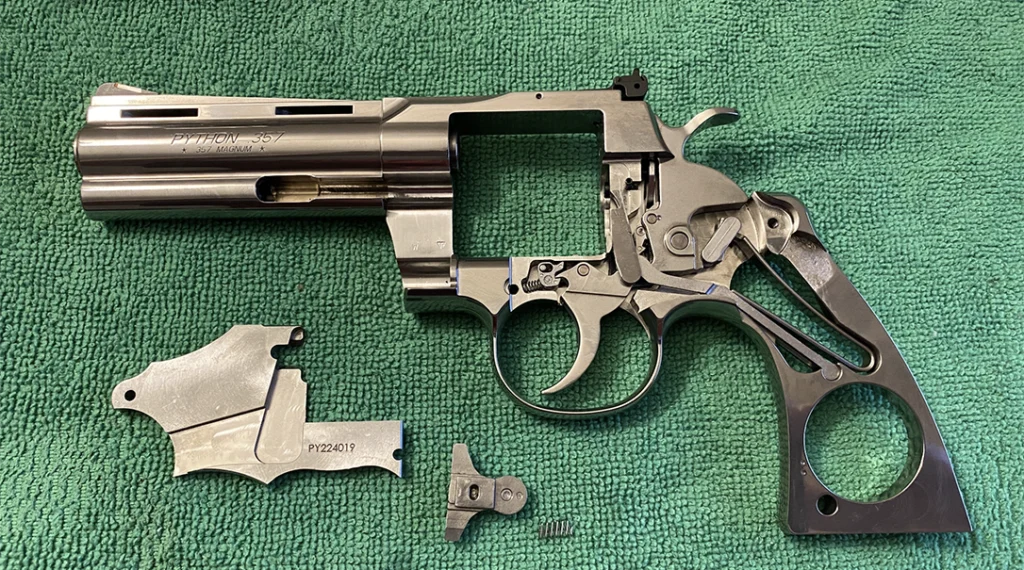
The modern Python weighed 3 pounds 2 ounces as configured. Its single action pull measured 3 pounds 4.7 ounces. Its double action pull measured 9 pounds 2 ounces.
The vintage trigger is smoother with less stacking. The modern trigger is lighter but has some slight stacking at the top.
This is not a flaw. It is a design choice driven by safety standards and durability goals.
Velocity Data
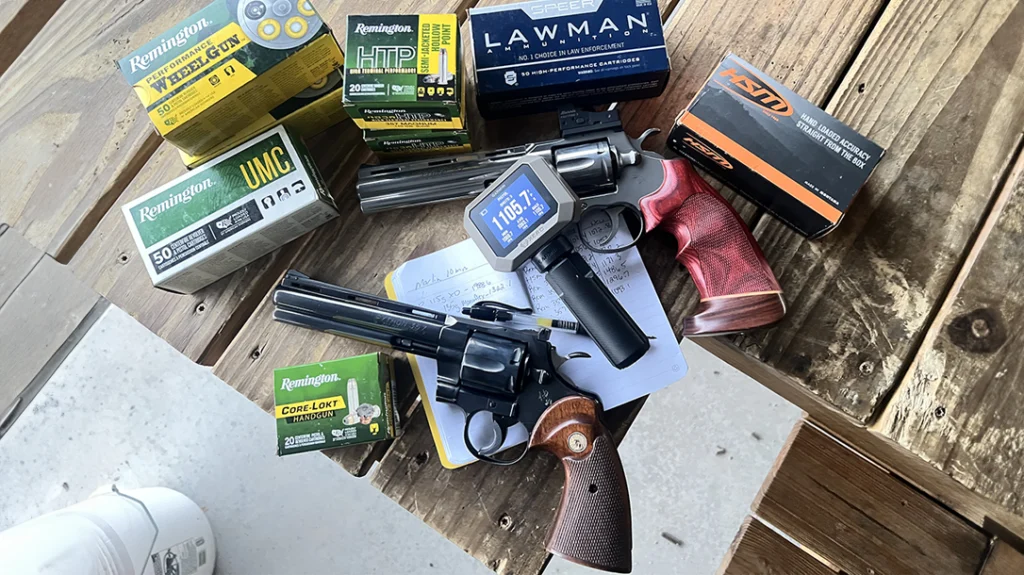
All ammunition was chronographed through a Garmin Xero.
| Ammunition | Bullet & Type | Vintage (fps) | Modern (fps) |
| Speer Lawman | 125 gr FMJ | 1070.4 | 1072.8 |
| Remington .38 +P | 125 gr FMJ | 1056.2 | 1052.9 |
| HSM .38 | 158 gr JSP | 781.2 | 837.2 |
| Remington .38 +P | 110 gr JHP | 1127.4 | 1171.3 |
| Remington .357 | 110 gr JHP | 1466.5 | 1486.5 |
| Remington .357 | 158 gr SWC | 1330.2 | 1296.7 |
| Remington .357 | 180 gr JHP | 1119.7 | 1093.1 |
The modern gun tends to produce slightly higher velocities with lighter bullets and slightly lower velocities with heavier bullets. This likely reflects differences in barrel tolerances and internal friction rather than meaningful performance gaps.
Stewardship vs Use
If there is a real divide between these two guns, it is not mechanical. It is philosophical.
The vintage Python is no longer just a firearm. It is a responsibility. Skilled Colt revolver smiths are becoming rare. Every round through the gun is one more cycle on parts that are no longer being made. This does not mean you should not shoot it. It means you should understand what you are doing when you do.
The modern Python is a tool. It is meant to be used, carried, and trained with. It is overbuilt, durable, and comparatively affordable. Matte stainless examples can be found around $1,100. Vintage guns now routinely command several times that.
Collectors who lock away vintage guns and never shoot them are not villains, but they are participants in a slow quiet loss of living mechanical knowledge. Guns that are never shot are never maintained. Skills that are never used disappear. The Python was never meant to be a relic.
Two Snakes, One Name
These revolvers share a name but not a mission.
The vintage Python represents what American manufacturing once was when skilled labor, time, and pride were allowed to dominate the process. The modern Python represents what it must be now in a world of regulation, economics, and mass production.
Neither is wrong. Neither replaces the other.
If you are a true enthusiast, you will want to experience both. The vintage gun will teach you what craftsmanship feels like. The modern gun will give you permission to shoot without guilt.
That is not a competition. That is a conversation across time.
Cheers to Colt and the Python; two of the finest revolvers ever made.
WHY OUR ARTICLES/REVIEWS DO NOT HAVE AFFILIATE LINKS
Affiliate links create a financial incentive for writers to promote certain products, which can lead to biased recommendations. This blurs the line between genuine advice and marketing, reducing trust in the content.