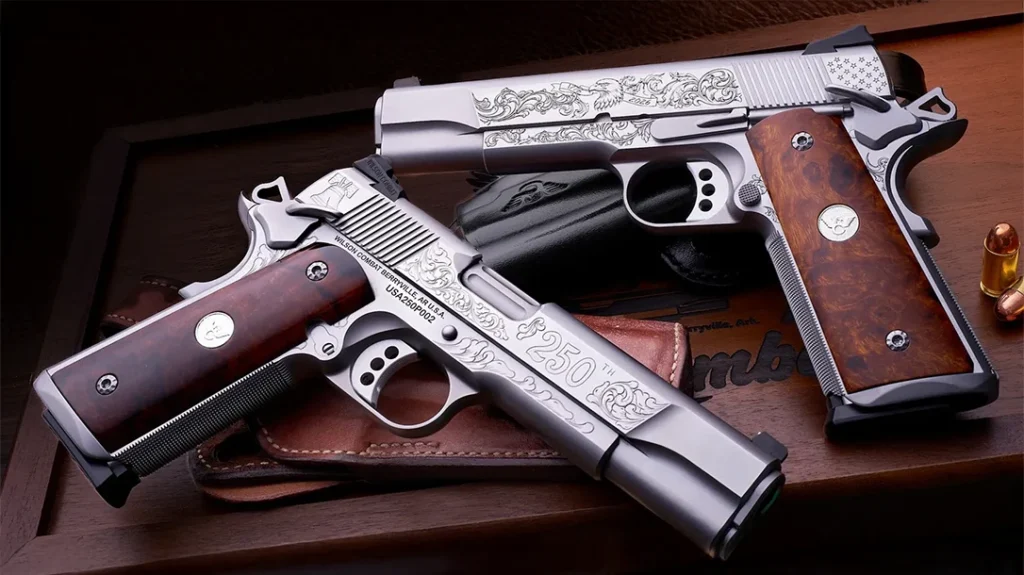
“There are many like it, but this one is mine.” Yes, it’s a line about rifles made famous by the US Marine Corps Rifleman’s Creed. But it’s not just for rifles, it applies to handguns too, especially when it comes to the most legendary semi-automatic pistol of all times: the 1911.
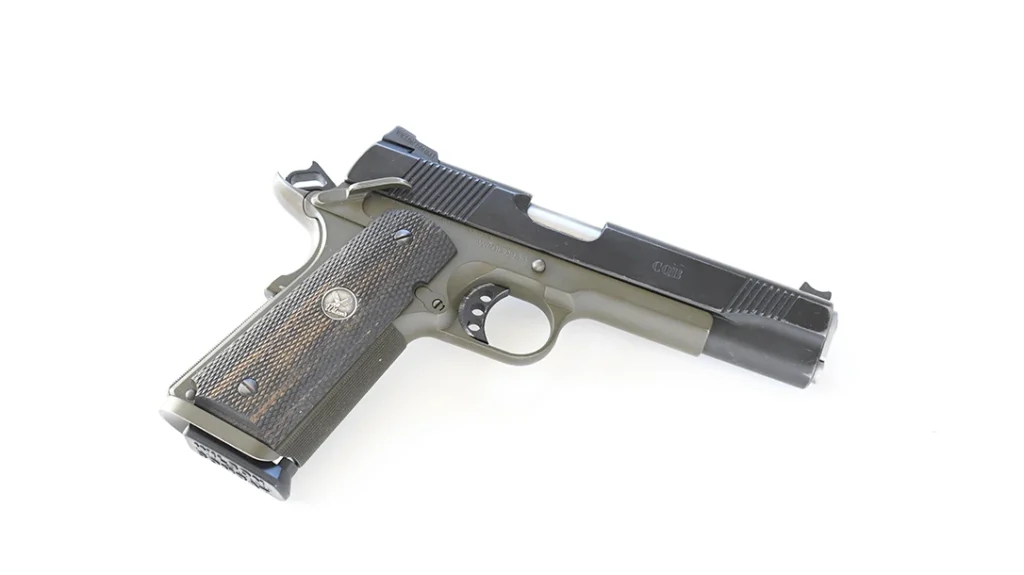
In my case, there are many 1911s but this one is mine refers to my 2001-built original Wilson Combat CQB 1911 pistol. It’s chambered in the Lord’s cartridge .45 ACP, of course. Not only is this gun my first-ever 1911 and the first “nice” gun I ever bought for myself when I didn’t have a lot of money (still don’t), but that shooting that gun in the early days led me to fall in love with 1911s on a deeper level.
You can read about a gun, watch videos about a gun and listen to other people talk about shooting a gun. However, nothing compares with having your own and seeing for yourself what it does in your hands. That was me with my CQB when I first acquired it over a decade ago. At the time, I loved shooting that gun so much that it even motivated me to learn how to handload, in order to keep it fed.
Advertisement — Continue Reading Below
Wilson CQB Maintenance
For perspective, I bought this gun secondhand. Allegedly, I am its third owner and there’s no telling how many rounds it had seen in its years prior to being mine. It didn’t take long for it to become my favorite gun to shoot. I’d load up a batch of .45 ACP on my press and it would be a pile of empty brass almost immediately. My Wilson Combat CQB was like a strong magnet. Any .45 ACP cartridges in its vicinity eventually ended up getting shot out of its barrel. Handloaded, factory-loaded, FMJ, LRN coated, SWC–none of that mattered. They all got shot.
I also loved (still do) putting this gun in other people’s hands and let them enjoy a few magazines. Suffice to say, it wasn’t long before my Wilson’d round-count shot-up.
Advertisement — Continue Reading Below
In order to function correctly, 1911s need proper maintenance, more so than more “modern” guns. There’s no getting around this and it’s something serious 1911 shooters have always understood and accepted. It’s true that many contemporary handguns can function tens of thousands of rounds with very little in the way of maintenance, but even “good” 1911s need to be overhauled at around 10,000. The reason USMC MEU(SOC) 1911s had every part stamped with the last digits of their serial numbers was to help the armorers at Quantico keep track of them while they underwent frequent rebuilding and servicing. It was a necessity to keep the whole fleet running and eventually a reason why those Marines switched to the Glock 19.
Putting Things In Perspective
The original Model of 1911 prototype that John Moses Browning entered into military trials had to withstand only 6,000 rounds. While that doesn’t sound like much, locked-breech repeating pistols shooting metallic cartridge ammunition were still in their infancy. Black-powder firearms were only a generation behind, so the fundamental 1911 design and Browning’s genius definitely deserves credit.
Advertisement — Continue Reading Below
As long as you stay on top of it, a well-built, well-lubricated and well mainted 1911 will function properly. Even after dutifully changing springs and keeping an eye on the extractor tension, there comes a point when a 1911 needs to take a trip back to the gunsmith’s bench.
After nearly 25 years, it was time for my 2001-built CQB to take a trip back to Wilson Combat’s mothership in Berryville, Arkansas for an extended spa and rejuvenation session.
Turn Of The Millennium
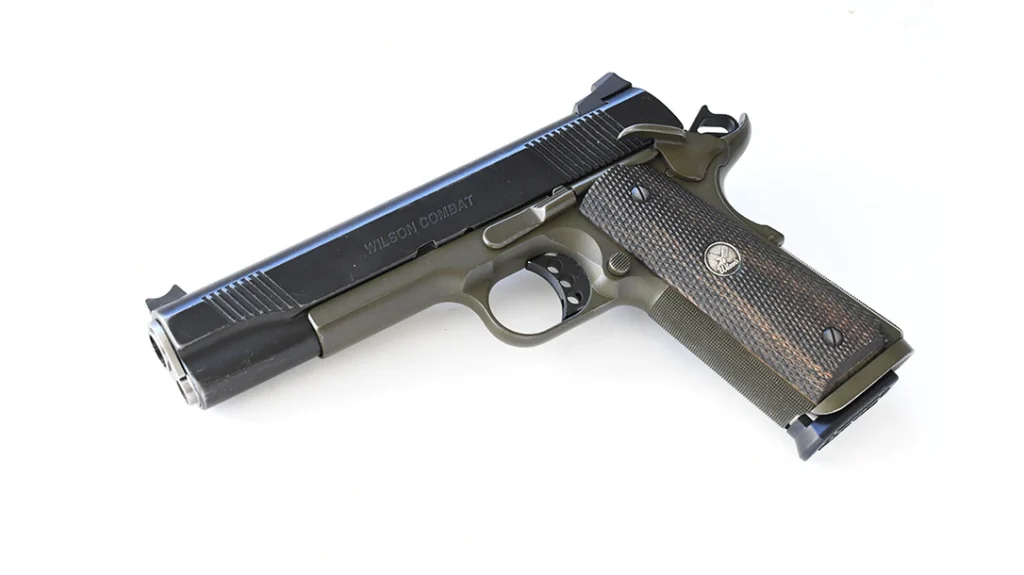
My gun sports the original Wilson Combat Armor-Tuff OD black slide riding atop a green frame. The frame, with 30-LPI checkering on the frontstrap is adorned with a pair of Wilson Combat wooden medallion stocks with the old-school Wilson Combat eagle logo. In fairness, it wasn’t old-school at the time, it was Wilson Combat’s actual logo. The black-green-and-wood look is so iconic, that describing it as livery wouldn’t be wrong.
Advertisement — Continue Reading Below
My 1911, whose serial number falls below 1000, also came with a low-profile magazine well and a pair of ambidextrous safeties. The tritium vials in its night sights have long since expired. This handgun is decked out with everything one would expect on a modern 1911. In fact, guns like this CQB helped set the tone for fighting 1911s at the turn of the millennium.
I already mentioned its 30-LPI checkered frame. It’s also built with a matching 30-LPI flat mainspring housing, an upswept beavertail grip safety and commander hammer. The trigger? Skeletonized, of course.
Advertisement — Continue Reading Below
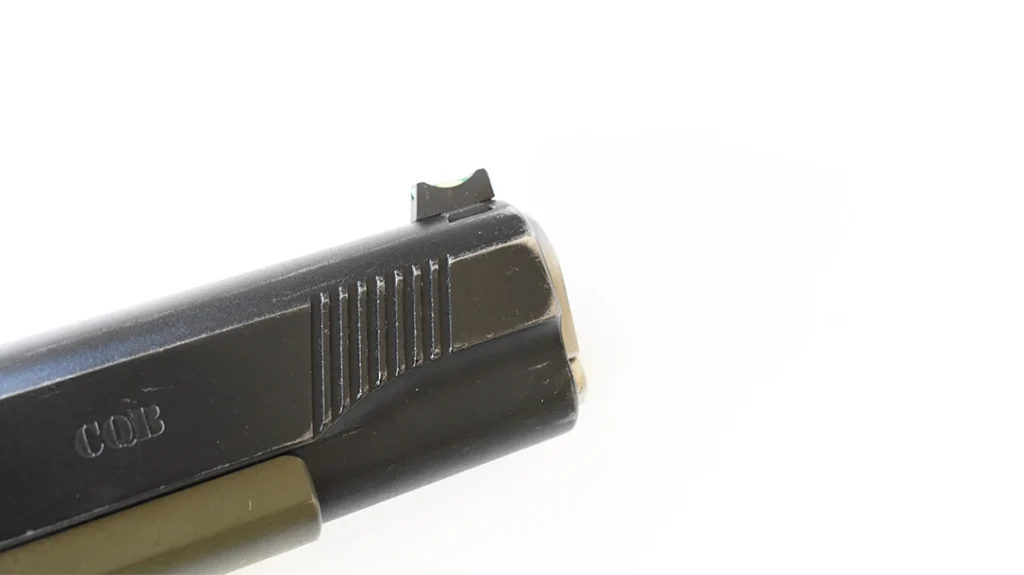
The slide’s ejection port is lowered and flared. Though almost taken for granted today, the slide’s forward serrations were avant-garde in the early 2000s. Speaking of the era, my gun uses a single-piece full-length guide-rod. I’m not sure if it was built that way, but I don’t mind it. (Pro tip, if you don’t have a bushing wrench, you can use the rounded lip of a USGI .45-caliber magazine as one).
Another way that this gun spoiled me then, as it does now is by its build quality. To date, the fit between the slide, frame and barrel feels superb. There’s nary a rattle or a wobble. Its stainless steel barrel shows unique wear patterns that mate up to the gun’s specific slide. The tension between the thumb-safeties and their plunger tube remains as exquisite as ever.
Wilson Combat’s Tune-Up Packages
This summer, I made arrangements to send the gun back for a full-rebuild and deep-level maintenance. After a quarter-century, I think it was called for. Wilson Combat offers its customers the ability to send their guns in for different tune-up packages. These workovers include full inspection, deep-cleaning, lubrication and spring replacement. In fact, the very first sign that my gun was in need of a gunsmith’s bench was its extractor losing tension. Basic 1911 maintenance includes watching your extractor like a hawk.
Advertisement — Continue Reading Below
Although Wilson Combat gave me the option for a full frame and slide refinish (included in some packages), I insisted that I wanted it left as-is. It’s got 25 years of character, and a good deal of the holster wear is by my own hand. Because this gun is a personal heirloom, I wanted it to keep its character. In essence, the goal was to restore this CQB 1911 to its full glory, just like the day it left Wilson’s Gun Shop in 2001.
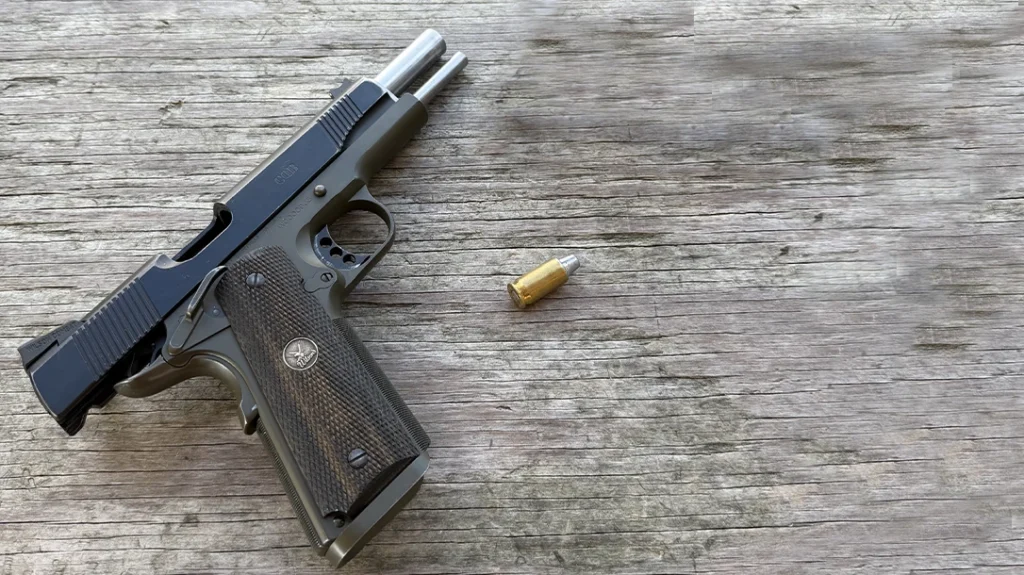
I only changed one thing. I had Wilson swap out my 1911’s original faded night-sights for a newer Wilson Combat square-notch rear Battlesight and a Wilson Combat Snag-Free green fiber-optic front sight. Wilson also replaced and fitted a new extractor to my slide. For the sake of prudence, I also requested a fitted spare.
CQB 1911 Reinvigorated
After Wilson shipped my gun home (about 10 weeks from start to finish), I was overcome by that same emotion and excitement that you feel when you bring a new gun home. Since this was my gun, the feeling was even stronger.
After removing the gun from the box and remembering its familiar feeling in my hands, I lowered its hammer with my thumb to gently retract the slide and check the chamber. I pointed towards a safe spot and dry-fired it. Besides admiring the new sight picture courtesy of the new battlesight set, the new springs make the gun feel revitalized.
That Wilson Combat included a 15-yard 3-round test target stapled to the work order only exacerbated this feeling. The target has a 3-shot clover with the pistolsmith’s signature and load data.
Thank you, Richard Moore.
It didn’t take long before taking my CQB to the range. My preferred load continues to be a 200-grain handload consisting of a lead semi-wadcutter over 4.2 grains of Clays. W231 or HP38 also work quite well for this application. Thanks to extra mass from the full-length guide rod and a new recoil spring, the recoil impulse with these lead handloads could be described as delicious, maybe even addicting.
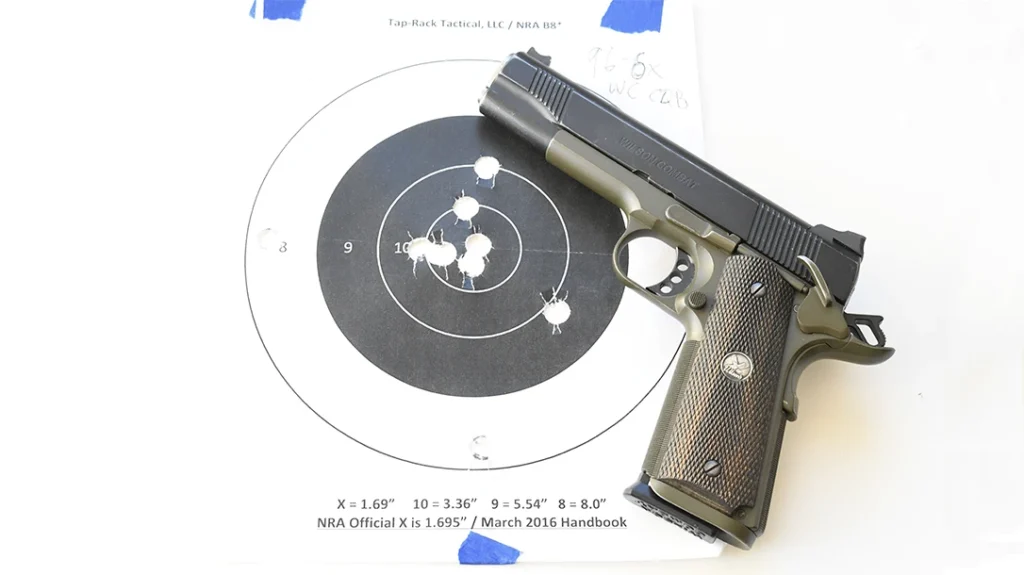
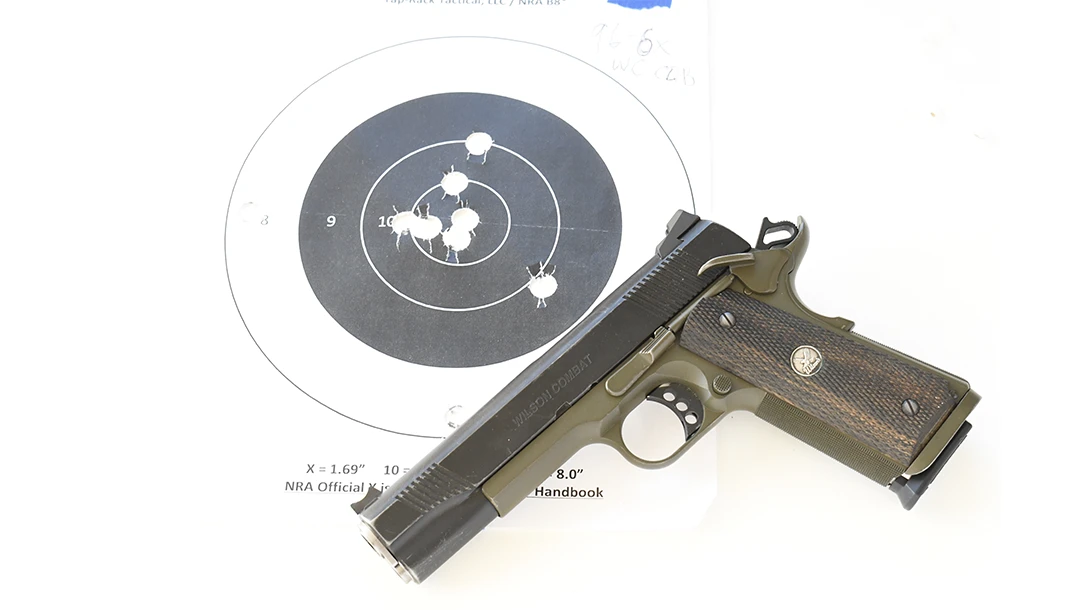
Wishing to reacquaint myself with my old 1911, I spent that range session shooting at several NRA B8 targets on the 25-yard line, something My goal was to see how the new sights behaved at 25 yards in tandem with my 200-grain handloads, which clocked in at 854 FPS on average. I walked away satisfied after shooting a strong 96-6X with 10 rounds for record while confirming that a perfect center hold will punch the X-ring. Using the green orb of the fiber-optic insert, put bullets slightly lower, between the 8 and 9-rings.
Here’s To More Decades Of Service
In its heyday, this iteration of the CQB was one of Wilson Combat’s high-end production pistols and one of its flagships. It was also one of its first “natively” built products. (Remember, Wilson Combat started in 1977 as a shop working over Colts and making 1911 parts).
By all means, the CQB remains a pillar in Wilson’s catalog today. But owning a classic green-and-black Wilson Combat CQB 1911 signifies something about their owner: a degree of seriousness and dedication to the craft. I’m not saying that in order to sound cool in my article, it’s an observation I’ve noticed over the years about men I personally know who own such a gun.
That CQB 1911 owners can send their guns back to Berryville for serious overhauling and maintenance is so wonderful, especially considering how 1911 pistolsmithing is a dying art.
I’m looking forward to enjoying my own heirloom for the next several thousands of rounds.
There are many 1911s out there, but [that] one is mine.
WHY OUR ARTICLES/REVIEWS DO NOT HAVE AFFILIATE LINKS
Affiliate links create a financial incentive for writers to promote certain products, which can lead to biased recommendations. This blurs the line between genuine advice and marketing, reducing trust in the content.