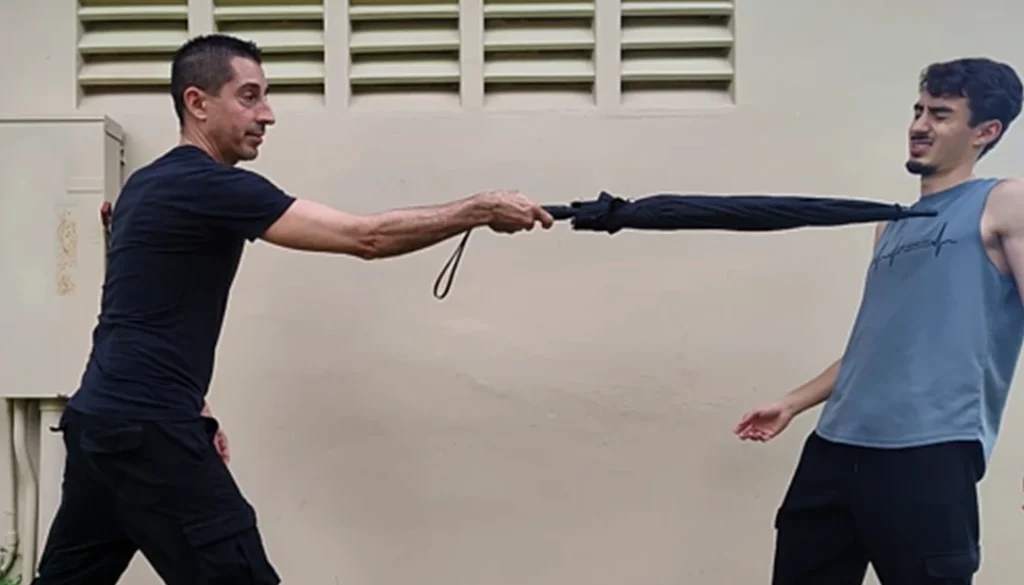
Self-defense can be a sticky situation in the eyes of the law. There is a fine line between being seen as the defender and the aggressor. This makes it hard to determine whether you should engage or stand down. These three real-life cases show how who started a fight is critical in determining who pays for it in court.
Should You Engage or Stand Down?
Case One: Montana v. James Stiffler
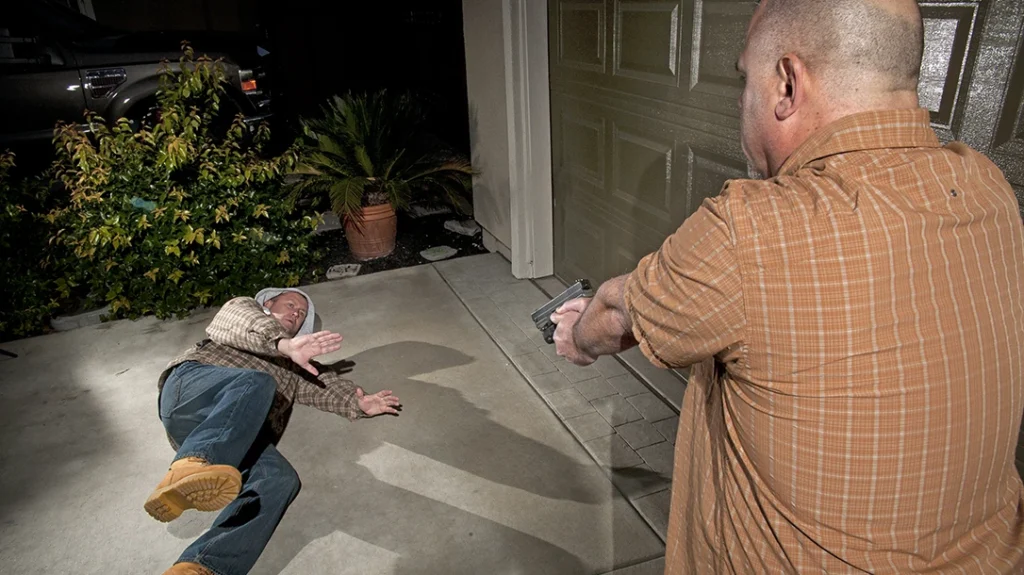
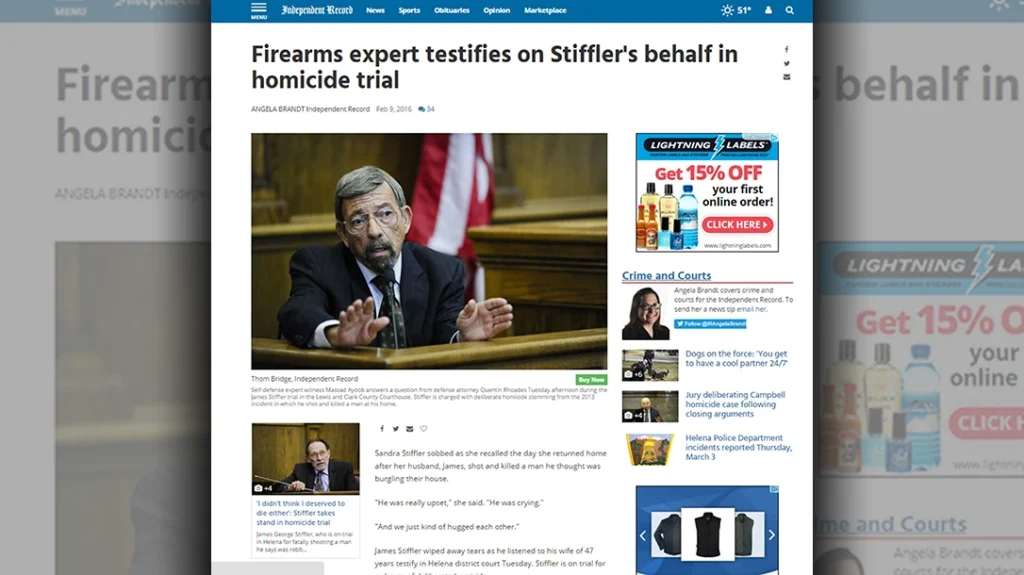
In February 2016, in Helena, Montana, I spoke as an expert witness for the defendant in Montana v. James Stiffler. The defendant, a senior citizen, had come home to find his front door kicked in. He could see through the window a large male stranger inside the house.
Fearing that his wife was in the house and in danger, he grabbed his 9mm pistol from his glove box, rushed inside, and confronted the hulking intruder.
Advertisement — Continue Reading Below
“I’m going to hurt you,” the man growled as he came at Stiffler.
In a single motion, the homeowner brought the pistol up from low ready and fired. The assailant reflexively spun off line from the upcoming gun, faster than it was humanly possible for the homeowner to cognitively process and stop an already-underway trigger pull. As a result, the bullet entered behind the lateral midline and exited the center of the chest.
The intruder dove out the window, made his way to his getaway car, and died behind the wheel. Some 665 days later, the county prosecutor decided to charge Stiffler with deliberate homicide. Thus, Case One was born.
Advertisement — Continue Reading Below
Action/reaction paradigms were explained to the jury, including why an opponent’s quarter turn, accomplished in a quarter second, would happen faster than the shooter could mentally process that the attack had broken off and stop a desperate pull of a trigger. However, the jury deadlocked at 10 to acquit and two to convict.
The latter reportedly stated that they voted “guilty” because the prosecutor had told them in final argument that in entering his own home to rescue his wife, the defendant had become the initial aggressor. Before it could be rescheduled for another trial, the prosecutor dismissed the case.
Advertisement — Continue Reading Below
The Real Victim
If you are a parent, the following dialogue may sound familiar to you:
“Johnny, stop hitting your brother!”
“But Dad, he hit me first!”
Advertisement — Continue Reading Below
At home, the arbitrating parents generally rule against whoever started the conflict as the guilty party deserving of punishment. In macrocosm, it happens between nation-states, where it is arbitrated by an entity such as the United Nations. The entity then levies punitive sanctions against the initial aggressor.
In the middle, in a personal conflict that ends in the use of sometimes-lethal force, the same principles hold true. The “initial aggressor” rule has its roots in ancient law. It has long been established that when someone starts a fight without a lawful reason and ends up killing the other party, he cannot claim self-defense.
Case Two: Texas v. Raul Rodriguez
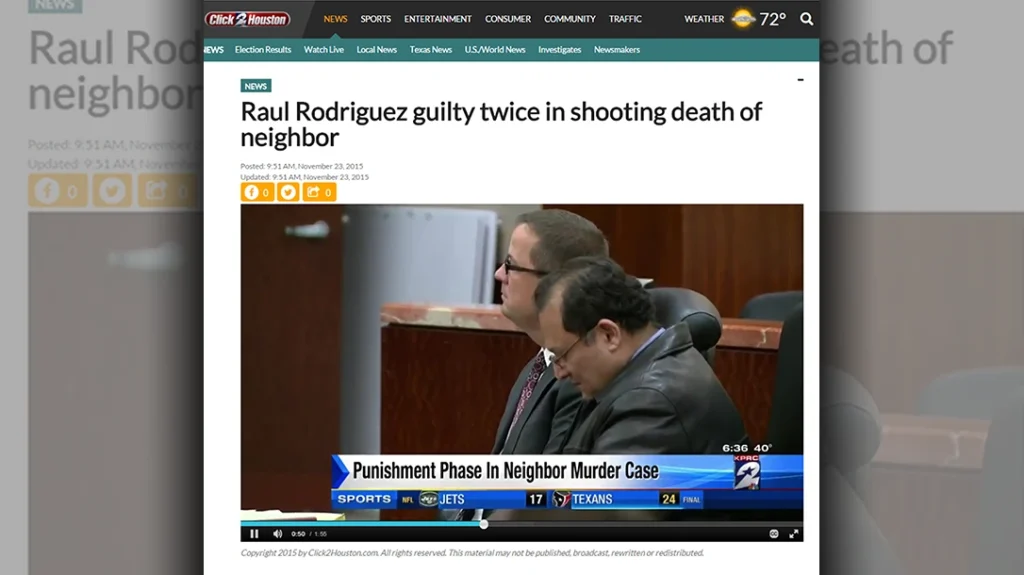
According to Click2News in Houston in late 2015, “Five years ago, Rodriguez went to the Danahers’ home to complain about loud music coming from a birthday party. Rodriguez was armed with a pistol, flashlight, and a cellphone that was recording video.
Advertisement — Continue Reading Below
“Rodriguez claimed Danaher became aggressive, and he fired in self-defense. Two other men were wounded in the shooting. In 2012, a jury rejected Rodriguez’s claim he had the legal right to ‘stand his ground’ and use deadly force to defend himself. The jury found Rodriguez guilty of murder and sentenced him to 40 years in prison.
“Two years later, an appeals court overturned the conviction on the grounds the first jury was given confusing instructions. A second jury also found Rodriguez guilty of murder, but this time sentenced him to life in prison.
“Rodríguez’s attorney hoped to parlay his client’s years in the military and as a Houston area firefighter into a lighter sentence. Prosecutor Donna Logan countered that argument. ‘You don’t get a military discount for murder. You don’t get a discount when you commit a murder because maybe you worked for the fire department for a few years,’ said Logan.
Advertisement — Continue Reading Below
“Rodriguez will be 80 years old before he is eligible for parole.”
Falsely Accused
In Case One, the defendant had every right to enter his own home to defend the endangered spouse he believed to be trapped inside by a dangerous felon. Only in the farthest-reaching flight of overzealous prosecutorial fantasy could he have been seen as an illegal “initial aggressor.”
In Case Two, the defendant had gone to the other man’s property. He was loudly and offensively shouting at him while conspicuously open carrying a large pistol at a time when it was not legal to do so in that state. It is hard to argue with two juries that saw him as an initial aggressor and therefore culpable.
Case Three: Florida v. George Zimmerman
The prosecution portrayed the defendant as a bullying vigilante, going to great lengths to paint him as the initial aggressor. At his cleverly titled legal blog “blawg,” criminal defense attorney Richard Hornsby said the state’s attorney’s probable cause affidavit included the following:
“When the dispatcher realized Zimmerman was pursuing Martin, he instructed Zimmerman not to do that, and an officer would meet him…Martin attempted to run home, but was followed by Zimmerman…Zimmerman confronted Martin, and a struggle ensued.”
In the brilliantly crafted and delivered defense, ace lawyers Mark O’Mara and Don West proved otherwise to the jury. The dispatcher had asked where the suspicious stranger (Martin) had gone. Zimmerman (the duly elected, not self-appointed, captain of the Neighborhood Watch) reflexively and obligingly left his car to go looking and find out the answer to the dispatcher’s question.
The dispatcher never “instructed” Zimmerman not to do so. He merely told him he didn’t have to, at which time it is clear from the tape that Zimmerman stopped doing so. The defense showed the young man had ample time to go home.

However, he instead had apparently doubled back and literally ambushed Zimmerman. He punched him to the ground, raining blows on him and finally trying to get Zimmerman’s gun before the latter fired the single shot of the encounter.
The six wise women on the jury understood what was what. I believe their acquittal of George Zimmerman on all charges was absolutely the correct verdict, supported by the evidence.
Of the many lessons exemplified in Case Three, one is that you may be falsely accused of being the initial aggressor. If that happens, evidence analysis and a professional, leave-nothing-to-chance defense are what you’ll need to prove you were not the one in the wrong.
Additional Cautions
Let’s say the other person clearly and illegallystarted a fistfight or an armed encounter with you. He realizes you’re going to win. So, he raises his hands and cries, “I give up! I’m sorry! I’m leaving now,” and turns to leave.
At this point, he has ceased to be the aggressor, and your right to harm him in self-defense has also ceased.If you now continue to strike him, or you shoot him in the back as he flees, you have shredded what the courts call your “mantle of innocence.”
Not only have you now become the illegal aggressor in a second assault, but you have literally given himthe right to harm or even kill youin self-defense. The bottom line? Don’t be the initial aggressor, and do everything in your power to keep from being seen as such in the eyes of the law.