Custom 1911s are not a new idea. Since John Moses Browning patented the design on Valentine’s Day in 1911, shooters and gunsmiths have been cutting, welding, polishing, tuning, and reimagining the platform in pursuit of something closer to perfect. The 1911 invites that behavior. It rewards it. Every era leaves its fingerprints on the design through parts, finishes, and ideas that reflect what shooters cared about at the time. This pistol is one of those fingerprints.
It is not a single maker’s pure vision. It is a union of histories, people, and technologies that came together into one machine. Built by Robar and chambered in 9×25 Dillon, this 1911 represents a strange, wonderful intersection of American gunsmithing culture, competition driven experimentation, and practical craftsmanship. It is also, simply, a joy to shoot.
Robar Custom
Robar Custom was founded in 1983 by Robbie Barrkman, a former Gunsite Academy instructor and competitive shooter who believed that firearms should first and foremost work well, feel right, and survive hard use. That philosophy guided everything the company did, from precision rifles to service pistols to competition guns.
Advertisement — Continue Reading Below

Robar became famous not just for mechanical work but for surface science. They introduced NP3 coating to the American firearms market and showed what modern metal treatment could do for reliability, corrosion resistance, and long term durability. Barrkman and his team were never chasing trends. They were chasing solutions. That mindset lives inside this pistol.
Dillon the Wildcat
The other half of this pistol’s DNA comes from Dillon Precision and the 9×25 Dillon cartridge.
Advertisement — Continue Reading Below
Founded in 1969 by Bill Dillon, the company built its reputation on making reliable reloading equipment for shooters who demanded consistency and control over their ammunition. That practical engineering mindset led to experimentation. In the late 1980s, Dillon employees Randy Shelley and Eric Harvey created the 9×25 Dillon by necking a 10mm case down to 9mm.
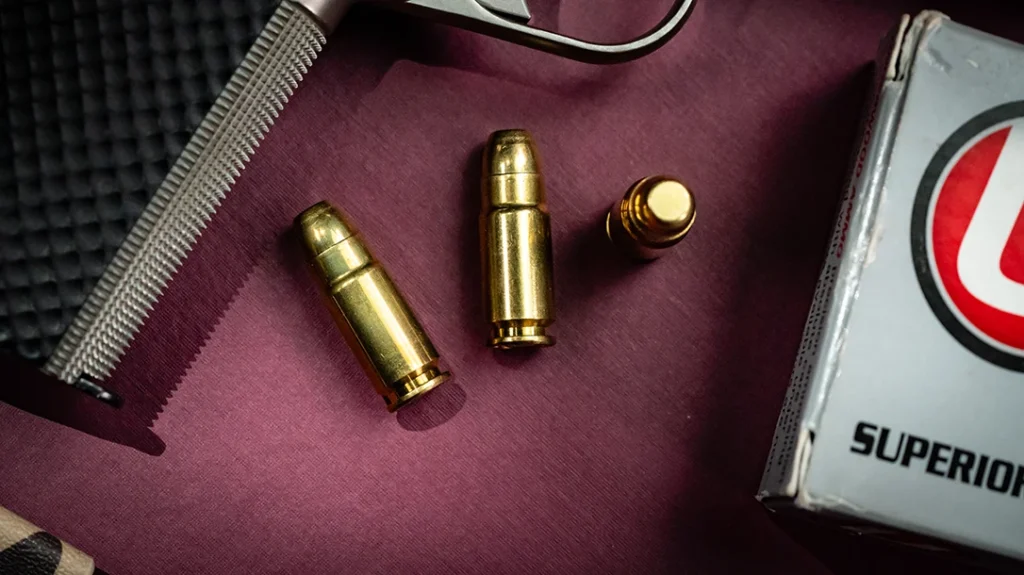
The goal was simple. Generate enough velocity to make Major power factor while feeding compensators with gas to tame recoil. The result was a screaming fast cartridge that pushed 9mm bullets into ballistic territory normally reserved for much larger rounds. It worked. It just became unnecessary as rules changed and other cartridges caught up. That does not make it less interesting.
Advertisement — Continue Reading Below
Robar Custom 1911 Build
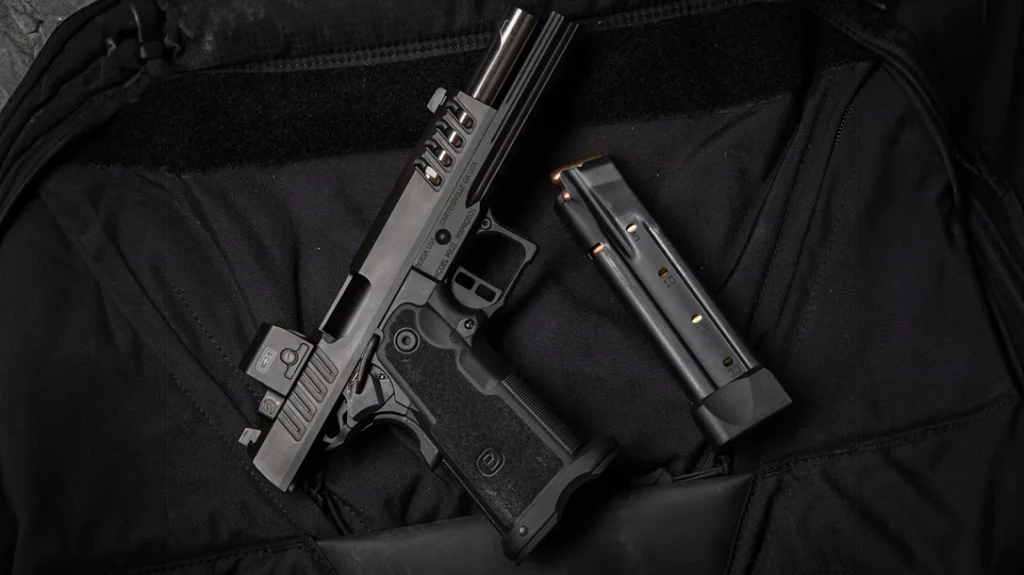
This 1911 is a 5-inch gun with a bull barrel and a reverse plug up front. The slide is a forged Springfield unit that provides a solid foundation. The frame is a Rock Island, chosen not for prestige but for dimensional consistency and strength. The grips are aggressive G10 Recons from VZ Grips that lock the gun into the hand, which matters because the 9×25 is spicy.
The barrel is a Nowlin. That matters. Nowlin barrels have earned their reputation through consistent rifling, excellent steel, and tolerances that favor accuracy without sacrificing reliability. It is a perfect choice for a high velocity cartridge that demands stability and precision.
Everything visible and invisible wears Robar’s NP3 coating. NP3 is an electroless nickel coating infused with PTFE particles that dramatically increases corrosion resistance, reduces friction, and improves wear life. It creates a surface that is slick, self lubricating, easy to clean, and extremely durable. On a 1911, where sliding surfaces, locking lugs, and small parts all live in friction’s shadow, NP3 makes sense.
Advertisement — Continue Reading Below
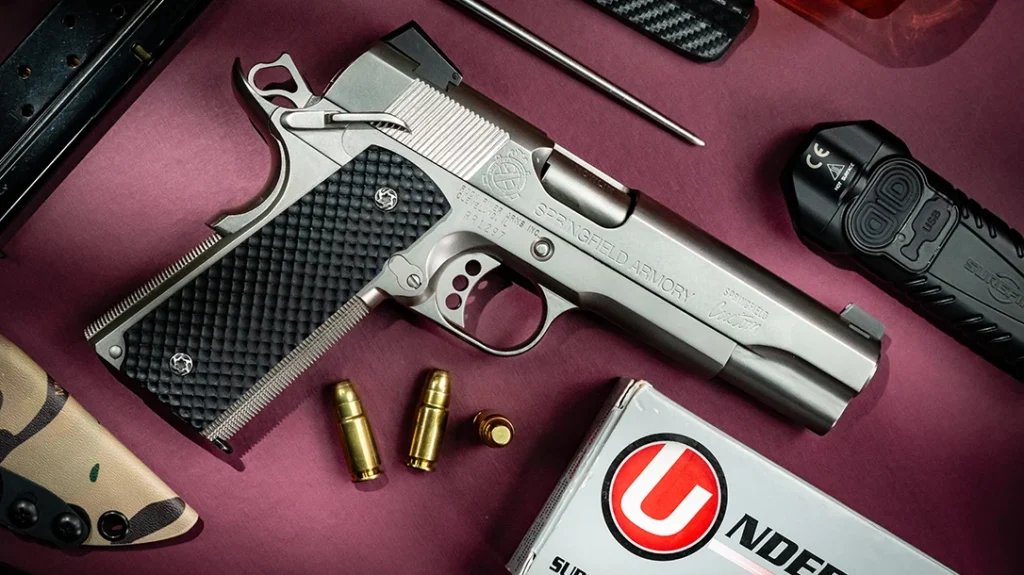
The pistol weighs 41 ounces. The trigger, measured on my Lyman gauge, breaks at 4.1 pounds. That is heavier than most competition 1911 triggers, but it is crisp, clean, and predictable. I had no trouble shooting it at 82 yards.
The sights are a Novak compact adjustable rear and a Trijicon night sight up front. That combination gives precision with low light capability and fits the personality of the gun well.
Advertisement — Continue Reading Below
This pistol is a Frankenstein, but it is a pretty one. Every part is here because someone thought it should be.
Robar Custom 1911 Range Time
I test pistols on three targets. A paper target at 21 feet, an eight inch steel plate at 50 feet, and a USPSA plate at 80 yards.
This 9×25 is flat flat shooting. The gun landed shots at point of aim at all three distances. The flight speed makes it feel like a rifle in the hand. Recoil impulse is less than expected for the energy delivered, but the grip texture is appreciated because things are moving quickly.
Advertisement — Continue Reading Below
I brought a box of Underwood 125 grain ammunition advertised at 1700 feet per second. Underwood has a good reputation for honest velocity, and this was no exception. Five rounds over my Garmin Xero averaged 1634.2 feet per second. That delivers 741 foot pounds of energy at the muzzle.

That is squarely in 10mm territory and brushes up against .44 Magnum energy levels from a pistol sized package. With manageable recoil and excellent shootability, it is a stout and impressive combination.
It is also impractical.
The 9×25 Dillon is not easy to find. Brass is not common. Data is not abundant. It lives outside the mainstream. That does not make it bad. It makes it a commitment.
Final Shot
There are pistols that carry more rounds and cartridges that are easier to source. There are guns that are more logical choices for most people.
That is not why this exists.
This Robar is an icon dripping with American gunsmithing provenance. It represents a time when shooters, builders, and engineers were pushing boundaries simply because they could. It carries the fingerprints of people who shaped the culture we now enjoy.
Every year we stand on the shoulders of those who came before us. This pistol is a physical reminder of that truth.
Taking this monster to the range puts a massive smile on your face. It connects you to the people who built it, the ideas that shaped it, and the culture that allowed it to exist.
That is worth something.
WHY OUR ARTICLES/REVIEWS DO NOT HAVE AFFILIATE LINKS
Affiliate links create a financial incentive for writers to promote certain products, which can lead to biased recommendations. This blurs the line between genuine advice and marketing, reducing trust in the content.