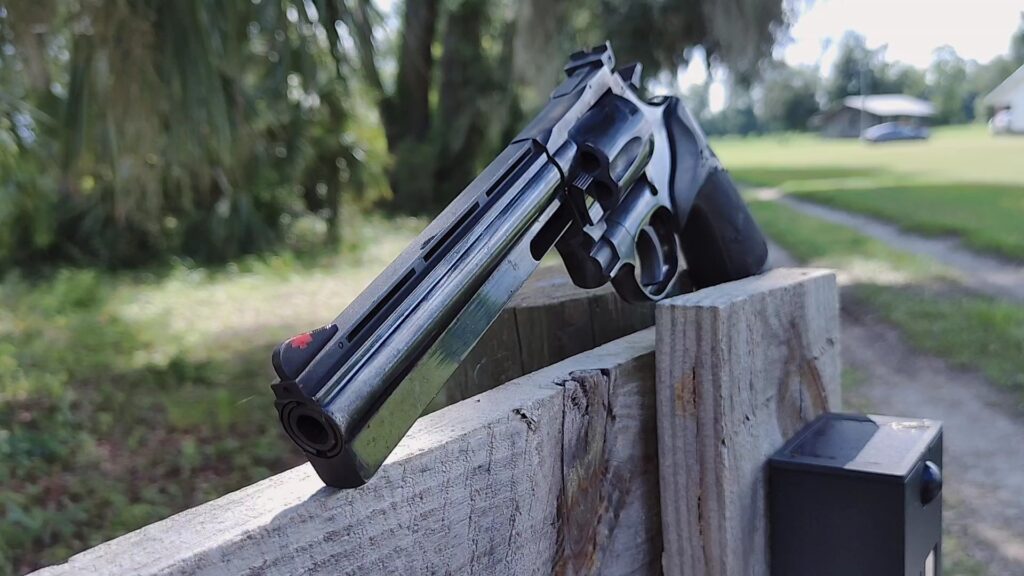
In the world of single-action revolver clones, the default choices are reproductions produced by Uberti and Pietta. Uberti tends to focus on finely finished minute variations, whereas Pietta offers a wider variety. Their percussion revolvers diverge from the typical Colt and Remington to include obscure and unrelated designs like the Paterson and LeMat. But Pietta also produces a fine Colt Single Action Army revolver. Their most versatile offering is the Pietta King Trio Revolver. This six-shooter allows the user to fire .38 Special, .38 Super, .357 Magnum, and 9mm Luger cartridges.
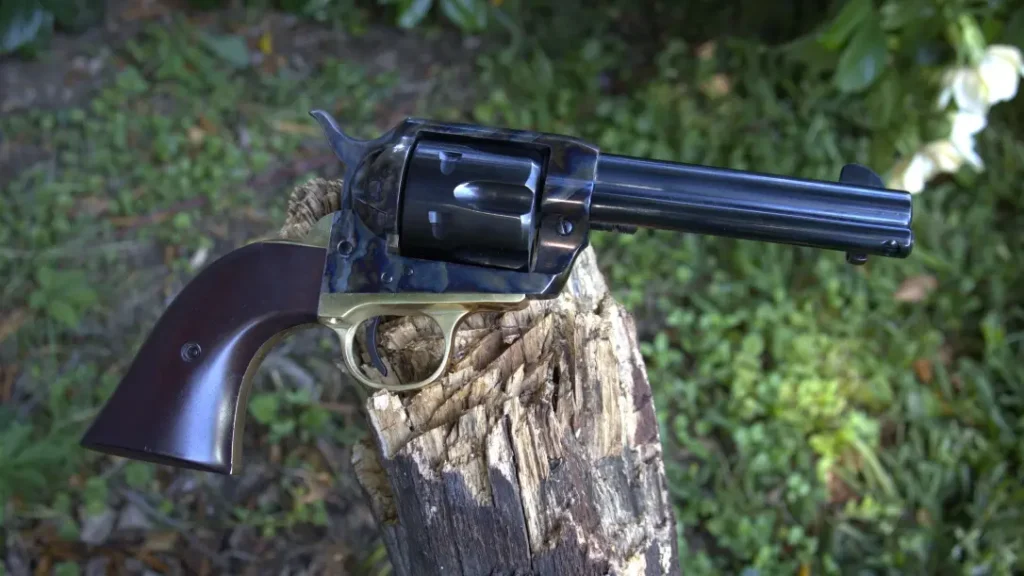
The Pietta King Trio Revolver – Three in One
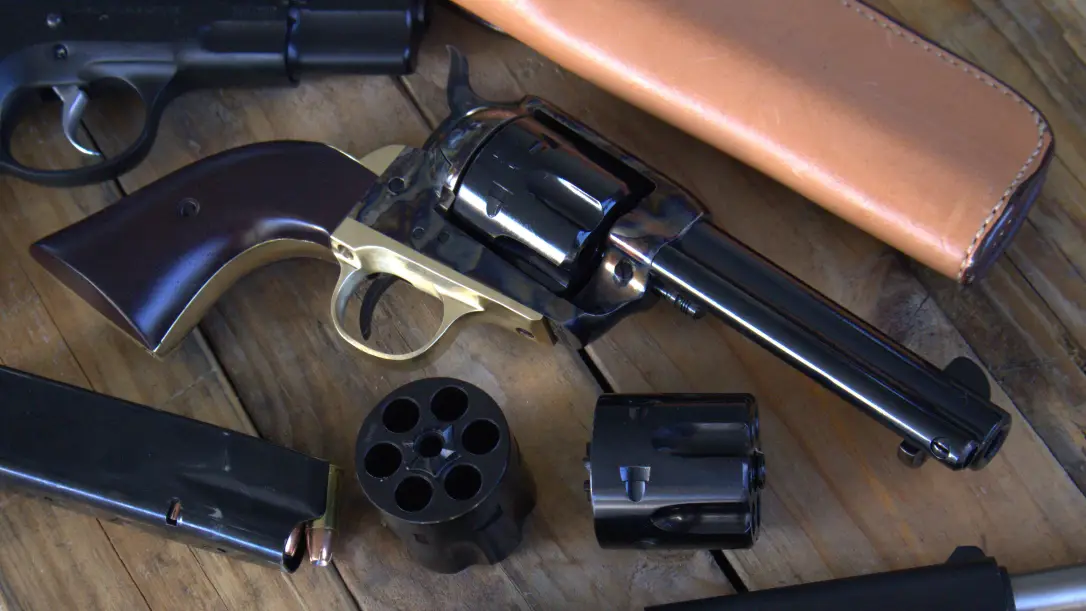
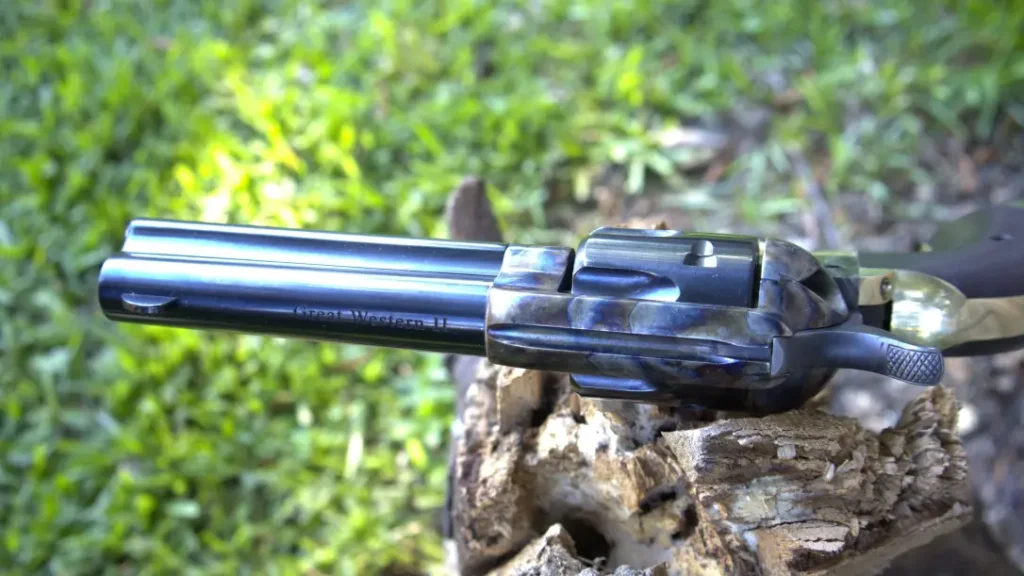
The King Trio is Pietta’s standby Great Western II revolver. It is paired with three interchangeable cylinders: one in .38 Super, one in 9mm, and one in .357 Magnum.
Advertisement — Continue Reading Below
The revolver itself is a faithful clone of a second-generation Colt SAA. It has a higher-visibility square-notch rear sight milled into the top strap of the frame and a wide half-moon front sight. The cylinder pin is retained by a simple spring-loaded bolster in lieu of a set screw, as seen on first-generation Colts.
The King Trio features either a 4 ¾ inch or 5 ½ inch deep blued barrel and black varnished walnut grips. It also has an attractive, though not period, brass grip frame. The cylinder frame is all-steel and has a vibrant case-hardening job. Other features include a full ejector rod with a crescent-shaped button and the classic four clicks of the hammer as it is cocked from the safety notch to half-cock to full cock. The Pietta King Trio is an exclusive offering through Davidson’s in Prescott, Arizona, and has an MSRP of $800. The model for this review is the handy 4 ¾ inch barreled model.
Advertisement — Continue Reading Below
Why All These Calibers?
Colt Single Action clones serve as a channel for our inner cowboy. But I always liked the platform’s simplicity and ruggedness. They are simpler than a modern double-action and can handle some big-bore cartridges if need be. The King Trio caught my attention because of the sheer number of cartridges you could shoot.
The .357 Magnum cylinder, which will also handle the shorter .38 Special cartridge, is a no-brainer. Both are popular revolver cartridges, with the former a legitimate hunting round with the right load. 9mm Luger makes sense since its bullet diameter is close to the .357, and it happens to be the most popular pistol cartridge today. You can have a single action without having to take a reverse mortgage on ammunition.
The .38 Super left me scratching my head. It is a high-pressure cartridge with more power than standard 9mm, and it is popular in places where 9mm is either unavailable or not allowed. The Super is also popular in IPSC circles, but I could not see wielding a single-action revolver in that sort of competition. The answer I ultimately came up with is “because we can.” 1911 .38 Super owners can rejoice at getting a revolver in the same caliber. The user gets the added benefit of using .38 Super and .38 ACP. Certainly, if there is a run on ammunition, more options for range work are always a good thing.
Advertisement — Continue Reading Below
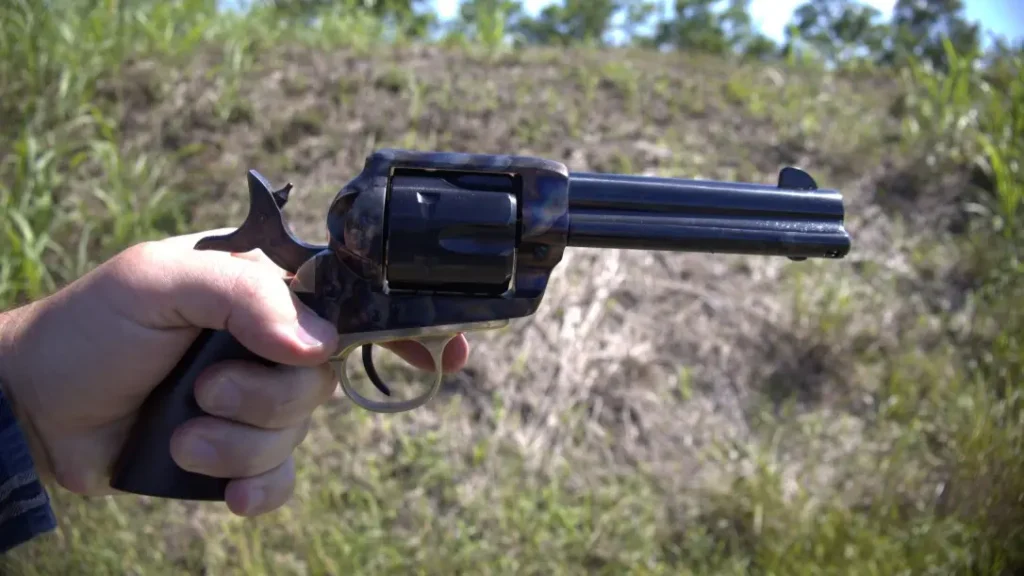
On The Range with the Pietta King Trio
The Pietta King Trio was a straightforward shooter on the firing line. It went through a three-hundred-round battery of tests. These tests range from accuracy on paper to offhand winging shots on steel out to fifty yards. It ultimately passed the test, but the journey was more interesting than the destination on account of all the caliber changing.
Picking Calibers
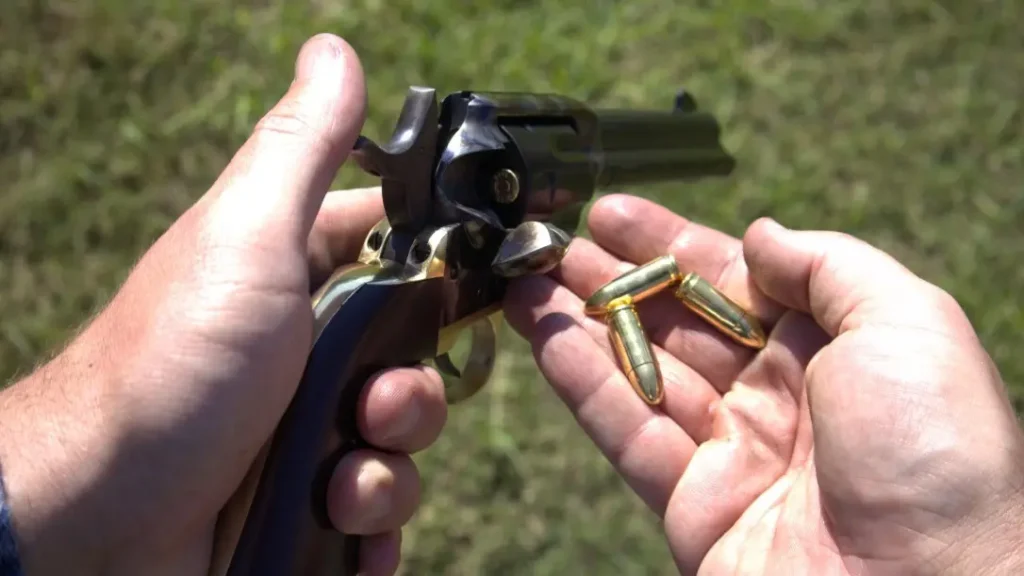
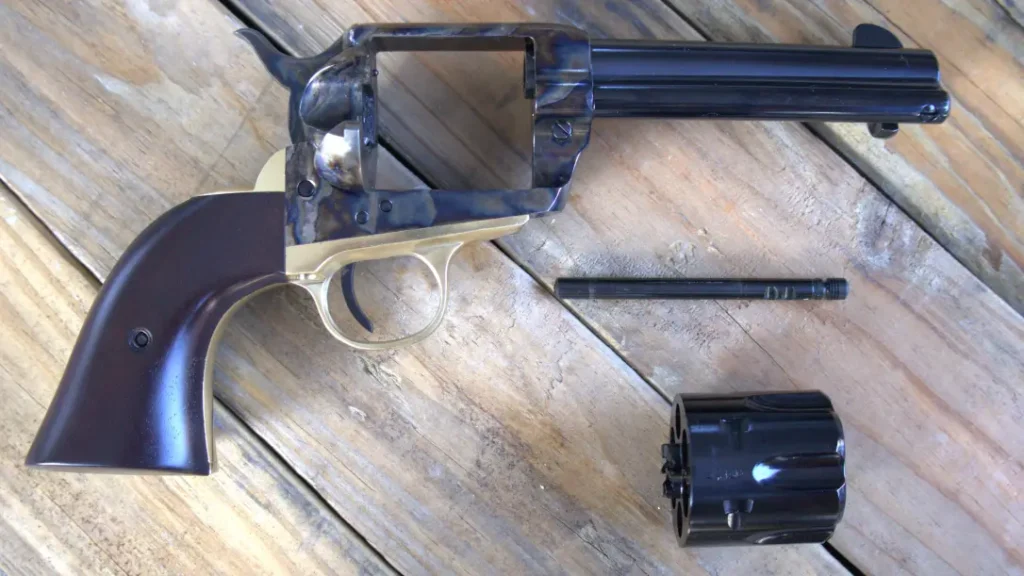
It is a simple proposition to pick the caliber you want to shoot out of the Pietta King Trio. Each cylinder is stamped on the backplate with the caliber it is intended for. Once you have selected the caliber you want to shoot, the existing cylinder has to be removed from the revolver. This is done by drawing the hammer to half-cock, then pushing in the bolster. The bolster rides in the frame underneath the cylinder pin. Draw the cylinder pin out, open the loading gate, and the cylinder comes right out.
Advertisement — Continue Reading Below
Putting in the new cylinder is a bit of a trick. The cylinder is pushed into the frame and sometimes requires a clockwise roll to push past the cylinder hand. It is lined up with the cylinder pin recess. Then the cylinder pin is pushed in place while the bolster is depressed. There are two notches on the cylinder pin that interface with the bolster, when there should be just one. Pushing the second notch into the bolster causes the cylinder pin to go too far into the recoil shield. This prevents the hammer from traveling fully forward to fire the revolver. The first cylinder locking notch is the one you want to lock into. It secures the cylinder and pin at the right depth.
Accuracy
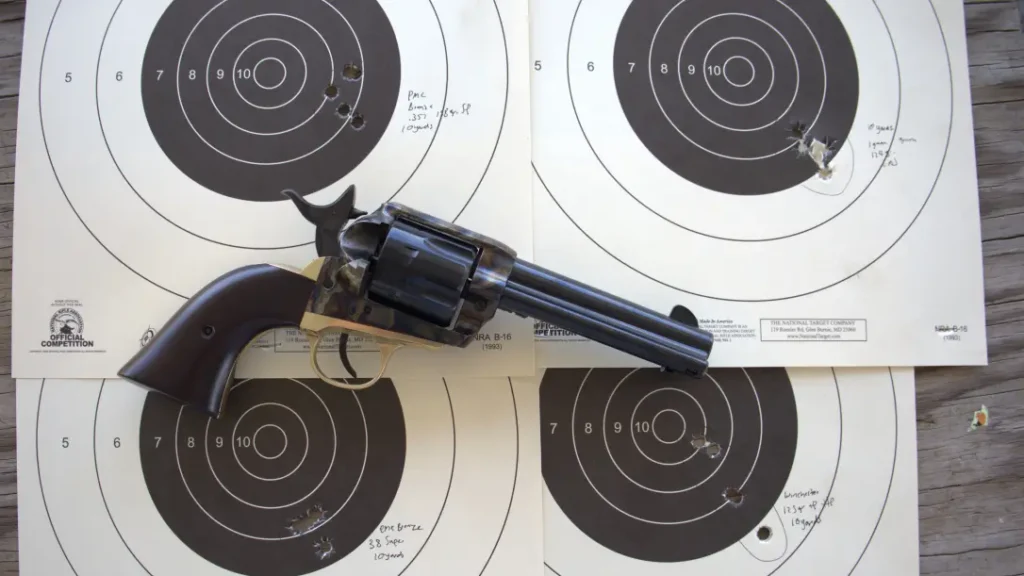
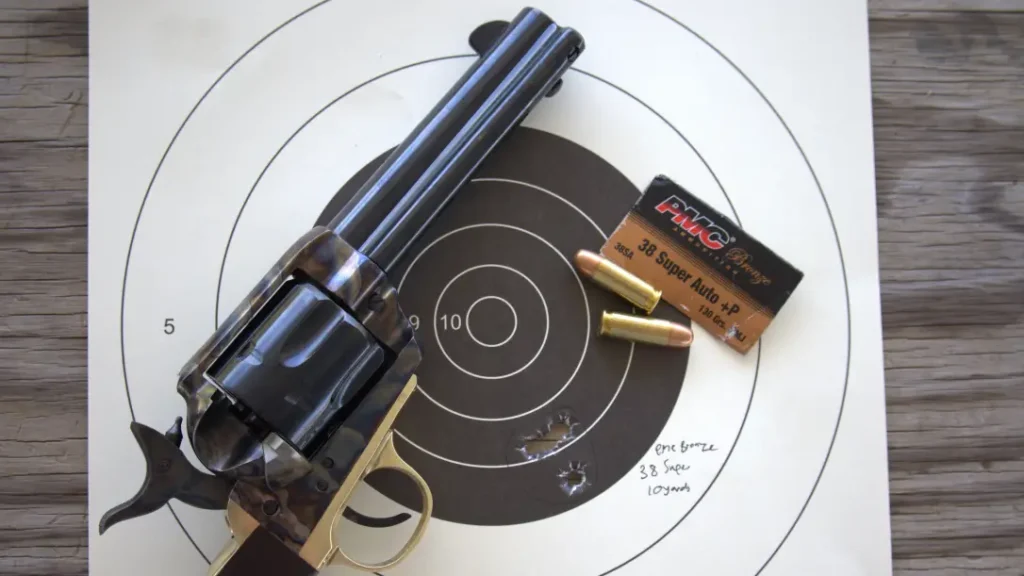
I started my shooting with the King Trio with some offhand accuracy testing at ten yards to get on top of the fixed iron sights. The ammunition used included:
Advertisement — Continue Reading Below
| Brand | Muzzle Velocity (fps) | Accuracy (inch) |
| PMC Bronze .38 Super 130 gr. FMJ +P | 1,047 | 0.75 |
| Winchester .38 Special 125 gr. +P JHP | 1,030 | 2.2 |
| Igman 9mm 124 gr. FMJ | 1,138 | 1.08 |
| PMC Bronze .357 158 gr. JSP | 1,264 | 1.3 |
| Double Tap .357 180 gr. Hard Cast | 1,487 | 2.3 |
As the King Trio is nominally chambered in .38 Super, it shoots the PCM Bronze .38 Super FMJ load the best. It gave five-shot groups frequently coming in at under one inch. But the 9mm Igman load is never far behind. The sights themselves hit 1.5 inches to the right at ten yards. With the .38 Special, .38 Super, and 9mm, the King Trio also hits two inches low. The heavier .357 Magnum loads hit to the point of aim.
Advertisement — Continue Reading Below
Recoil and Handling
Felt recoil is mild with the .38 Special +P load and brisker with the 9mm and .38 Super loads. Even the harsher PMC Bronze .357 load doesn’t break the grip, although muzzle rise is significant. The Double Tap bear load’s recoil is severe, but the only pain comes when the trigger guard smacks the middle finger. I could see that being painful with a full box.
The trigger is narrow, which can affect the left-to-right movement of the pistol in the hand. Thankfully, the trigger pull and the balance of this SAA clone make it an easy shooter. I am used to a bit of slop in Pietta triggers. But this King Trio has no take-up at all and breaks even at 3 ½ lbs. As with any SAA, the sights naturally align like a finger is pointed.
Loading and unloading are straightforward. The hammer is drawn back to half-cock so the cylinder will spin. The loading gate is then opened, and cartridges are dropped in one at a time. Like most Colt clones, there is no drop safety. Loading one round, skipping a chamber, then loading four, before drawing and lowering the hammer, puts you on an empty chamber for carry. Unloading follows the initial loading procedure, except that the cylinder is rotated and the empty shells are punched out with the ejector rod. The rod comedically pops out the short .38 Super and 9mm cases with ease.
Going the Distance
I spent the remainder of my ammunition engaging a pair of eight-inch steel plates and a ½ D8 silhouette out to fifty yards. Getting hits out to that distance was not difficult, particularly with the .357 Magnum loads. This flat shooting round hits to the right elevation, although at fifty yards, that 1 ½ inches of windage became six inches. I had to aim for the left edge of the plates in order to knock them. Hitting the torso was easy to accomplish with all the rounds tested, and I even tried my duelist stance. With the heft and balance of the King Trio, I was able to hit more times than not.
Revolver Royalty with the Pietta King Trio
At the start, the Pietta King Trio was a head scratcher when it came to calibers. But on its own, it is one of the best-made Pietta revolvers out yet. It has its foibles. Cylinder pin over-advancement is possible if you don’t pay attention. Likewise, the safety and half-cock notches are on the shallow side and give less audible and tactile feedback. However, the King Trio is both aesthetically well-made and a good performer. It made it through the three-hundred-round battery of tests without a single failure. I would not hesitate to use the Pietta King Trio in SASS if only all its cartridges were allowed.
Quick Specs
- Caliber: .38 Super/ 9mm Luger/ .357 Magnum
- Capacity: 6
- Barrel Length: 4.75 inches
- Overall Length: 10.5 inches
- Height: 5 inches
- Width: 1.6 inches (cylinder)
- Weight: 2 lbs. 8.2 oz. (unloaded)
For more information, visit Pietta.
WHY OUR ARTICLES/REVIEWS DO NOT HAVE AFFILIATE LINKS
Affiliate links create a financial incentive for writers to promote certain products, which can lead to biased recommendations. This blurs the line between genuine advice and marketing, reducing trust in the content.