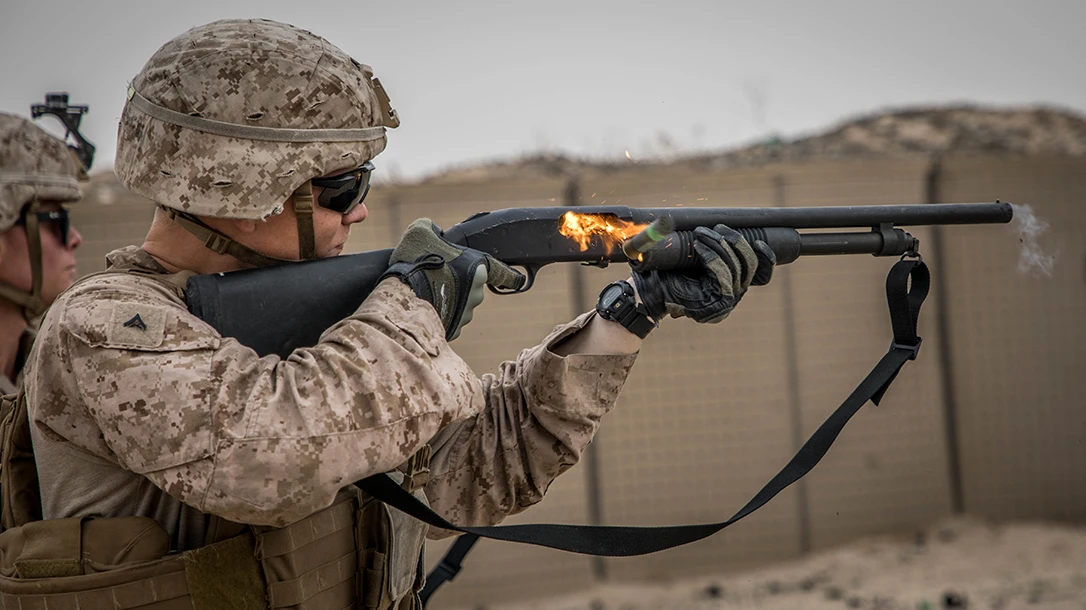
When the U.S. Army goes shopping for a pump shotgun, they don’t browse… they go straight for the workhorse that’s been kicking doors and clearing trenches since the late ’80s. Mossberg just announced a new $11.6 million contract to deliver additional 590A1 pump-action shotguns to America’s warfighters. Proof that some tools are so dependable, they never leave the loadout.
First Mossberg 590
The military first tapped the Mossberg 590 back in 1987 after it crushed the brutal MIL-SPEC 3443E test. A trial designed to separate real combat guns from the range-toy pretenders. But Uncle Sam didn’t stop there. He wanted something even tougher. Something that could take abuse, sand, rain, mud, and the kind of round counts that make lesser shotguns tap out. Mossberg answered with the 590A1, a beefed-up variant purpose-built for the worst environments on earth.
“Mossberg is honored to receive an additional contract from the U.S. Department of Defense for the battle-proven 590A1 shotgun,” said John MacLellan, VP of Sales and Marketing. “This award reflects our long commitment to supplying rugged, mission-capable firearms…”
Advertisement — Continue Reading Below

Legendary Action
Built on the legendary Mossberg 500 action, the 590A1 brings all the hallmarks of a bombproof pump gun. Twin action bars that refuse to bind, steel-to-steel lock-up, dual extractors, and an anti-jam elevator that keeps things feeding even when conditions go feral. Add an anodized aluminum receiver, ambidextrous top-tang safety, metal trigger guard, heavy-walled barrel, metal safety selector, and a parkerized finish, and you’ve got a shotgun that laughs in the face of abuse.
In an era full of high-tech gadgets and battery-dependent gimmicks, it’s refreshing when the military doubles down on a classic that still hits like a sledgehammer and never asks for anything except a little lube and a lot of shells. The Mossberg 590A1 continues to prove that when the mission gets ugly, simplicity and durability still win wars.
Advertisement — Continue Reading Below
WHY OUR ARTICLES/REVIEWS DO NOT HAVE AFFILIATE LINKS
Affiliate links create a financial incentive for writers to promote certain products, which can lead to biased recommendations. This blurs the line between genuine advice and marketing, reducing trust in the content.