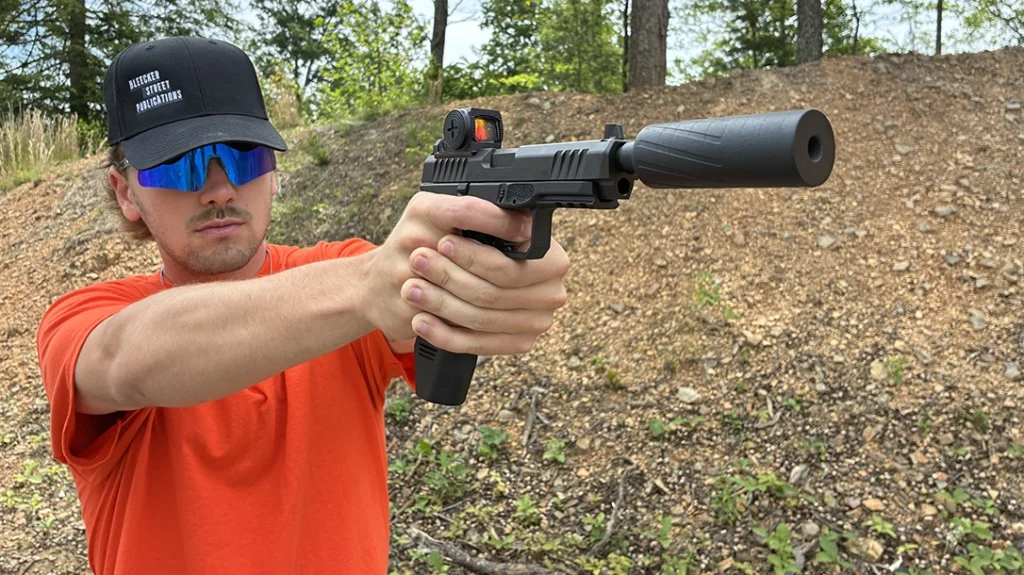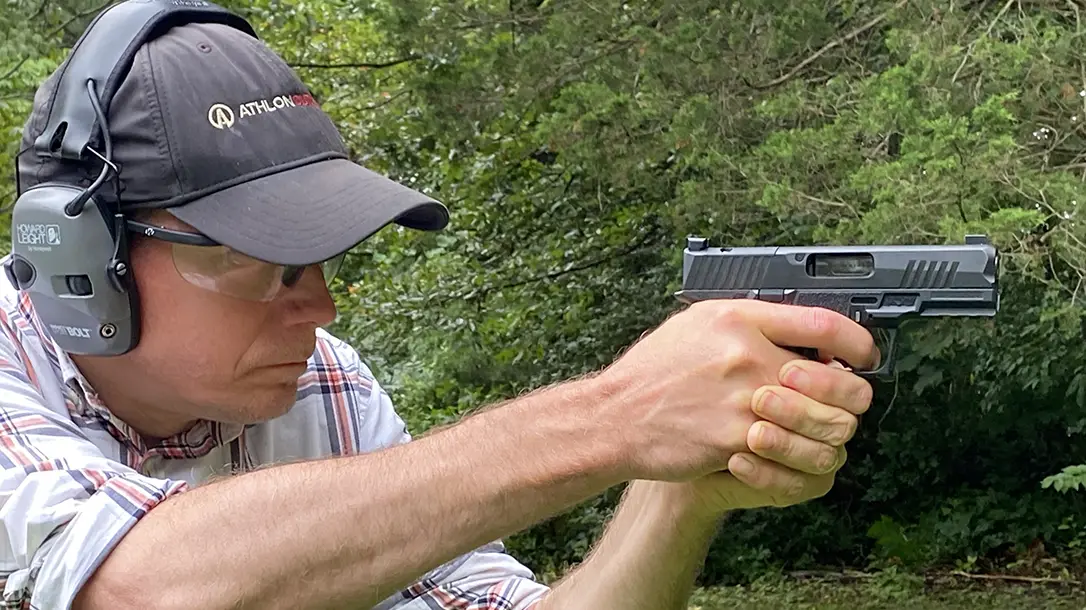
Kimber introduced its first striker-fired pistol, the subcompact R7 MAKO, in 2021. It remains one of the very best on the market at any price point. The Carbon Compact is the newest addition to the Kimber R7 MAKO family.
The Kimber R7 MAKO Carbon Compact
Don’t make the mistake of thinking it’s nothing more than a scaled-up version of its older, smaller brother. Up top, the two guns are alike except for the barrel and slide length.
They both feature stainless steel barrels and slides, the latter sculpted and relieved at the nose for easier reholstering, and FNC-treated for durability. (FNC is ferritic nitrocarburizing, which is the same surface hardening treatment Glock calls Tenifer).
Advertisement — Continue Reading Below
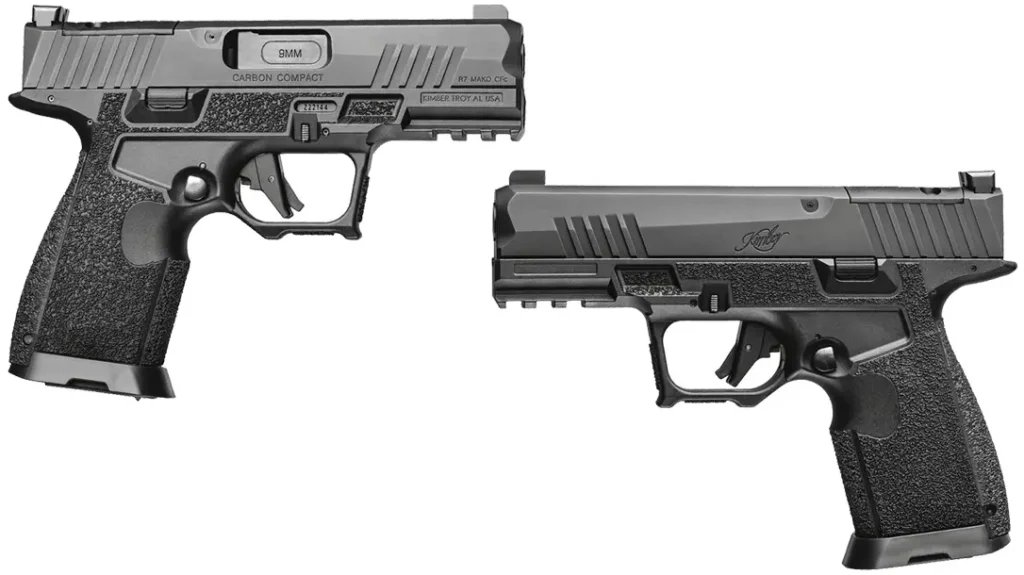
They are both optics-ready, featuring rugged steel 3-Dot TruGlo Tritium Pro night sights with a front orange ring dot and rear white ring dots. Additionally, they are both fully ambidextrous with dual magazine release buttons and slide lock release levers. These levers are easy to operate but well shielded to prevent accidental activation. The big difference is in the lower, in the design of their polymer frames.
Kimber enlarged the original R7 MAKO platform to a 15-round magazine compact size. As a result, they had the room to incorporate improvements that maximize the advantages of their unique soft-shooting action and make an already great gun even better.
Advertisement — Continue Reading Below
They started with the polymer itself. As the name implies, carbon fibers are added to the polymer blend. This resulted in increased stiffness and tensile strength (the latter reported to be 60,000 psi).
Metal components are mounted in rather than cast inside the polymer frame, adding rigidity and strength. I saw no issues with the more conventional polymers used in the smaller guns. However, the carbon polymer does seem exceptionally stiff.
Advertisement — Continue Reading Below
With the magwell flaring off, I could barely flex the long edge of the magazine opening when pressing it hard against a wooden table corner.
The Carbon Compact in Hand
The changes incorporated into the new Carbon Compact polymer frame are designed to give the shooter more positive control of the firearm. Likewise, the longer grip provides a full four-finger hold to all but the biggest banana finger hands.
The magwell-flaring curves comfortably around the bottom of my pinky, but it is easily removed if it crowds your fingers. Four back strap options allow shooters to customize it to their grip geometry and adjust its pointing characteristics.
Advertisement — Continue Reading Below
The most important new feature of the Carbon Compact frame is the deep half-circle undercut where the triggerguard meets the front strap of the grip frame. It cuts into both of them, creating a pocket for the middle finger to anchor itself. Unlike finger grooves, which are finger-size specific, this single pocket is universal. It also reduces the circumference of the grip at the top, making it easier to grasp securely with small hands.
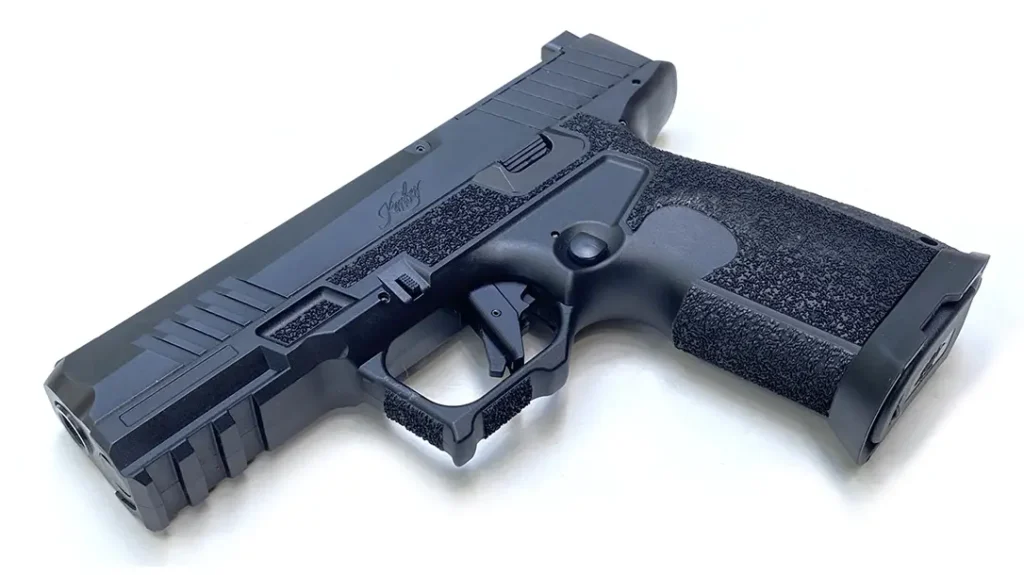
The R7 already had a high beavertail to get the top of the shooting hand closer to the bore axis. The Carbon Compact’s deep triggerguard/front strap undercut now pulls the lower three fingers of the shooting hand upward, too. This provides a more natural relationship with the trigger finger for pointing.
Advertisement — Continue Reading Below
Aggressive stippling on the grip, frame sides, and trigger guard improves purchase even with wet hands. Both sides of the grip frame behind the trigger are relieved and free of stippling. This provides better access to the trigger and a shelf to nestle the shooting hand thumb in.
To provide anchoring points for the supporting hand, two lugs were molded into the triggerguard, as well as deep, fingertip-size shelves in the frame above the front of the triggerguard.
Shucking Spent Cases
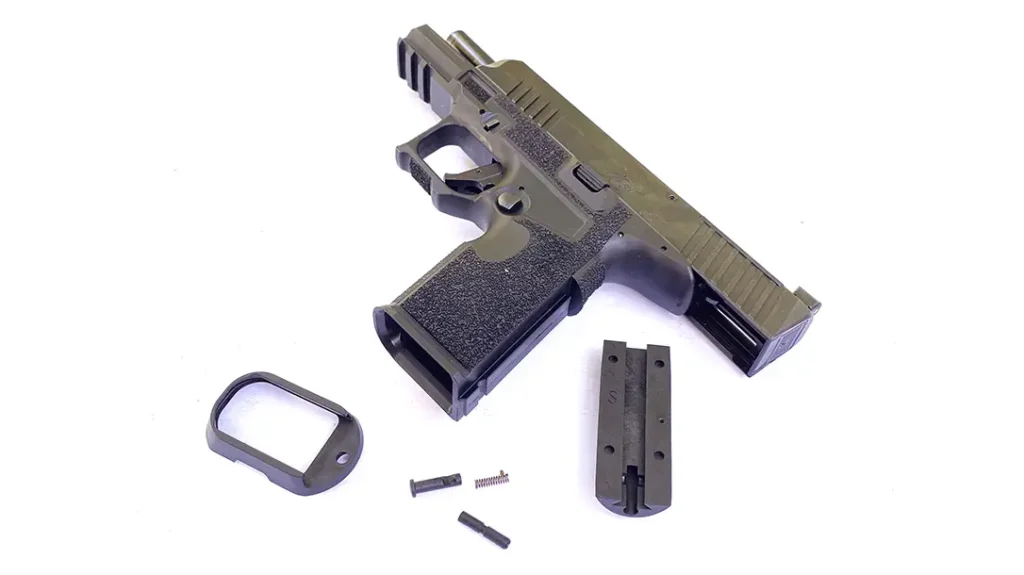
The last two new features of the frame that I like are the detachable, extended flared magazine well, which facilitates speedy reloads, and the three-slot front Picatinny accessory rail, which greatly increases versatility when mounting a light or targeting laser.
Advertisement — Continue Reading Below
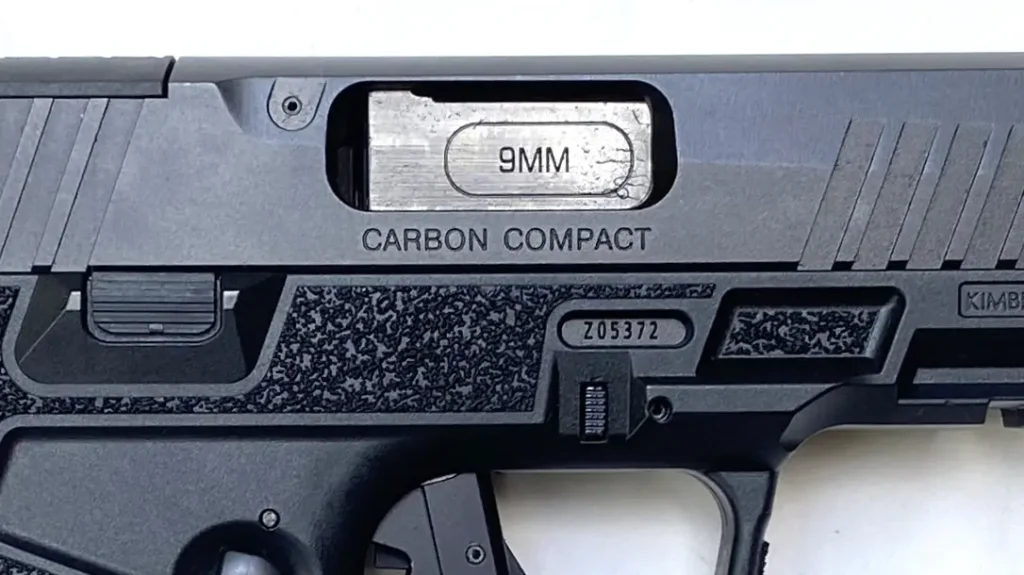
Unlike most modern auto-loading pistols, the R7 MAKO ejection port isn’t open on two or three sides. It’s cut through the right side of the slide only. I initially worried that spent cases might get hung up as they tried to make their way out of the comparatively narrow opening. However, this wasn’t the case. The pistol functioned flawlessly in my tests.
Inside the Carbon Compact
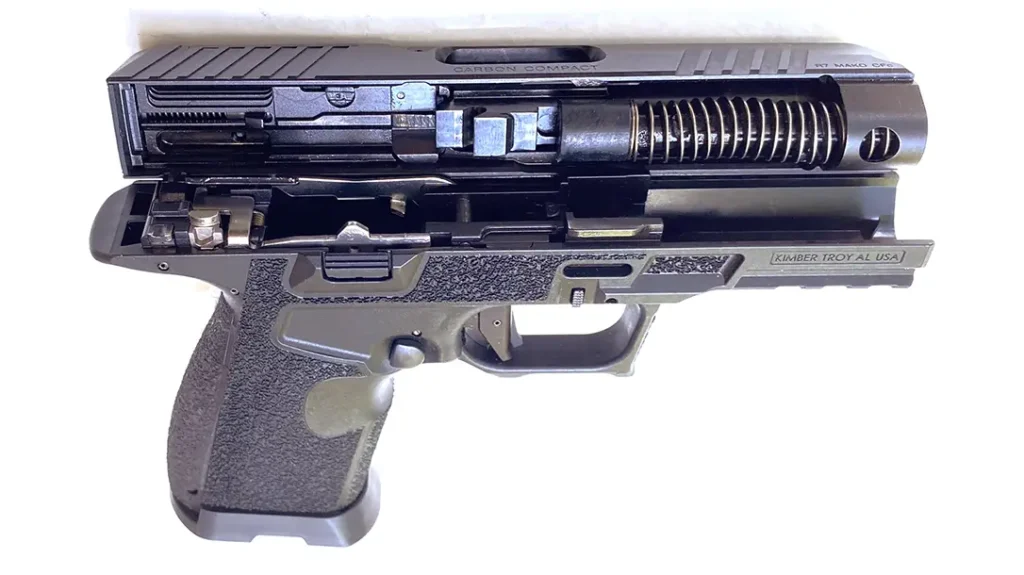
The right-side-only ejection port makes for a stronger slide. However, the main reason behind this design feature is to create a less disruptive mechanism for the barrel and slide to go into and out of battery.
Most of your modern, rectangular slide, locked breech, tilting barrel, auto-loading pistols lock into battery along a vertical joint formed by squaring off the top front edge of the barrel chamber so it can mate with a similarly squared edge at the top front of the slide’s ejection port. At the start of recoil, the chamber end of the barrel is pulled downward by the cam, separating the locked joint and allowing the slide to continue rearward alone.
By contrast, in the R7 MAKO, a rectangular locking lug protrudes from the top rear of the barrel chamber and mates with a matching cavity machined into the top of the slide. Consider that if you keep the unlocking cam under the barrel in the same place. The farther back the barrel/slide lock-up joint is moved, the less tilt is needed to break the joint.
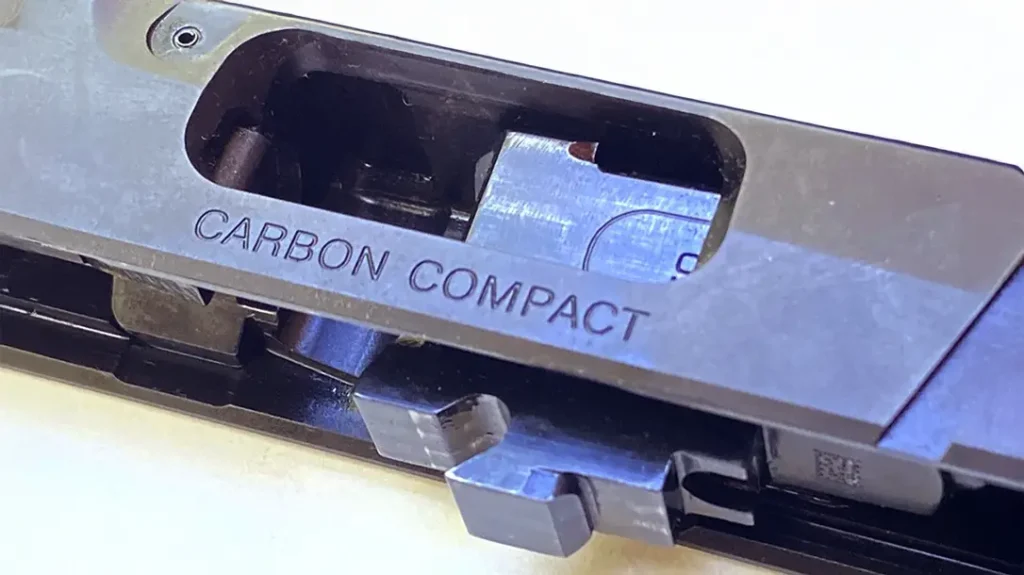
With its locking joint about an inch further to the rear than typical locked breech guns, the R7 MAKO barrel has noticeably less tilt when out of battery. This, according to Kimber, translates into less felt recoil.
I can’t say for sure how much of a role each of the Carbon Compact’s features plays in its performance. However, it feels to me more controllable than its peers. Softer shooting with less muzzle flip let me get back on target between shots faster.
Trigger Time
All Carbon Compact pistols have Kimber’s Performance Carry Trigger. It is flat-faced, made of metal, and factory-set for a 5- to 6.75-pound pull. At 0.40 inches wide, it allows for more surface contact with the fingertip, making the pull feel lighter than it actually is.
The gun I tested for this story had a notably good trigger. In fact, it’s among the very best triggers I’ve found on any striker-fired gun and better than many single-action autoloaders. It approached the quality of Walther’s Performance Duty Trigger used on its PDP series.
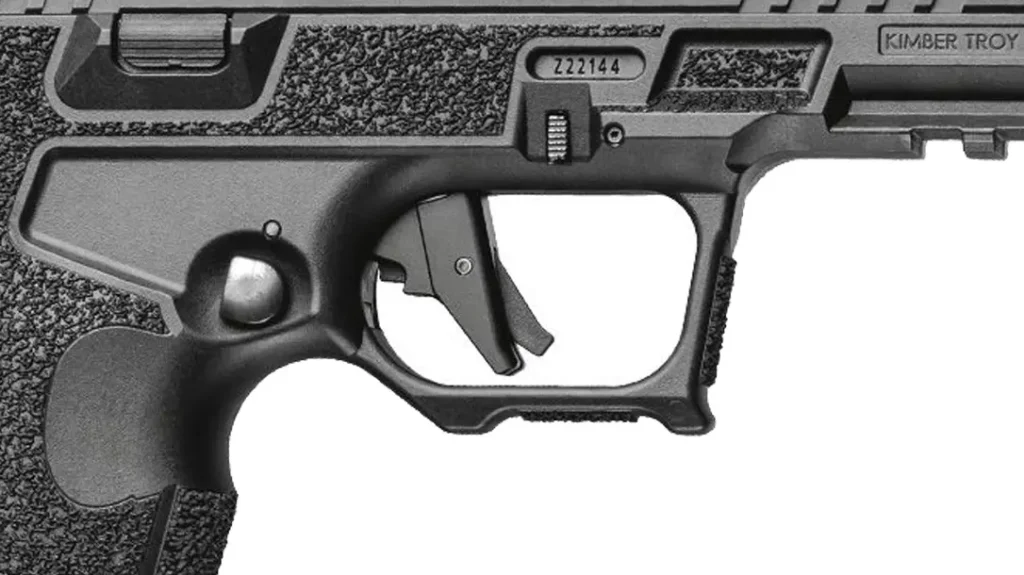
Unlike most modern striker-fired autoloaders, the Carbon Compact trigger has a single-stage trigger pull. This means there is no initial take-up after pressing in the safety blade. In addition, the trigger stroke itself is quite short and requires only 4-4.5 pounds of finger pressure to move it through 0.15 inches of travel to a nice break.
If you neither want nor need a two-stage trigger-pull on a handgun, you will probably love Kimber’s Performance Carry Trigger. There’s no wasted motion. Every bit of rearward movement is transmitted to the trigger connector to deactivate the drop safety and release the striker.
Running the Carbon Compact
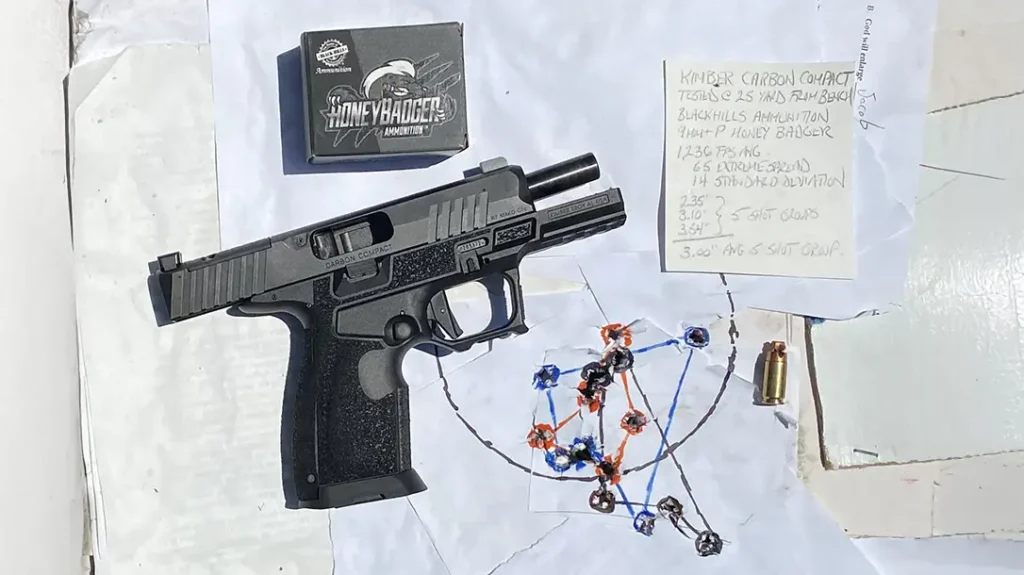
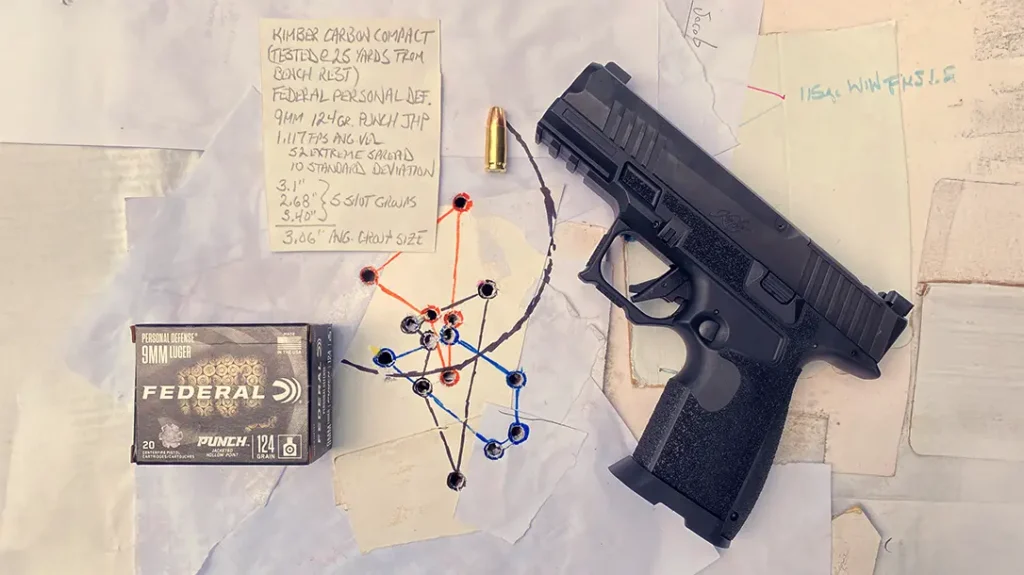
For accuracy evaluation, I used the iron sights and fired five-shot groups at twenty-five yards from the bench on a Caldwell Pistolero rest using three different brands of premium self-defense ammunition. I got good accuracy and perfect reliability from all of them.
Black Hills Ammunition’s 127-grain solid copper bullet Honey Badger load shot the tightest groups. They averaged 3.00 inches and 1,256 feet-per-second (fps) with a standard deviation of 14. This unique bullet looks like a modified Philips screwdriver tip and does not expand at all. It relies on massive hydrostatic disruption of tissue rather than a permanent wound cavity to incapacitate the target.
Federal Personal Defense Punch 9mm Luger 124 Grain JHP averaged 3.06 inches center-to-center and 1,117 fps with a standard deviation of 10. To increase reliability, the primers are sealed. As a result, they better resist oil or moisture migration into the pocket that could desensitize them over time.
Hornady Critical Defense 115-grain FTX JHP averaged a respectable 4.08 inches and 1,124 fps with a standard deviation of 14. The FTX bullet doesn’t expand and petal open quite as dramatically as some premium hollow points. However, it’s earned a record of enviable reliability through heavy clothing that would clog other hollow-point bullets.
The patented FTX bullet features a soft, rubbery plug clenched inside the hollow point cavity by the star-crimped nose of the bullet jacket. This prevents barrier materials from clogging the hollow point before it hits tissue.
Parting Shots
Compared to other popular compacts, the Kimber R7 MAKO Carbon Compact is a little bigger and bulkier looking than the popular Springfield Armory Hellcat Pro TB and SIG P365 Fuse. Both of those are likewise grown from their original subcompact forms.
The Carbon Compact is closer to a Glock 19 in size (0.36 inches less in overall length, 0.15 inches taller, and slightly thinner in width across the slide and grip). However, it is much easier to grasp and keep hold of thanks to its superior grip design.
All American-made, the Kimber R7 Mako Carbon Compact tested for this story is competitively priced, too. I found online retailers advertising it for as low as $649. It’s also available with a factory-installed Holosun HS 407K red dot optic and with or without a threaded barrel for suppressor use.
Kimber R7 MAKO Carbon Compact Specs
| Caliber | 9 x 19mm |
| Barrel | 3.92 inches 1:10LH twist stainless steel |
| Length | 7 inches |
| Height | 5.14 inches |
| Width | 0.96 inches across the slide, 1.19 inch wide across the grip panels. 1.33 inches across the flared magazine well |
| Weight | 24.2 ounces empty |
| Sights | optics ready for RMSc/Holosun K footprint, 3-Dot TruGlo Tritium Pro night sights with orange front ring and white rear rings, rear sight drift adjustable for windage |
| Material | carbon fiber reinforced polymer frame/stainless steel slide |
| Action | striker fired, locked breech, semi-auto |
| Trigger | 4-4.5 pound pull, single stage, aluminum, flat faced |
| Finish | FNC treated matte black slide & black polymer frame |
| Capacity | 15 round flush fit magazine, two included |
| Accessories | four user-installed grip backstrap options, lock, soft-sided nylon transport case |
| MSRP | $735 |
Performance
| Hornady Critical Defense 9mm | |
| Bullet Weight & Type | 115 FTX JHP |
| Velocity | 1,124 |
| Best | 2.22 |
| Federal Personal Defense 9mm | |
| Bullet Weight & Type | 124 PUNCH JHP |
| Velocity | 1,117 |
| Best | 2.68 |
| Black Hills Honey Badger 9mm+P | |
| Bullet Weight & Type | 100 Honey Badger |
| Velocity | 1,236 |
| Best | 2.35 |
Performance was tested with a series of five-shot groups fired at 25 yards from a bench rest with a Competition Electronics Pro-Chrono Digital Chronograph set 15 feet from the muzzle. Bullet weight is in grains, velocity in feet-per-second and the group size in inches.
WHY OUR ARTICLES/REVIEWS DO NOT HAVE AFFILIATE LINKS
Affiliate links create a financial incentive for writers to promote certain products, which can lead to biased recommendations. This blurs the line between genuine advice and marketing, reducing trust in the content.