The 1860 Henry Rifle is more than a firearm. It is an inflection point. Across the 19th century, it took just seventy years to go from flintlock muskets to machine guns. In that time, the basic design concepts for small arms we use today came into being. In the realm of repeating rifles, the 1860 Henry is the one that started it all. Although awkward by today’s standards, the 1860 Henry remains popular among lever-action enthusiasts and cowboy action shooters. This is a review of the Henry Rifle from Cimarron.
The Henry Rifle from Cimarron -Benjamin Tyler Henry and His Rifle
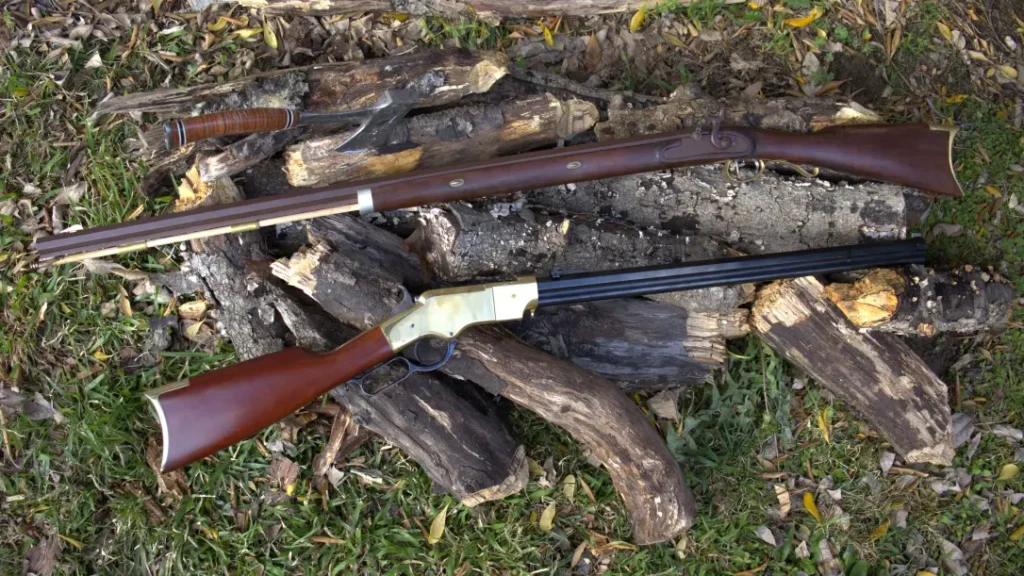
Walter Hunt’s lever-action pistol and caseless ammunition was an echo into the future that was not ready in 1848. The Volcanic Repeating Arms Company, founded by DB Wesson and Horace Smith with capital from Oliver Winchester, perfected the lever-action design, but making viable caseless ammunition was one step too far. In 1856, Volcanic went under. Smith & Wesson, the revolver company, was born the following year. Oliver Winchester was left with the rights to the design. He also had the mind and hands of Volcanic’s enterprising gunsmith, Benjamin Tyler Henry.
Advertisement — Continue Reading Below
In October 1860, Henry received a patent for a lever-action rifle based on the Volcanic. The new rifle was chambered in a .44 caliber copper-cased rimfire cartridge. In an interesting turn, the cartridge drew inspiration from Smith & Wesson’s .22 Short cartridge that debuted with their first revolver in 1857.
First Viable Repeating Rifle
The 1860 Henry was the first viable repeating rifle available in the world when the American Civil War broke out in the spring of 1861. The US Army spent too much treasure on their rifled muskets, and the 1860 Henry was deemed too fragile as a replacement. But the allure of a sixteen-shot repeating rifle was too much to overcome.
Advertisement — Continue Reading Below
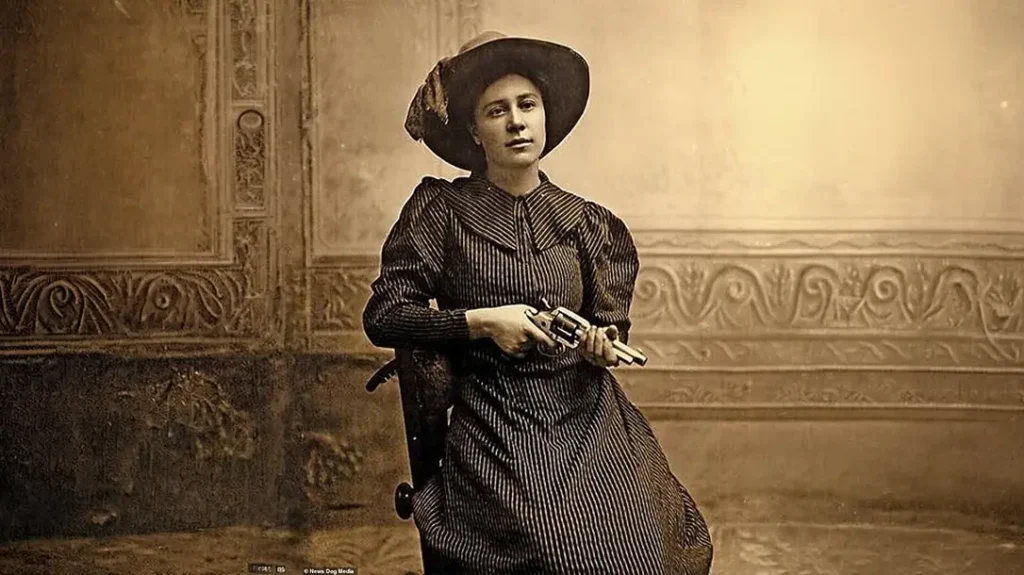
The Henry was adopted by the 1st DC Cavalry, and Gen. Benjamin Butler ordered 1,500 to outfit his troops. Private sales were brisk even during the period of hyperinflation that came with the war. Between 1860 and 1866, some 14,000 rifles were made by Winchester’s New Haven Arms Company.
Benjamin Tyler Henry left the company in 1864 amid pay disputes and a reluctance to change his design. In 1866, the improved rifle—the Winchester 1866—made its debut. The Winchester 1866 would go on to be the benchmark for the future of repeating rifles.
Advertisement — Continue Reading Below
Cimarron’s Henry 1860 Rifle
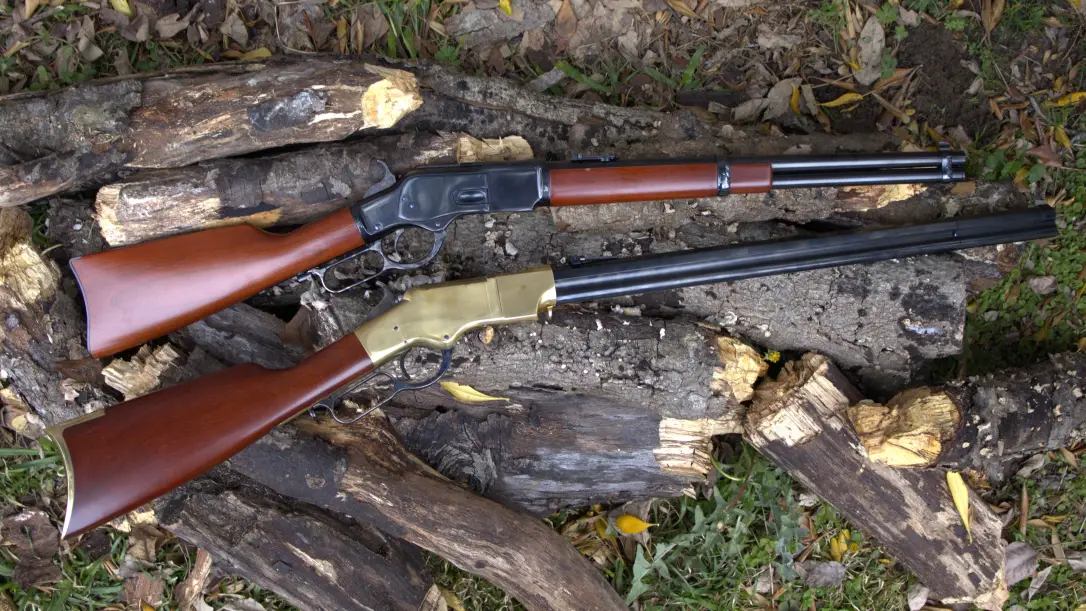
Uberti of Italy produces the Henry 1860 to Cimarron’s specifications. Cimarron’s models include an iron-framed model as well as traditional brass-framed rifles in centerfire .44-40 or .45 Colt. For consideration, here is the brass frame model in .45 Colt. It is erroneously called the Henry 1860 Civilian, but no distinct military model is known to exist.
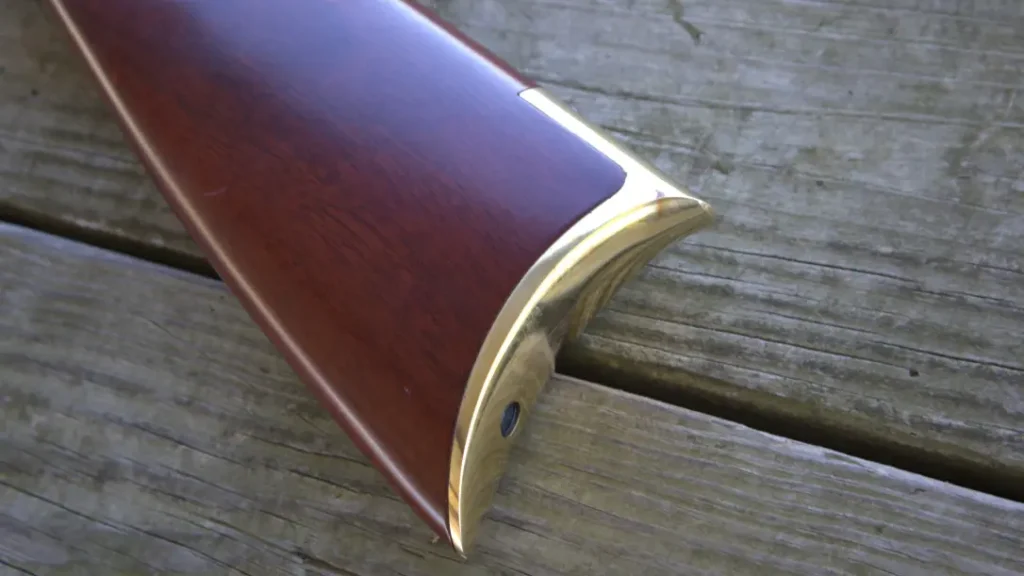
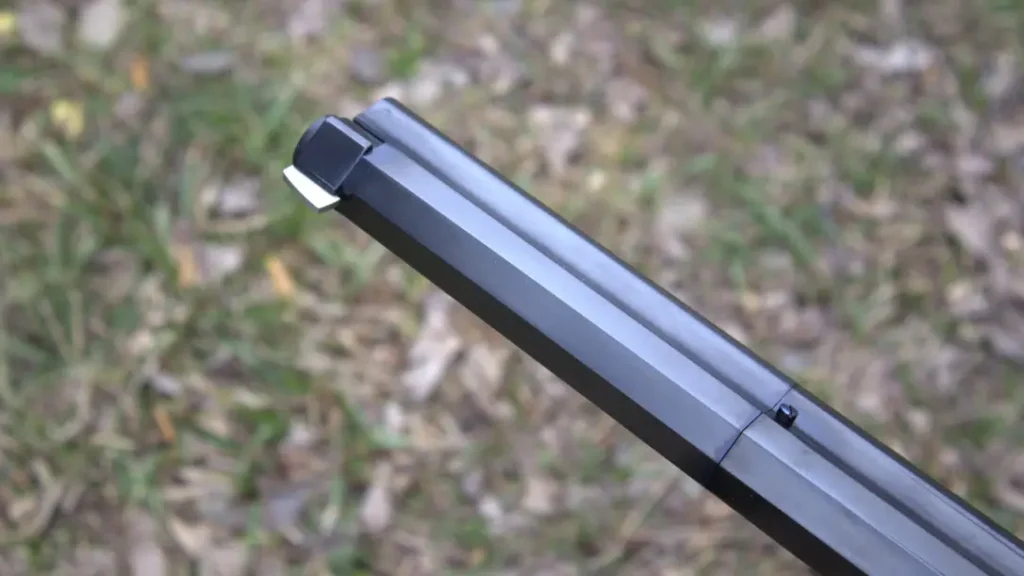
Cimarron’s Henry 1860 encompasses the classic lines of what would eventually become the Winchester repeater with a few key departures. Later rifles would feature a fore-end and a separate magazine tube that runs under the barrel. The Henry has a red-varnished walnut buttstock topped with a crescent brass butt plate, but no fore-end. The magazine tube that runs under the 24 ½ inch octagonal barrel is integral.
Advertisement — Continue Reading Below
Magazine Follower
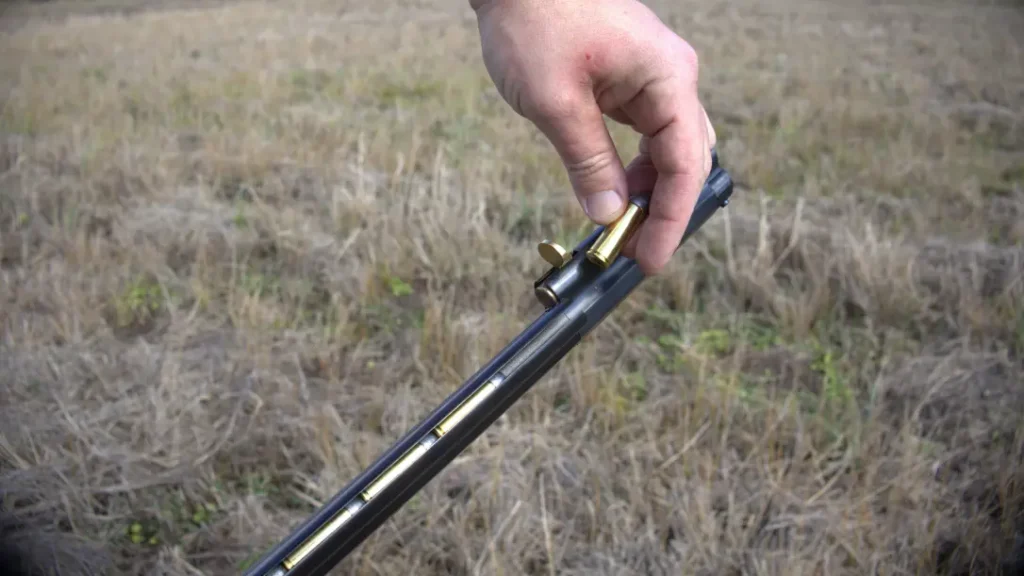
The tube itself has a magazine follower and spring that is pulled toward the muzzle and slides to the left side. This pushes the hinged barrel shroud over, exposing the tube for loading. This loading arrangement would not survive the Henry. The Winchester Model 1866 came with a King’s Patent loading gate in the receiver for faster top-off loading.
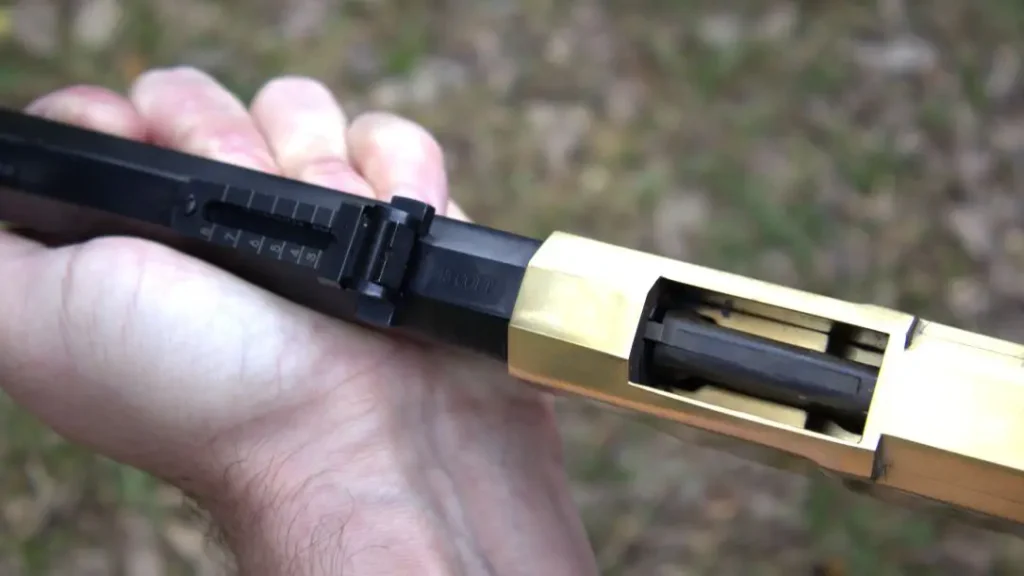
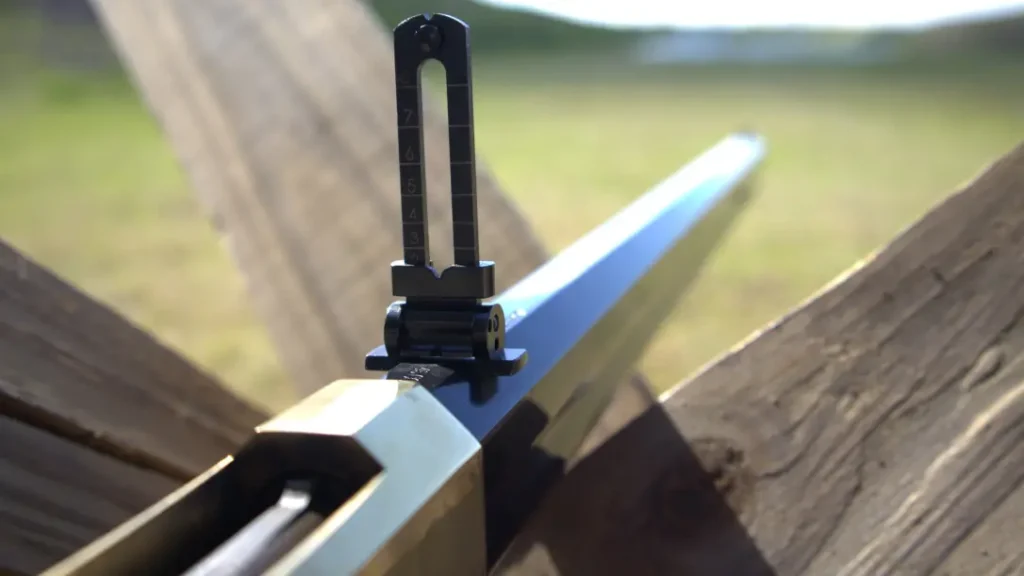
The sights consist of an immovable front post paired with a broad V-notch ladder sight. The rear sight in its folded position has a nominal zero of 100 yards. With the ladder raised, the sliding notch can be graduated from 200 to 800 yards.
Advertisement — Continue Reading Below
Standing the Test of Time
Aside from these peculiar differences, Henry’s action stands the test of time. It uses the same toggle-link action used on the Model 1876 rifle. The case-hardened lever loop, lever lock, bolt, hammer, half-cock safety, and brass elevator assembly also carry on into later models.
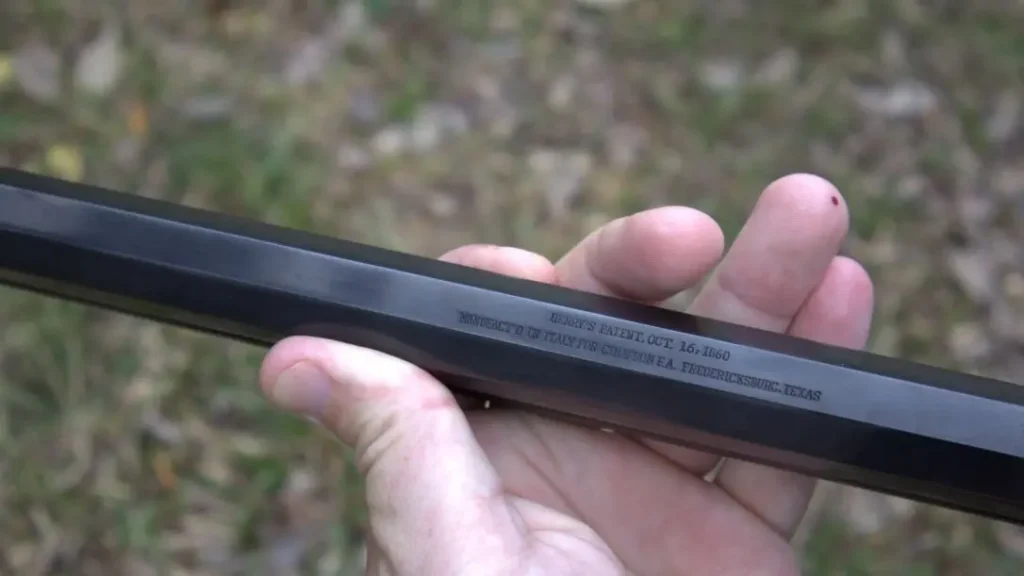
This all-forged machine is a faithful recreation of Benjamin Tyler Henry’s rifle, but there are a few modern giveaways. First is Cimarron’s address stamp on the front flat of the octagonal barrel. Lastly, like all other modern Henry rifles, it is a centerfire rifle. This one is in .45 Colt, and Cimarron’s Henry holds up to fourteen of them.
Advertisement — Continue Reading Below
On The Range with the Cimarron 1860 Henry Rifle
While we cannot separate the art from its era, it is easier to appreciate it given what art we have in this era. In other words, how is the Henry 1860, as a shooter? For the present, I shot the Cimarron Henry one hundred rounds of modern .45 Colt ammunition. But in a tip of my hat to the past, I used my .45 Colt Lee Loader to hammer together some authentic black powder loads to shoot, as it was done in 1860.
Loading Up
If you are familiar with tubular-fed .22 rifles or lever-action rifles from the Henry Repeating Arms Company, the original 1860 Henry’s loading procedure will ring a bell. The follower is drawn through its slot toward the muzzle and tilted to the left side. This swings the barrel shroud over and allows you to load the ammunition. The rounds are dropped in primer first until the tube is full.
The shroud and follower are twisted back in place. The follower is then lowered onto the bullet of the last round of the magazine. From there, the lever lock is twisted out of the way, the lever is racked, and a round is chambered. From there, the hammer can be lowered to the half-cock position for carry.
Accuracy
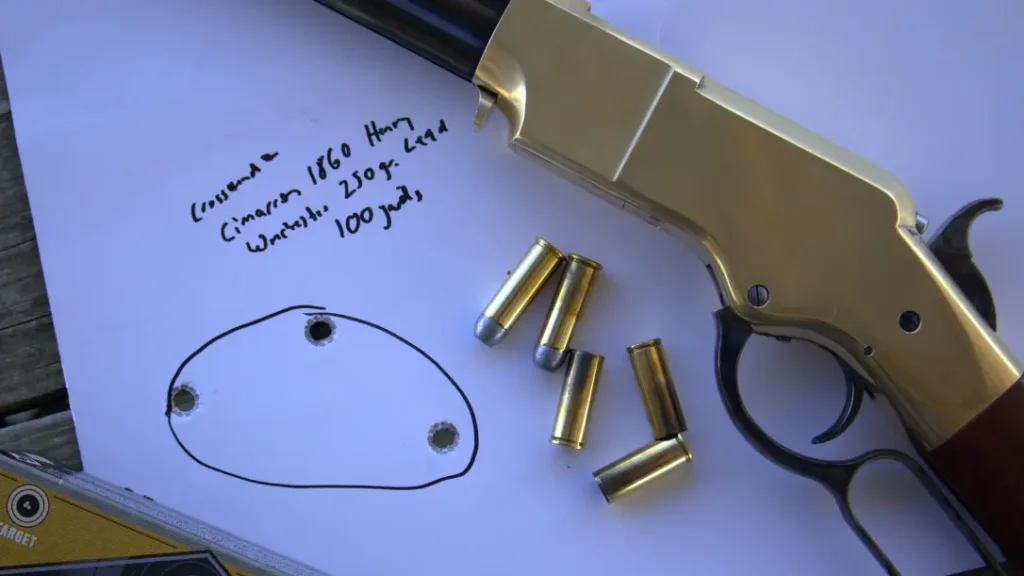
Without fail, in my experience, replica guns tend to shoot high out of the box. My first priority with the Henry 1860 was to get on top of the sights. From a bench rest, I fired some rounds down range at 25 yards. Then I went out to 50. Finally, I went for groups at 100 yards.
At that distance, the pistol-like sights are still easy to see and give plenty to read on the target. The rear sight is not the typical buckhorn style that covers up much of the target, but it is overly roomy with the front post at that distance. The trigger pull is a respectable four pounds with no mush. All this combined to give some respectable accuracy, even though 100 yards is a poke with .45 Colt.
Ammo
Winchester’s 250-grain flat-point load gave me a respectable three-shot group at three inches. However, the bullets hit ten inches below my point of aim. I then tried Federal American Eagle 225-grain jacketed soft points. These rounds were warmer than the Winchester load, but the group sizes could never come below four inches. My 250-grain handloaded rounds were the hottest of the bunch. Each round was backed by 36 grains of Scheutzen FFFg black powder. At 100 yards, my three-shot group came in at 3 ¼ inches and only dropped six inches from the point of aim. Not bad at all.
Shooting Impressions
There are a few nuances to shooting the Cimarron 1860 Henry, but otherwise, it is an experience utterly familiar to the later Winchester rifles. The 1860 has the same toggle link action as the 1873 Winchester. What it lacks in strength for higher-pressure cartridges, it makes up for in sheer effortlessness of action. The Henry is smooth to operate and fast to cycle. The only friction point comes from the elevator that moves cartridges robustly from the magazine tube to the chamber. Like a Winchester, a brisk run of the action ejects the empty cases straight up.
The loading procedure takes some of the bite out of the Henry’s speed. I had to watch for a sharp edge at the opening of the magazine while dropping rounds in. But the magazine spring and follower are easy to manipulate. The speed can be further interrupted if you do not mind the follower, which travels back toward the shooter as the rifle’s magazine is empty. This requires a shift of the shooting hand at some point. This bug of the Henry design, along with the heat produced by black powder cartridges, is why the Model 1866 has a fore-end.
200 Yard Shots
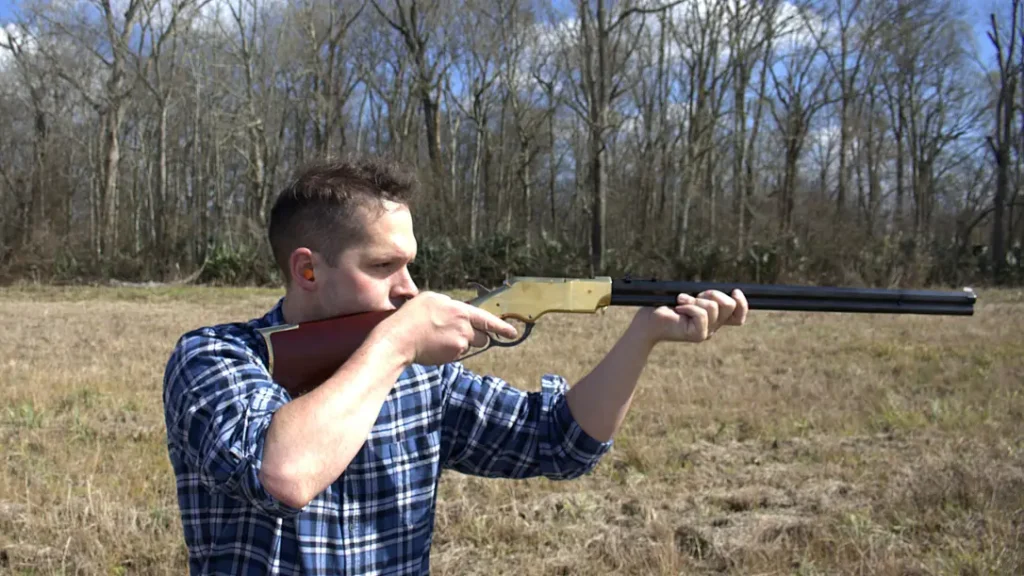
Lever-action rifles are quick-handling as a general rule, but the Cimarron Henry 1860 went by its own drum beat. The 24-inch octagonal barrel gives the Henry a muzzle-heavy feel more akin to a target rifle. This is offset by a surprisingly short thirteen-inch length of pull that is friendly to shorter-statured shooters. The Henry is a little slow on the offhand, but it showed itself to be a natural from a supported position. With the ladder sight employed, I could drop rounds into a 200-yard gong from a seated position with some regularity.
The ammo selection for this test was not as creative as it could be, but the Cimarron Henry 1860 got through all 150 rounds I provided without an issue. Replicas like these are generally reliable with conventional bullet shapes. The toggle link action and brass elevator are foolproof and lend themselves well to indifferent shooting, even after caking with black powder fouling that would gum up other rifles.
Cimarron 1860 Henry: A Homage to America’s First Fighting Rifle
Repeating rifles are the default long arm we have today. Single-shot rifles are a niche item. It is hard to imagine a world where the roles were reversed. In fact, single shots were the default for most of firearm history. The Henry 1860 rifle changed all of that. Even among those of us who call ourselves lever-action enthusiasts, some of the idiosyncrasies associated with the Henry can be forgiven. After all, it was the first entry bound to be improved upon. In six short years, the Henry was superseded, but the allure of being the first remains. Yet in a sea of repeaters, the Henry 1860 is a sight to behold, and Cimarron’s version will turn heads.
For more information, visit Cimarron.
WHY OUR ARTICLES/REVIEWS DO NOT HAVE AFFILIATE LINKS
Affiliate links create a financial incentive for writers to promote certain products, which can lead to biased recommendations. This blurs the line between genuine advice and marketing, reducing trust in the content.