As personal safety tools continue to evolve, manufacturers are placing greater emphasis on reducing user risk while maintaining effectiveness. One product gaining traction in that space is REPULS Defense Spray, developed by Crotega Safety Solutions.
Already in use among law enforcement and private security professionals, REPULS is now being introduced to the broader consumer market as an alternative to traditional pepper spray.
What Sets REPULS Spray Apart
REPULS Defense Spray is built around a key distinction: it is not an aerosolized pepper spray. Instead, it uses a patented, water-based ocular irritant delivered through a controlled liquid stream.
Advertisement — Continue Reading Below
This design directly addresses several well-documented limitations associated with capsaicin-based sprays, including blowback in windy conditions, cross-contamination in confined spaces, and respiratory irritation affecting both the user and bystanders. By eliminating aerosol dispersion, REPULS reduces environmental exposure while maintaining a focused delivery method.
How the REPULS Formula Works
The REPULS formulation is designed to disrupt vision immediately upon contact. It causes involuntary eye closure and impairs an assailant’s ability to focus, creating a window for disengagement.
Unlike traditional pepper sprays, the formula does not rely on chili-derived capsaicin. Instead, the formula utilizes water, ammonium propionate, ammonium citrate, and a surfactant. Ammonium propionate is used as an antiseptic, antifungal agent, and preservative in the food and feed industries. Propionic acid is produced when bacteria ferment sugars such as glucose. The propionic bacteria found naturally in human sweat glands and human intestines produce propionic acid and carbon dioxide in a fermentation reaction.
Advertisement — Continue Reading Below
Unlike traditional pepper spray, this formula avoids severe respiratory distress side effects and can typically be flushed from the eyes with water. It is still effective at deterring threats but less lethal.
Key Features and Advantages
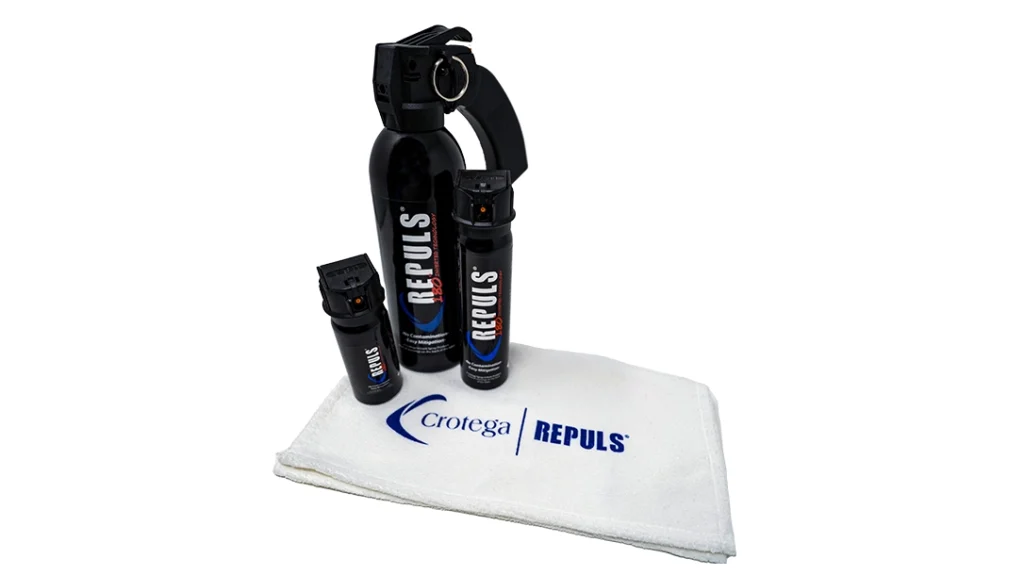
REPULS deploys in a direct liquid stream, as opposed to a spray, which allows for improved accuracy and reduces the risk of self-exposure. Because of this, it is approved for indoor and in-vehicle use. This makes it viable in environments where traditional sprays are restricted, including hospitals, emergency rooms, schools, campuses, office buildings, and courtrooms
Advertisement — Continue Reading Below
Another notable thing is that REPULS includes a blue dye component, which can assist in identifying an assailant following deployment.
Multiple Options
REPULS is available in two key formats, the keychain model and the jogger/hiker model.
The keychain model is designed for convenience and portability. This model features a quick-release system suitable for keys, bags, or packs. It is available in multiple finishes, including standard and decorative options. Built for active use, the jogger/hiker version includes a secure hand strap for retention during movement, making it well-suited for outdoor activities such as running, hiking, or walking.
Advertisement — Continue Reading Below
Both models are lightweight, compact, and affordably priced, positioning them as accessible entry points into personal defense tools.
Final Thoughts
The personal defense category has historically relied on a narrow set of technologies, with pepper spray remaining largely unchanged for decades. REPULS represents a shift toward more controlled, user-conscious design, addressing many of the drawbacks associated with traditional options.
By combining a water-based irritant, precision delivery, and indoor-safe usability, it introduces a new standard for those seeking a practical and modern approach to personal protection.
Advertisement — Continue Reading Below
WHY OUR ARTICLES/REVIEWS DO NOT HAVE AFFILIATE LINKS
Affiliate links create a financial incentive for writers to promote certain products, which can lead to biased recommendations. This blurs the line between genuine advice and marketing, reducing trust in the content.